
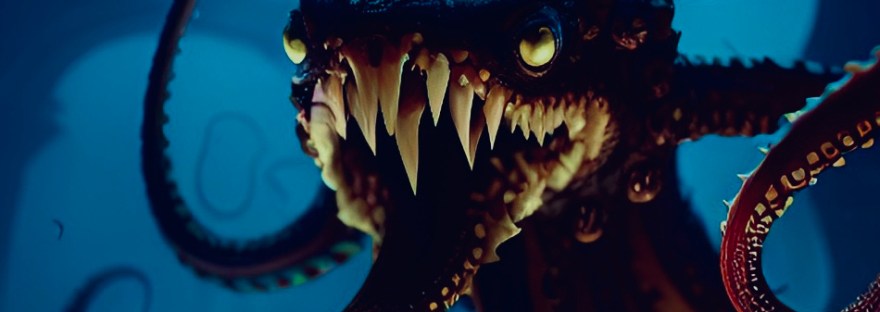
A devotee to the god of the sea and desperate to shake her pursuers, Sarlona calls upon the denizens of the deep to help her escape when cornered on the beach. Chief among them is the kraken—a sea monster believed to rend ships and devour sailors. Although depicted as a massive octopus in Scandinavian lore, the kraken in Drained is described more like giant or colossal squids (Architeuthis dux and Mesonychoteuthis hamiltoni), the sightings of which probably inspired the original tales.
Like the kraken, the massive squids inhabit another world—those ocean depths we humans have only gotten glimpses into. So far, scientists have had to base their conclusions about the species on dead or dying specimens and a few video recordings. What we do know is that they are, in fact, giants. They’re also voracious predators.
Description. Earlier this month, I made the regrettable mistake of wearing an octopus t-shirt to the doctor’s office, where no less than three people assumed that my garb wasn’t an aesthetic choice but a mark of my expertise. They all wanted to know the difference between an octopus and a squid. While no tuethologist (cephalopod biologist), I did have an answer. Generally, octopi have eight appendages and spend most of their time on the sea floor. Squids have ten appendages and swim open waters.

Those ten appendages come equipped with toothed suction cups meant for wrapping around wriggling flesh and not letting go. Two of them, the tentacles, are longer than the others and designed to snatch prey at a distance. The colossal squid’s tentacles bear horrific, swiveling hooks at the ends. Including the tentacles, giant squid specimens have measured as long as 43 ft. The colossal squid has shorter appendages but is heftier, with known weights exceeding 1000 lbs. Ranking as the largest invertebrates on earth, I think it’s safe to say both species live up to their names. Of course, no one knows how big they might grow in the abyss. With eyes the diameter of a basketball, their eye size is perhaps more impressive than their overall dimensions. These monsters have bigger eyes than any other animal—critical for detecting the tiniest trace of light in the depths.
Distribution and Habitat. Giant squid have been documented in temperate ocean waters worldwide. Colossal squid dwell in the Southern Ocean. The giant squid inhabits only the deep sea, usually at depths greater than 1000ft. Those found near the surface are often injured or dying, their delicate, red skin observed torn and ragged.
Diet. Giant and colossal squids eat fish and smaller squid. They may lure their prey nearer with bioluminescence, emitting light from either their skin or eyes at will. The lorkai, though unrelated to cephalopods, can also make their eyes fluoresce. While once believed to feed rather passively, video footage in their natural habitat shows that giant squid are probably active hunters like colossal squid. Squids are fast. They swim using jet propulsion—sucking in water and squirting it through a siphon to shoot forward while steering with their mantle fins.
Giant squid themselves are prey for other animals, especially when young. Sperm whales and deep-sea sharks feed on even adult giant and colossal squids. In addition to the toothed suckers that scar the skin, giant squid shoot ink to dissuade their predators. However, their eyes are probably their best defense, able to detect hungry whales at a distance in extreme darkness.
Life cycle. We know little about giant squid reproduction, but scientists believe males inject sperm packets into the arms of females. Those females disperse millions of fertilized eggs. The lucky few squid to survive to maturity grow tremendously fast—giant squid only live four or five years.
Monster? There’s no solid evidence that giant (or colossal) squid rise from the deep to attack boats and snack on sailors like the kraken was said to. They seem only to come to the surface when dead or nearly so. But there is a strange tale or two of mysterious marine life latching onto boats and dragging them to a standstill in modern times. And smaller, better-studied cephalopods can put up a hells of a fight on the deck of a boat and have even attacked divers. So, while it probably can’t be blamed for sunken ships, the giant squid’s size, toothed suckers, and mystery qualify it as a monster in my book.
If you want to know how successful the kraken is in defending Sarlona against monsters of a different sort, check out Drained next month.
Resources: Giant and Colossal Squid Fact Sheet, Smithsonian Ocean, Marine Bio Conservation Society, and the Ocean Conservancy

 K.W. Bernard