

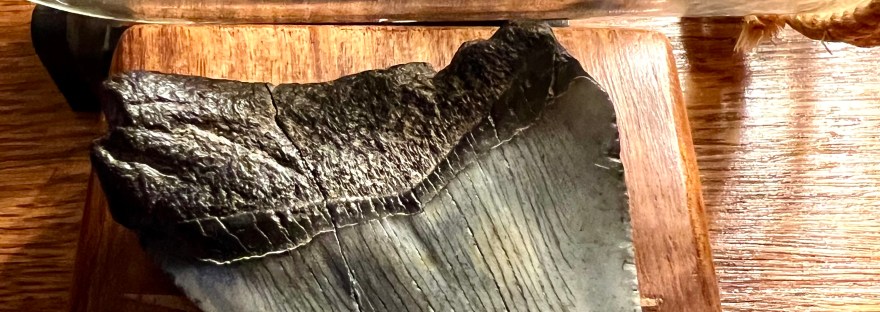

With the Meg 2’s release earlier this month and the last few weeks of beach weather upon us, what better time to examine Otodus megalodon—a prehistoric shark of kaiju-like proportions?
The megalodon is an extinct shark species from a dead genus (Otodus) in a lost family (Otodontidae) and the largest ever known. It ruled the seas for perhaps 20 million years, from the early Miocene (23 million years ago) into the Pliocene (2.6 million years ago).
Just how big was it?
It’s hard to say from fossilized teeth and a few vertebrae. Since sharks are cartilaginous fishes, they don’t leave much behind to weather millennia. But by extrapolating from tooth size and what we know about the tooth-to-body-length ratios of living shark species, paleobiologists can make educated guesses about the megalodon’s length.
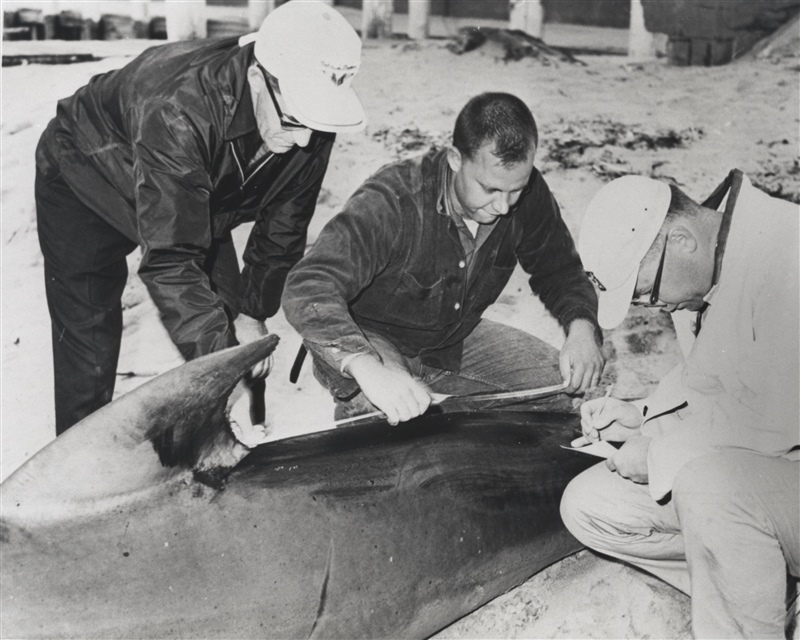
Researchers have estimated the megalodon’s maximum total length to range from around 47.5 to 65.5 ft. Most seem to favor the higher end of the spectrum. Even the lower estimate is more than twice the length of the largest officially recorded great white. Scientists believe the weight of the megalodon may have exceeded 68 tons. That’s more than ten times the weight of a mid-sized African elephant, making it one of the largest carnivores to ever live. While that puts most meat-eating dinosaurs to shame, we can’t say the megalodon was the largest predator. Sperm whales rival its length, and blue whales (which prey on krill) dwarf even the megalodon.
Geochemical sorcery and ecological analogs
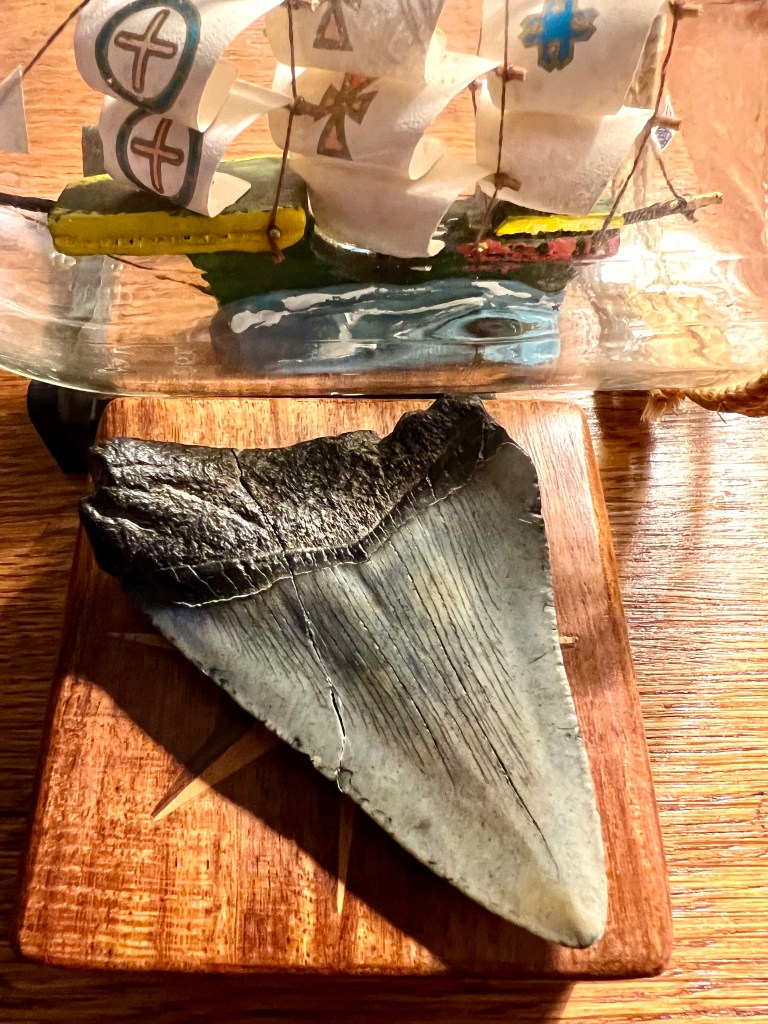
Given that our only clues are teeth and the marks they left, plus a smattering of spine, researchers have inferred a lot about the megalodon. Through modeling using extant (living) shark species as stand-ins and isotope analysis, paleobiologists have been able to paint, or at least sketch, a picture of how the megalodon lived. Admittedly, researchers have based many of their conclusions on great white sharks, which they no longer consider closely related to megalodons. Scientists believe these two apex predators belong to the same order—Lamniformes—the mackerel sharks, but not the same family. There are still good reasons to use the great white as a model, though. It’s the largest lamniform shark that doesn’t filter feed and the only one with triangular, serrated teeth like the megalodon.
Like great whites, megalodons were probably ovoviviparous—they hatched from eggs inside the womb and then were born live. Analysis suggests baby megalodons were already over 6 feet long at birth, a size likely attained by cannibalizing the embryos of their siblings in the womb.
Juveniles would have spent their time in the relative shallows of the continental shelves, where they’d be a bit more protected and have better access to appropriately sized prey. If the “little” guys survived into adulthood, they may have lived for up to a century, roaming worldwide except for the frigid Arctic and Southern Oceans.
Baleen for breakfast
There’s no doubt the megalodon fed on marine mammals. We know this from bite marks left on the fossilized remains of pinnipeds (seal-like animals) and cetaceans (whales and dolphins). Based on the great white’s behavior, we assume it hunted them, but it’s possible the megalodon only scavenged from these animals. Geochemical analysis of the fossilized teeth supports the megalodon’s superpredator status—it was higher up the food chain than great whites. Megalodons fed on baleen and beaked whales up to the size of today’s orcas and probably ate their fair share of squids and other sharks, too. There’s even evidence they tangled with sperm whales on occasion. It makes sense that the megalodon would target giant prey items, not just because it’s so large but to avoid competition with less massive predators. A small whale could have sustained a megalodon for a couple of months.
More than a cold-blooded killer…
Though we think of fish as cold-blooded (perhaps especially those with flesh-rending teeth that devour cute, large-brained mammals), some aren’t. A few fish, like tuna, swordfish, and yes—the great white shark—are partially endothermic (warm-blooded). They can metabolically raise and maintain their body temperature above the ambient water temperature. Although we can’t be sure, most researchers believe the megalodon, like the great white, was endothermic. This warmer body temperature could have allowed megalodons to swim faster (and farther) and exploit a wide range of habitats.
Never too big to fail.

The fossil record indicates the megalodon died out about 3.6 million years ago. Several factors likely contributed to its extinction. Around the time of the megalodon’s decline, the oceans grew colder, and sea levels dropped. Young megalodons may have lost their habitat as shelf areas and their productive waters disappeared. Many small baleen whales went extinct, leaving adults with fewer opportunities to feed when competition with up-and-comers like the great white shark and sperm whales was likely growing fierce. And, while advantageous when one can afford it, endothermy comes with a steep energy bill. With food resources dwindling, it may have become a liability.
Could a few megalodons still lurk in the depths?

While the notion of a prehistoric superpredator surviving in the Mariana Trench only to emerge and wreak havoc in modern times is a spectacular sci-fi premise, there’s no evidence the megalodon’s oceanic reign overlapped with the existence of even the earliest Homo sapiens.
Yes, reports of massive sharks appear online, sometimes accompanied by videos or photographs. As much as I love cryptids and the thought of a supersized shark, these images are far from convincing. Many purported megalodons are easily identified as whale, basking, great white, and Greenland sharks. The vague silhouettes captured in satellite images are likely whale sharks or actual whales. And when the size estimates of these incredible ichthyiods are outlandish even for the megalodon, there’s something fishy going on.
Stuck in the trenches?

Don’t get me wrong. I don’t think we know about everything cruising around in the abyss. The USO (unidentified submersible object) folks constantly remind me that our oceans are less explored than outer space. But I’m more willing to entertain the notion that a non-human intelligence or Cthulhu-like monster is plotting its takeover from the Mariana Trench than the megalodon. We don’t know what we don’t know. But we do know some things about the megalodon—it wasn’t a deep-sea shark.

Endothermy would have allowed the megalodon to make nightmarishly deep dives through the thermocline like the sperm whale and the great white shark on occasion but also would have prevented it from living down there. While thermal vents might create some small spa pockets on the sea floor, contrary to sci-fi, the bottom of the sea is almost as cold as ice. Judging by where the megalodon left its teeth (everywhere but the polar seas), it couldn’t tolerate freezing water long-term. The energetic cost would be massive, and we know what the megalodon fed upon—marine mammals. Those have to come up to breathe. So, living in the trenches 13,000 ft below the waters where even the deepest diving among your prey dare swim doesn’t make much sense. Unless the megalodon was just a scavenger of sunken whale carcasses and not a predator. And wouldn’t that be disappointing?
RESOURCES:
A. Collareta et al. Did the giant extinct shark Carcharocles megalodon target small prey? Bitemarks on marine mammal remains from the late Miocene of Peru. Palaeogeography, Palaeoclimatology, Palaeoecology (2017) https://doi.org/10.1016/j.palaeo.2017.01.001
Boessenecker RW, Ehret DJ, Long DJ, Churchill M, Martin E, Boessenecker SJ. 2019. The Early Pliocene extinction of the mega-toothed shark Otodus megalodon: a view from the eastern North Pacific. PeerJ 7:e6088 https://doi.org/10.7717/peerj.6088
Jack A. Cooper et al. The extinct shark Otodus megalodon was a transoceanic superpredator: Inferences from 3D modeling. Sci. Adv. 8, eabm9424(2022). DOI:10.1126/sciadv.abm9424
Kenshu Shimada (2019): The size of the megatooth shark, Otodus megalodon (Lamniformes: Otodontidae), revisited, Historical Biology. DOI:10.1080/08912963.2019.1666840
Kenshu Shimada, Matthew F. Bonnan, Martin A. Becker & Michael L. Griffiths (2021) Ontogenetic growth pattern of the extinct megatooth shark Otodus megalodon—implications for its reproductive biology, development, and life expectancy, Historical Biology, 33:12,3254-3259, DOI: 10.1080/08912963.2020.1861608
Michael L. Griffiths et al. Endothermic physiology of extinct megatooth sharks. Proceedings of the National Academy of Sciences. 120 (27) e2218153120 https://www.pnas.org/doi/abs/10.1073/pnas.2218153120
Skomal GB, Braun CD, Chisholm JH, Thorrold SR (2017) Movements of the white shark Carcharodon carcharias in the North Atlantic Ocean. Mar Ecol Prog Ser 580:1-16. https://doi.org/10.3354/meps

 K.W. Bernard