

A few days ago, a fun article popped up in my Facebook feed:
Maine is Now Home to a Venomous Species of Black Widow Spider.
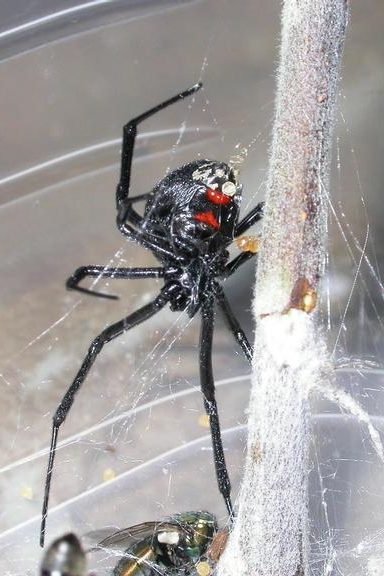
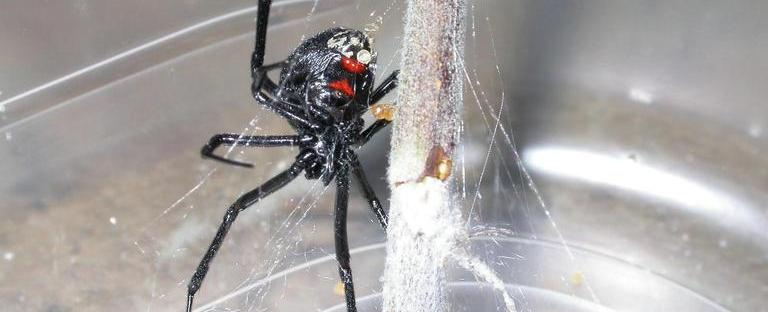
I take issue with the title’s phrasing, but, in a way, it’s true—the northern black widow (Latrodectus variolus) could be considered an “infrequent inhabitant” of southern and central Maine. And, unlike our hundreds of other spider species, it’s highly venomous.
That hasn’t stopped me from assuring Mainers who call me about spiders that unless they’ve been traveling or opened some strange packages, they don’t have to worry about species of medical concern.
Yes, L. variolus has been reported here, and given its distribution in nearby states and provinces, it could be indigenous. But folks have been saying this for decades. While each warmer winter probably brings L. variolus closer to establishing a firm population here (modeling even predicts it), there’s little evidence that it already has. We still don’t have the collected specimens or scientific studies to suggest a continuous presence. Individual L. variolus spiders show up occasionally—that’s it. Other highly venomous spiders, like the southern black widow, western black widow, and the brown recluse, appear too. The difference is that these spiders are almost certainly one-offs transported here by human activity. With L. variolus, it’s less clear.
But if you want to go looking for trouble…
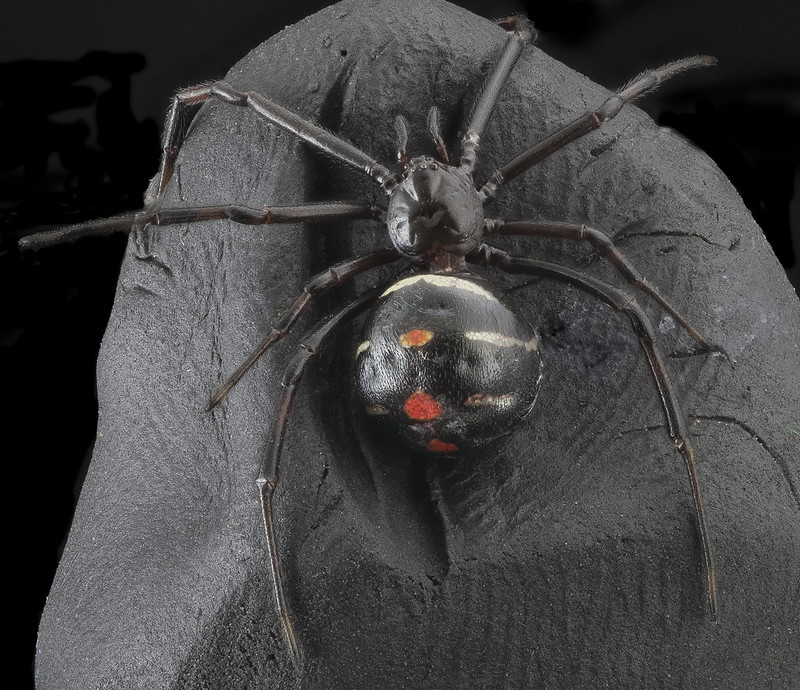
Photo by Sam Droege.
Adult female L. variolus are easy to recognize at around one-half inch long with a glossy black, bulbous abdomen and conspicuous red markings. The pattern on the northern black widow’s underside usually appears as two separate triangles rather than a complete hourglass. In addition, L. variolus typically bears a line of red spots down the back of the abdomen and may have pale, yellowish stripes when young.
Male black widows are much smaller and lack the mature female’s enlarged, rounded abdomen. Their tiny fangs can’t puncture human skin well enough to deliver venom. Males have yellowish/whitish bands and halos around their red spots. Young juveniles are brownish or tan with white or yellowish markings similar to males.
Don’t get wrapped up
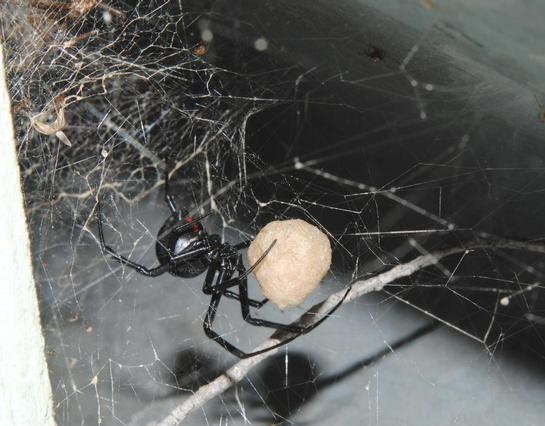
Black widows belong to the cobweb weaver spider family (Theridiidae). They construct tangled, ugly webs of thick silk, often in cavities like rodent burrows or bait stations, hollow stumps, crevices in rock walls and wood piles, baskets, boxes, and—very unfortunately—shoes and outhouse holes. Mature females stick close to their webs. If you think black widows are around, don’t stick a body part in a dark nook without inspecting it first.
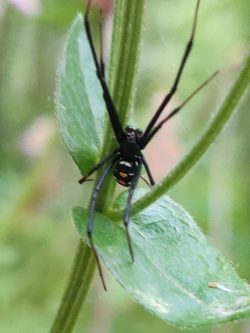
Photo by Jana Miller.
The life of the widow
Black widows get their name from the female’s habit of devouring her mate, but many spider species eat slow or clumsy males. That’s the risk the little guys run when they stride into the territory of a larger predator and start annoying her. If the male can’t escape after accomplishing his mission, at least his corpse will nourish his progeny.
We don’t know very much about L. variolus and its life cycle. If the species is like its southern relative, females could produce several egg sacs per season, each giving rise to a couple hundred spiderlings. Once they leave the sac, the bitsy brood deploy silk strands into the wind to carry them to new homes. It takes a few months and several molts for them to reach maturity. Female black widows can live up to a year and a half. Males don’t live as long.
Our bark is worse than their bite
Spiders don’t want to bite us. Most will try to run for their lives when we lumber too close, including L. variolus. Bites usually occur because we inadvertently squish the spider against our skin.
Not only are black widows rather skittish, but their deadly reputation is also exaggerated. Few fatalities have resulted from their bites—the last one reported in the United States occurred in 1983. Those most at risk of death or long-term complications include young children, the elderly, and individuals with heart conditions.
Still, bites are serious. Anyone bitten by a black widow should call poison control and seek medical attention right away. The bite site rarely hurts or swells much, but the black widow’s neurotoxic venom acts throughout the body. It can cause excruciating pain (especially in the abdomen), nausea, tremors, high blood pressure, rapid heart rate, difficulty breathing, and other unpleasant symptoms.
Avoid Shelob’s lair
Although the odds of encountering L. variolus in Maine are exceedingly low, we can do a few things to reduce the number of spiders in our homes and avoid spider bites in general. Cluttered, undisturbed areas provide excellent habitat for many species. So, sweeping, dusting, and tidying up can convince spiders to leave. Closing any gaps and cracks around doors and windows will help keep them out in the first place. Wear gloves when working outside around woodpiles, rock walls, and other debris to prevent bites. Check boots, shoes, and gloves stored in basements, attics, garages, and sheds before putting them on. And if you’re upta camp, check the hole in the outhouse before sitting down!
RESOURCES
Barry, D., and G. Fish. 2010. Structural and General Pest Management – Maine Pesticide Applicator Training Manual: Category 7A. University of Maine Cooperative Extension.
Jennings, D.T., and C.P. Donahue. 2020. A Checklist of Maine Spiders (Arachnida: Araneae). Forest Health and Monitoring Maine Forest Service Technical Report No. 47. Maine Department of Agriculture, Conservation and Forestry.
Rochlin, I., W. Hockett, and A. Francis. 2021. A case of pediatric northern black widow spider (Latrodectus variolus) bite in New York, USA. Toxicon, Volume 194: 86-89. https://www.sciencedirect.com/science/article/pii/S0041010121000519
Wang, Y., N. Casajus, C. Buddle, D. Berteaux, and M. Larrivée. 2018. Predicting the distribution of poorly-documented species, northern black widow (Latrodectus variolus) and black purse-web spider (Sphodros niger), using museum specimens and citizen science data. PLoS One. 13: e0201094. https://journals.plos.org/plosone/article?id=10.1371/journal.pone.0201094
BugGuide.net – https://bugguide.net/node/view/26421
Michigan State University Extension – https://www.canr.msu.edu/resources/northern-black-widow-spider-latrodectus-variolus
Penn State Extension – https://extension.psu.edu/southern-black-widow-spider
University of Florida Extension – https://edis.ifas.ufl.edu/publication/IN1000

 K.W. Bernard