Wow, did May go fast! It seemed like I blinked, and it was gone. As ephemeral as its flowers. I’m not complaining, though. We had a late frost, and I lost a few plants, but we also had plenty of sun and summer weather. I’m ready for more.
Drained has a tentative new release date—June 12th! That’s right around the corner! I’m reviewing the galley proof now.
Monster of the Month
That’s right, monster. I’m dropping it down to one per month for now. I’ll admit it—it’s a struggle to keep up with the blog. It didn’t help that I fell deep down the rabbit hole of what was supposed to be this month’s second monster—massive mantids. I’m excited to keep working on it and share it with you in June.
Black Flies (Family Simuliidae)
Black flies are a fixture of springtime in Maine, so much so that they’ve been nicknamed the Maine state bird. We have more than 40 species! They swarm from our woodland streams and descend en masse to buzz around our heads, crawl into our orifices, and drink our blood. Learn about black flies and how to handle them here.
Maine Magic
The kiddo and I spent some time at the beach for Mother’s Day. There’s nothing I enjoy more.
The Menagerie
These pups love the warm weather. We’re trying to introduce Ray to water, but he takes after his big sister so far and gives the kiddie pool a wide berth.
Black flies are a fixture of springtime in Maine, so much so that they’ve been nicknamed the Maine state bird. We have more than 40 species! They swarm from our woodland streams and descend en masse to buzz around our heads, crawl into our orifices, and drink our blood.
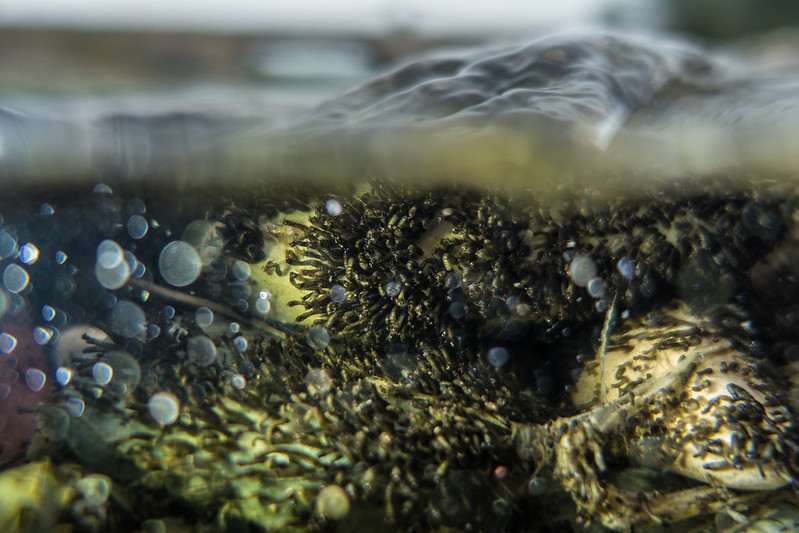
Numerous black fly larvae anchored to rocks in a clean, well-oxygenated river. Photo courtesy of the National Park Service.
Description – Adults are small, robust, humpbacked flies. They have stubby antennae and a short, stout proboscis. Their color ranges from black to yellow. The aquatic larvae are shaped like bowling pins with one “leg” near their head on the underside. Tiny hooks on their hind ends help anchor them in flowing water. Most species bear two fanlike structures for filtering food from the current.
Distribution – Black flies inhabit every continent but Antarctica.
Habitat – Black flies need clean, moving water for their larvae. We find them in abundance near rivers, streams, and brooks. Since they can’t thrive in waters where dissolved organic matter is high or dissolved oxygen is low, their presence often signifies a healthy environment.
Life Cycle – Black flies have two different life cycles, depending on the species. Some overwinter as eggs, but most spend the winter as larvae. Females lay eggs in or near the water. After they hatch, larvae anchor themselves to rocks, logs, and other underwater objects by weaving a silk pad and hooking onto it. If the current doesn’t provide much to eat, they can let go and hope for better feeding grounds downstream. Because they breathe through their skin, they need highly oxygenated water to survive. When ready to pupate, most larvae build a silken cocoon underwater, usually in the spring after overwintering. Most adults emerge in April or May, riding an air bubble to the surface. Some species have multiple generations annually and produce biting adults throughout spring, summer, and early fall. I’m fortunate to live nearby a river that harbors one such species. Scientists have studied few black fly species in depth, but some appear entirely female, reproducing asexually.
Diet – Female black flies require blood to nourish their eggs, but like the males, they feed on nectar for their own energy. Some are opportunistic, biting whatever mammal or bird is available. Other black flies are picky, specializing in one group of animals or even one species. Simulium annulus, for example, targets loons. Some hunt humans voraciously, while others have no interest in us. A few species like us enough to circle our heads incessantly and try to burrow into our tear ducts, but rarely bite. The larvae feed on microorganisms, filtering them from the water using fanlike mouthparts.
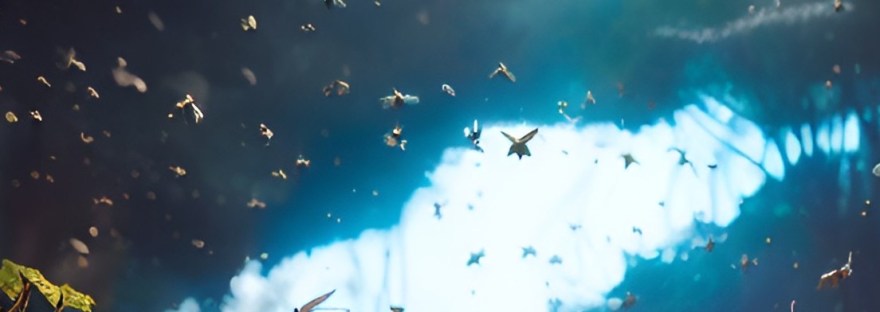
Adult black flies have a short proboscis armed with serrated, scissor-like mandibles for slicing into flesh. Some species harass humans but don’t bite often. It took me ten minutes of standing still and getting pelted in the face by a hundred flies to get this picture.
Bites – While their antics and the welts they leave behind are maddening, blackflies aren’t the public health threat ticks and mosquitoes are–in the U.S. In some parts of the world, they cause tremendous misery through the diseases they transmit, river blindness being one of them. That’s not to say bites are harmless here. They tend to swell and bleed. A few hours with black flies leave some people looking like they just finished a bar brawl instead of a hike. How much and for how long depends on the person and previous exposure. Folks accustomed to them generally don’t react as much. Likewise, those first few bites at the beginning of the season often balloon up, but subsequent attacks leave milder welts. Sometimes individuals develop a sensitivity, however, and their reactions worsen as time goes on. And, while they’re not known to vector pathogens to humans in the U.S., they can still make us sick. When injected from numerous bites, their toxic saliva may cause fever, headaches, nausea, and swollen lymph nodes.
We don’t just have to worry about ourselves, either. Even up north, black flies can transmit disease to livestock and poultry. Occasionally, one hears a horror story in which the black flies are so thick that animals die via smothering, exsanguination, or toxic shock from their bites.
Battle Plan – Black flies are a byproduct of thriving streams and river restoration, so little opportunity exists to target them at their source without severely harming the environment. Bacillus thuringiensis var. israelensis, a bacterium that kills only mosquitoes, black flies, and similar species, is the only reasonable chemical option to control the larvae. Some states have regional control programs and apply Bti aerially. Maine doesn’t, and applications require a permit from the DEP unless the stream is contained entirely on one property.
Because females can fly miles seeking a blood meal, adult-killing sprays seldom provide control for longer than a couple of days.
Rather than trying to wipe them out, in Maine, the strategy with black flies is to discourage bites. Unfortunately, since they rely more on sight to target their victims, DEET and other insect repellents aren’t as effective against them as against mosquitoes. Avoidance and mechanical barriers will work better. Cover up, knowing black flies will crawl through any gap in clothing they can find in search of juicy flesh (they’ve figured out buttons), and dark colors attract them. A trick I learned from my dad is to coat a plastic sun helmet or hard hat in mineral oil. When the flies land on the helmet, they get stuck and suffocate. But I recommend a quality head net if the black flies are thick.
Black flies are annoying, but they’re the price of living, working, and playing alongside nature. The good news is that they don’t typically follow folks indoors and only bite during the day. They’re easy to shake if you have shelter.
What a month. I love April, it’s when winter turns to spring in my neck of the woods, but this one was exhausting. Yard work, online programs, rewrites…I’ve had enough.
Dagmar, one of Drained’s antagonists, is pissed off about the delay. It doesn’t take much to rile her up. Try to stay out of her way.
Drained, you may have noticed, was delayed. That’s okay with me! My publisher decided at the eleventh hour that two chapters were too dark for the target audience. Whoops. I worked hard to lighten them up, and they’re better than ever. We’re shooting for May.
Happy Earth Day
Earth Day was on April 22nd. The kiddo and I picked up trash along our road (her idea) and planted seeds.
Monsters of the Month
A Real Maine Monster – Deer Tick (Ixodes scapularis)
Spring deer tick activity tends to peak in April. We saw our share this year. Don’t let your guard down as we move into May. Some hungry females are still looking for blood to nourish their eggs. Read more about deer ticks and how to manage them.
Cloaked Creatures
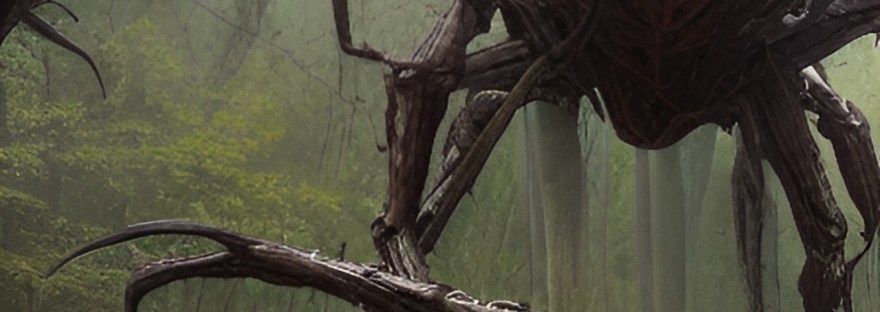
When they want to stay hidden, the monsters in Drained can turn themselves as transparent as the clearest glass. Looking right at a lorkai, you’d see little more than a distortion in the landscape. Picture the Predator from the movie of the same name (one of my favorites), and that’s pretty close. No doubt this badass alien helped inspire the lorkai’s abilities. But might transparent creatures exist?
Maine Magic
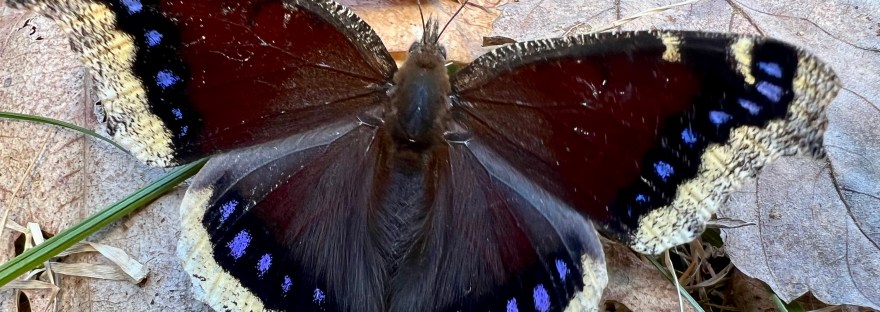
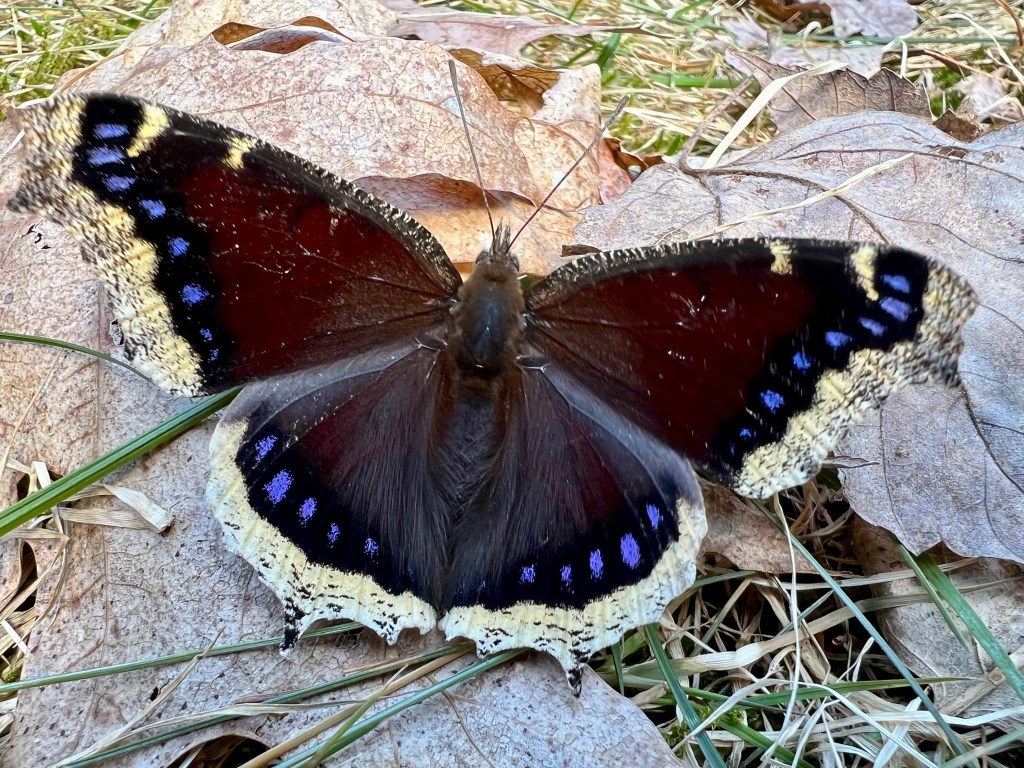
My favorite butterflies, the mourning cloaks, are back!
The Menagerie
As mentioned in my tick article above, Esmeralda tested positive for Lyme disease. It’s been a rough year for old Reld! But she’s still going strong and hasn’t displayed any symptoms. She won’t need antibiotics unless she does. The other beasts are doing well.
Happy Beltane!
Tomorrow is Beltane, a Celtic fire festival and the first day of the light half of the year for many pagans. It’s a time to celebrate spring. We have a tradition of cooking Bannock, making faery houses, planting flowers, and having a bonfire.
When they want to stay hidden, the monsters in Drained can turn themselves as transparent as the clearest glass. Looking right at a lorkai, you’d see little more than a distortion in the landscape. Picture the Predator from the movie of the same name (one of my favorites), and that’s pretty close. No doubt this badass alien helped inspire the lorkai’s abilities.
Lorkai don’t accomplish this using a cloaking device, like Predator’s Predator or Star Trek’s Romulans. They instantly destroy their pigmentation and change the density of their tissues to control light scattering. If that doesn’t make complete sense, that’s why I write fantasy instead of sci-fi. It’s biological magic, so there.
Transparent and translucent animals aren’t unheard of in nature, though. Various critters, including insects, mollusks, fish, and amphibians, most with glass in their monikers, have large see-through portions of their bodies. The vast majority live underwater, where the difference in the refractive index between their bodies and the medium they inhabit is less than in terrestrial environments. As far as I know, none are sizable, and they can’t morph to clear at will like the lorkai (though many cephalopods can instantly employ active camouflage).
Now, if you don’t mind transcending the laws of nature as we know them (and I sure as hells don’t), there may be real-life examples more akin to the lorkai than a larval octopus. Two reports come to mind.
The first is an alleged encounter at Skinwalker Ranch described in Colm Kelleher and George Knapp’s Hunt for the Skinwalker. A distorted entity was reportedly observed by Tom Gorman (a pseudonym for Terry Sherman) and his son, charging from the trees at another man in a pasture. The near-invisible creature roared in the man’s face and bolted back for the trees.
I chanced upon a second report in David Paulides’s book, Missing 411 Hunters. He reports Jan Maccabee’s strange encounter while bowhunting. While in a tree stand, the woods suddenly went silent, and she noticed a distortion in the trees higher up in front of her. She described it as something big covered in plastic wrap moving through the canopy. Reportedly, multiple witnesses saw a UFO around the same time, only a mile away.
In both accounts, the “something” was later titled the Predator. As an experiencer of the unexplained, I believe witnesses, so both recountings fascinate me. Could the stories have been exaggerated in the retelling? Of course. Might there be mundane explanations? Maybe. If not, what could these witnesses have seen? Aliens? Ghosts? Military personnel testing new stealth technology?
I haven’t a clue. Both anomalies were spotted in association with trees, where the movie Predator also spent substantial time. Might this cloaked alien be so firmly embedded in the zeitgeist that the brain might interpret something unusual in the trees as just that? Or could the trope be much older? Perhaps it’s something that’s always been in the canopies and our collective unconscious that birthed the iconic image of the Predator in the minds of its creators. The idea that humanoids could disappear using clothing (be it tech or magical) goes back at least as far as ancient Greece and Hades’ cap of invisibility.
But I’m partial to natural, biological invisibility–intrinsic active camouflage. Could there be some kind of monster like the lorkai in the wood, turning transparent at will? Perhaps a creature from another dimension, popping in for a visit? Stealthy fairy folk? Or an undiscovered aerial entity with the refractive index of air?
When I was a young kid growing up in southern Maine, we rarely encountered ticks. Then the developments moved in, the no-hunting signs went up, and the deer took over. My mom has had Lyme disease four times now.
I escaped north, avoiding the people, deer, and ticks–for a while.
Last year, for the first time in the 13 years I’ve lived here, I saw deer sign on the property. They came in during the winter a few times to chew on my apple tree. I wouldn’t mind, except I was pretty sure I knew what would follow them.
I did.
In November, I discovered several ticks on the dogs, including one engorged with sweet, delicious pug blood. Since UMaine Extension’s Tick Lab is right across the hall from me, I had it tested. Sure enough, the sanguineous little parasite carried the Lyme bacterium. A few months later, the dog tested positive, too.
This year I found ticks before the snow had melted from the yard.
So, I’m conscripted to fight against the minute monsters. Having written about tick control and organized tick management programs, at least I’m ready for battle.
DESCRIPTION
Ticks are arachnids, so they’re eight-legged (except as larvae), antennae-less, and have a combined head and thorax region. The part of the tick that looks like its head, the capitulum, is its mouthparts.
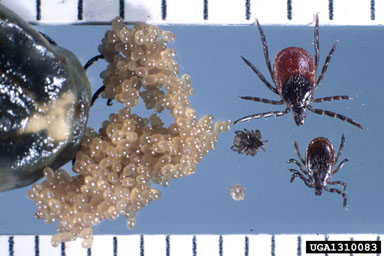
Adult deer ticks (Ixodes scapularis) measure in at the size of a sesame seed. Females are two-toned, reddish brown, with a little dark brown shield on their backs. Males are uniformly dark. Nymphs are lighter colored and about the size of a poppy seed. If you see the six-legged larvae, congratulations on your preternatural eyesight.
DISTRIBUTION AND HABITAT
While particularly numerous in the northeast, deer ticks range throughout the eastern half of the U.S. and southern Canada. They have little trouble surviving Maine’s warming winters with adequate leaf litter. Dry summer heat, on the other, makes life tough for ticks. That’s why we find them less in the sunny lawn and more along the edge of the woods, amongst overgrown vegetation, and in piles of leaves. They need these cooler, moist, protected areas to avoid desiccation. So, deer ticks tend to stick to the shadows where they belong.
DIET
Blood. That’s it. Unlike mosquitoes, which at least have the decency to feed on detritus as larvae or nectar as males, all deer ticks need blood to molt to the next life stage. Females require extra to nourish their eggs. Deer ticks will feed on many mammal and bird species at any stage, but they have their preferences. The larvae mostly attach to rodents. Nymphs may seek larger prey, including rabbits, turkeys, robins, skunks, canines, and humans. The white-tailed deer is the ideal blood donor for adult deer ticks, but they’ll try to make do with any large mammal, including us, and small ones in a pinch.
Despite the myth that deer ticks leap out at us from the trees, they’re passive hunters. They can’t fly, jump, or even skitter. The deer tick holds onto the vegetation with its back legs and reaches out with its front ones, hoping we brush by so it can grab on–a behavior called questing. It would seem ridiculous if the loot wasn’t our blood. Once the successful tick hitches a ride, it often crawls upward, seeking penetrable flesh.
Using their barbed mouthparts, ticks puncture and anchor themselves in the skin. Swelling around the bite may make the tick appear to have burrowed in, but they only embed their feeding apparatus. Deer ticks feed for about a week if not removed. As they engorge with blood, females may quadruple in length. Their disgusting swollen abdomens pale, making them difficult to distinguish from engorged American dog ticks, a larger, less dangerous species.
LIFE CYCLE
The deer tick has a two-year, three-host life cycle. Yep, they’re not just gross and disease-vectoring–they’re needlessly complicated. In spring, females lay up to 3000 eggs among the dead leaves. The larvae hatch in late summer and usually snag a small mammal as their first host (and first opportunity to pick up the Lyme bacterium). After feeding, the larvae drop off and molt into nymphs. Nymphs lay low, spending the winter under leaves and other debris. They start questing for a second host in late spring or early summer of the following year. In Maine, peak nymph activity occurs around mid-July. Once they drop off the second host, nymphs molt into adults. Females must feed a third time to produce eggs, seeking a host (ideally a white-tailed deer) in the fall. Males may also quest in hopes of finding a mate on the host. If a female fails her autumn quest, she’ll get a second chance. Adults spend a another winter under the leaf litter. Any time temperatures rise above freezing, females that missed out in the fall will be on the hunt, but peak spring activity typically occurs in April.
The abdomen of an engorged female deer tick with eggs (left), adult female (top right), adult male (bottom right), nymph (center), and larva (bottom center). Photo by Jim Occi, BugPics, Bugwood.org.
BATTLE PLAN
Staying inside isn’t an option. Someone has got to do the yard work and take the dog out. The kids need to play in the fresh air. But most ticks are picked up in the backyard. So, what do we do?
Destroy their barracks. First, we can make our properties less hospitable to ticks. If there’s one thing humans excel at, it’s destroying habitat. Conveniently (for us, not wildlife), deer ticks suffer in the immaculate turf we’ve decided should surround our homes. Keeping the grass short, pruning low branches, removing fallen leaves, and cutting back brush make the yard less inviting to ticks. Areas people frequent, like the mailbox, swing set, picnic table, and hose hookup, should be trimmed short or surrounded by woodchips or gravel.
Target their allies. Rodents are not only tick nurseries but serve as the primary reservoirs for the pathogens that ticks vector. The fewer, the better when it comes to tick management. Remove the brush, rock piles, debris, and groundcover vegetation that harbor them. Clean up food and feed and keep garbage in rodent-proof containers.
Build a wall or moat. Hear me out. If you can exclude deer with a fence (it’ll have to be at least 6′ high), that should keep a lot of gravid female ticks off the property. A moat, okay, a strip (> 3 ft wide) of woodchips or gravel where the lawn meets woods, can keep ticks from moving out of the forest and serves as a visual cue to remind folks when they’re passing into tick habitat.
Don your armor. Wear long pants, socks, and closed-toed shoes when entering enemy territory. Tuck your pants into your socks and shirt into your pants. Choose light colors to make ticks easier to spot. Then spray clothes from the waist down with an EPA-registered insect repellent that lists ticks on the label. Products containing 20% DEET or higher are effective against ticks. Insect repellents containing picaridin, IR3535, and lemon oil of eucalyptus can also work. A better option is to wear permethrin-impregnated clothing. You can buy pre-treated clothing or treat clothes you own already, but never apply permethrin to your body. Whatever repellent you choose, read and follow the label directions.
Be vigilant for infiltrators. Ticks removed within 24 hours of attachment seldom infect their host with a disease. So end each day with a tick check, and if you find one, extract the atrocious arachnid immediately. You may have heard of using a matchhead, Vaseline, duct tape, gasoline, or the blood of a three-toed salamander to coax a tick to let go. As much as I love a good spell, don’t use witchcraft to convince a tick to detach. It won’t (but it might vomit into your wound). Use tweezers or a tick spoon.
Chemical warfare. Sometimes the health risks of a pest outweigh the health (and environmental) risks of pesticides. With greater than 40% of deer ticks carrying human pathogens in some areas, it’s no wonder many folks choose to treat their yards. Applications made by responsible licensed professionals provide the best and safest control. Treatments must target tick habitat, don’t hire a company that wants to spray the whole lawn. While some plant extracts can kill or repel ticks, they’re less effective than pyrethroids (the go-to synthetic chemicals for ticks). Botanical pesticides often break down quickly in the environment, requiring repeat applications for adequate control.
One low-risk strategy shown to reduce tick abundance is a spray of Metarhizium brunneum combinedwith tick control boxes. Metarhizium brunneum is an entomopathogenic (bug-infecting) fungus that kills ticks. It occurs naturally in the soil. Tick control boxes target ticks’ rodent hosts, luring them in with bait. But instead of poisoning the rodent, the box treats it with fipronil, the same pesticide found in many topical flea and tick preventatives for pets. It kills immature ticks on the host.
What am I going to do?
I’m not ready to spray the yard, but if tick abundance on my property climbs to levels I’ve seen farther south, I will. For now, mowing the lawn short will be the top priority. We’ll keep pushing the forest back, clearing vegetation. I’m working hard to remove the invasive plants established by the previous owner. With their dense growth habit, these species make prime tick habitat. I’ve surrounded the garden beds with gravel. Next, I want to get a mini electric woodchipper to shred every twig at the forest edge and create my moat. After having a fence relentlessly crushed by falling trees and moose, I think a wall is out. I need to do a better job with the leaves this fall.
We vaccinated the uninfected dog for Lyme. Both canines now take a chewable that kills ticks when they bite. I prefer using a permethrin-containing topical because it prevents ticks from hitching a ride, but permethrin is highly toxic to cats. And, of course, one of mine is extra sensitive to it. She almost died once from chewing on the dogs the day after I treated them. I still apply it to my boots and one outfit dedicated to yard work.
Every night, on days when my daughter or I venture beyond the lawn, I do a tick check. It’s been a hard habit to get into, but critical for anyone who resides alongside tick habitat. Like many folks, I’m anxiously awaiting the human Lyme vaccine, which is in trials now.
If you’d like to learn more about tick management and tick-borne disease prevention, see the excellent resources below.









 K.W. Bernard