Welcome to the Druid’s Den, my blog about all things natural and fantastical.
Although I practiced Druidism in my twenties, my blog honors my druid heroine, Sarlona, and leans toward the fun and weird.
When the mood strikes, I feature a monster—real or alive in our imaginations, if nowhere else.
In addition to monsters, expect a healthy dose of nature, plenty of Maine, a sprinkling of magic, and perhaps ramblings on writing, book recommendations, or a cute pet picture or two.
Thanks for visiting!
Sign up for the Druid’s Den Newsletter to stay up to date with blog posts, events, promotions, and book news.
A nocturnal predator with dozens of appendages lurks in a damp, shadowy lair, awaiting its chance to snatch a victim with venomous jaws. Could it be a monster that strayed from our darkest dreams? A laboratory experiment gone nightmarishly wrong? An alien castaway from far beyond our solar system? Or is it merely an ancient arthropod?
There’s no doubt—the centipede is the ultimate creepy crawly. But despite inspiring one of the most hideous horror movies of all time and giving many people the heebie-jeebies, it’s far from a monster. Like spiders, centipedes are tiny, beneficial predators equipped with venom and more legs than we like to see. Admittedly, they’re not as sexy. They don’t leave dewdrop-coated masterpieces sparkling in the morning sun. Nor do they have a reputation as femme fatales. They lack the big, beautiful eyes and fuzzy cuteness of some charismatic arachnids. But just because they look like crunchy worms with an unholy number of legs doesn’t mean they crawled from the Abyss.
The centipede is a cool creature. I’ll prove it.
Venomous fangs legs
Centipedes are carnivores that use a pair of modified forelegs, called forcipules, to inject venom and subdue their prey. They feed primarily on other arthropods, but a few of the largest species can bring down small lizards, frogs, rodents, birds, and bats.
Not really. Centipedes are excellent runners and prefer fleeing to fighting when disturbed by giant, lumbering primates. Even if handled, most are too small to break human skin. Yes, larger specimens can deliver a very painful pinch, but death by centipede is exceedingly rare. Allergic reactions are possible, though. Individuals who react to bee venom may be at particular risk.
Clean romance only
Although I prefer spicy monsters, abstinence is interesting in an arthropod. Centipedes don’t mate. Males drop spermatophores (sperm packets), and if the ladies are into it, they’ll pick them up and be on their way.
Maternal instincts
Centipedes are great moms! Many guard their eggs and hatchlings by wrapping around them. They also groom the little ones, removing bacteria and fungal spores that could make them sick.
Chemical weapons
While more common in millipede species, a few centipedes secrete defensive substances, including hydrogen cyanide, a deadly poison. Of course, one little arthropod can’t contaminate the air enough to harm a person. Still, skin contact with these substances can cause lesions, and ingesting millipedes can make you sick.
Drained’s centipede
In Drained, Sarlona uses a spell to grow a hungry little centipede to gigantic proportions. It creates a fine distraction as it attacks her captors with its forcipules and knocks out a few guards with noxious fumes. I’ve explained elsewhere why arthropods can’t get very big and mentioned above that cyanide is more of a millipede thing, but, hey—it’s a magical world with fictional species.
So, what do you think? Are centipedes cool or just creepy?
Mitić, B. M., Jovanović, V. B., Todosijević, M. M., Eckhard, M., Vasiljević, L. C., Tešević, V. V., & Vujisić, L. V. (2024). Chemical defence of a centipede (Clinopodes flavidus). Journal of Insect Physiology, 155, 104649. https://doi.org/10.1016/j.jinsphys.2024.104649
Undheim, E. A., Fry, B. G., & King, G. F. (2015). Centipede Venom: Recent Discoveries and Current State of Knowledge. Toxins, 7(3), 679-704. https://doi.org/10.3390/toxins7030679
There’s nothing like a quiet beach on a clear night. Black waves breaking under a canopy of stars hold a special kind of magic. Never more so than when draped in the glittering light of the full moon.
My grandmother taught me that. When I was little, she’d take me for walks on the beach long after sunset, and I’d sit with her and watch the moonrise. To this day, I search for glimmers of divinity in the night sky over the Atlantic. It sustains me through gray, dead days.
The beach at night is pure magic.
So, for me, walking the beach at night is a ritual. Flashlights aren’t allowed, and footwear is discouraged. The magic happens when I’m wrapped in the dark with sand between my toes. But in October 2020, I may have gotten more than I bargained for.
Pink lingered in the west, and the evening’s first stars had just sparked to life when I ventured out onto Wells Beach. It was the perfect time for a walk—the weather was mild, the tide was low, and hardly anyone was around. I’d planned to trek the 2/3 mile to the jetty and watch the full moon rise from atop it.
Things first got a little weird when I passed a group of college-aged men standing around drinking. I thought I’d given them a wide berth, but one of them had a young dog on a super long rope. The dog charged, and before his owner could reel in the slack, he leapt and gave me a big puppy kiss on the mouth. Normally, I wouldn’t have cared—I love dogs. But this was still early in the pandemic, before the vaccine, and these guys weren’t social distancing. The man apologized, and I played it off, but it shook me a bit. Little did I know, the excitement was just getting started.
Clouds swallowed the remaining light, and dusk deepened into night. By the time I reached the jetty, it was much too dark to climb it safely. In fact, with the moon still tucked behind the sea, the night was so black that I felt a little disoriented. Though the clouds threatened to ruin my plans to watch the moonrise, I figured I’d stick around to see if they broke enough for a glimpse.
The stars are brighter over the sea.
As I waited, the darkness kept shifting around me. I couldn’t see more than a few feet ahead but sensed movement. Other people had arrived in hopes of watching the moonrise as well. That wasn’t surprising since most parking for the beach is by the jetty. Why shouldn’t other folks want to enjoy the full moon rise in such a lovely spot? It wasn’t late, after all. But the meandering shapes kept wandering uncomfortably near, especially for 2020, and none spoke to each other. They drifted silently about like ghosts. Until I heard the familiar, stuttered scratching of canine paws digging through sand. It wasn’t the people who kept coming so close but their loose dogs. Two pups had started excavating beside me.
I’d already had my fill of uncontrolled dogs for one evening, and I didn’t want to twist an ankle in one of their holes, so I backed away. The clouds were thinning anyway, and I’d been too near the jetty to view the rising moon over it.
Generously, the sky’s downy curtains soon parted to reveal the gorgeous harvest moon as it ascended over the jetty. Big and orange, it almost resembled the sun, spilling its magic across the sea and sand. I tried to let some of it seep into me and forgot about the other people and their dogs.
If you follow me on social media, you know how much I love to take photos that capture even a sliver of nature’s splendor. I couldn’t let such a glorious moon go undocumented! So I pulled out my phone and snapped a picture. Unfortunately, I made a critical error in iPhone night-sky photography—I accidentally left the flash on.
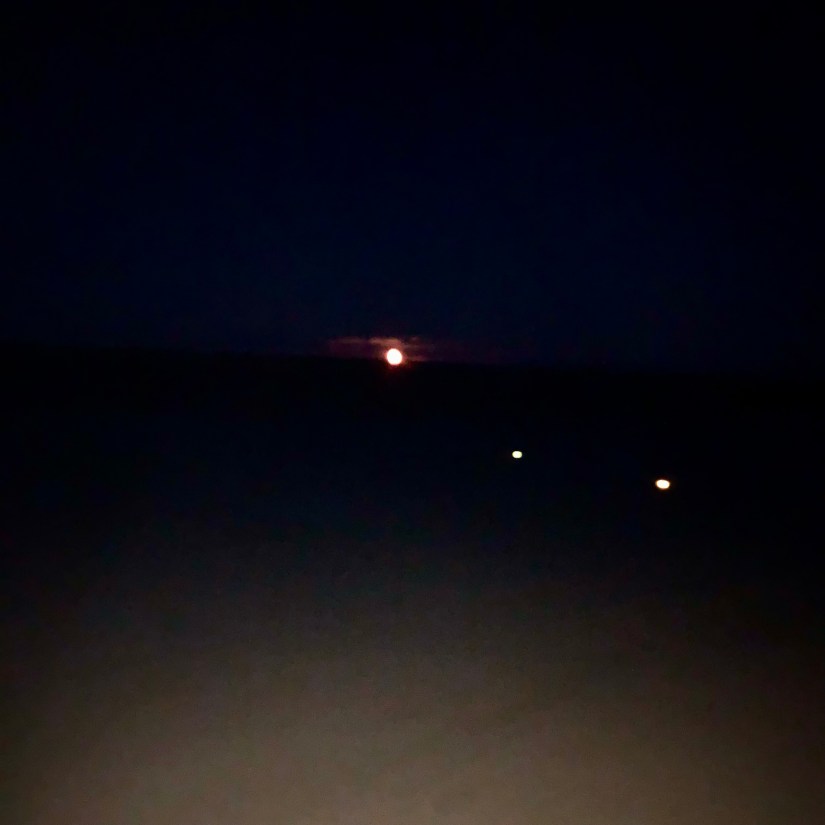
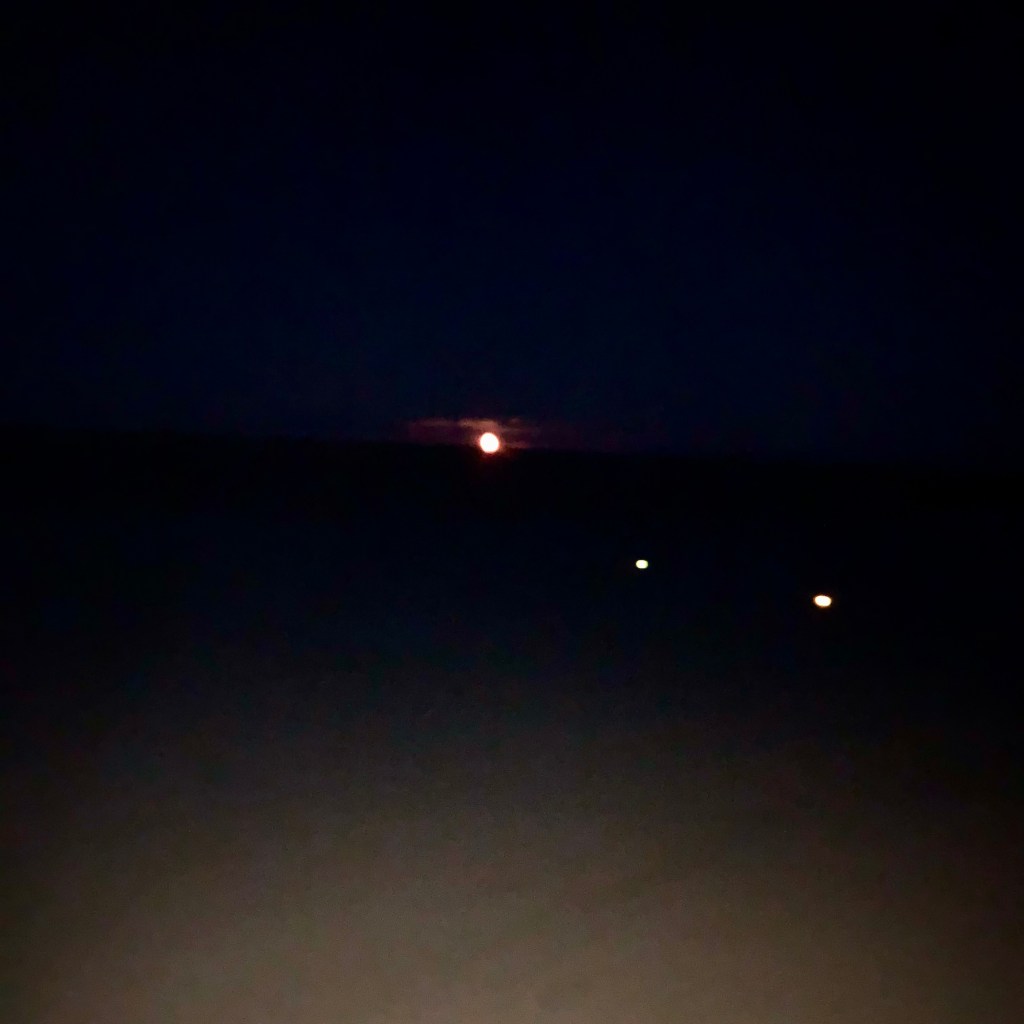
The photo taken with that fateful flash. The two smaller bright spots are eyeshine from the foxes.
Everything changed in that offensive burst of artificial light. There were no other people. There were no dogs. I shared the moonrise only with a pair of foxes. They instantly fixed their glowing gazes on me, bared their fangs in devilish grins, and, to my utter shock, trotted right toward me as though I’d called them.
For a few seconds, I did what you’re supposed to do when a wild canid comes your way—I stood my ground. Using my angriest dog-mom voice, I shouted, “No.”
They didn’t so much as break stride.
I instinctively backpedaled a few steps and yelled something ridiculous like, “No, you stay there.” They kept coming.
Shoving my phone in my pocket, I turned and sprinted as fast as I could. After twenty to thirty seconds, I looked over my shoulder—they were trotting after me, keeping pace. I ran hard down the beach for about half a mile before glancing back again. This time, they were gone.
My pursuers had similar smiles. Photo by Holly Keepers, USFWS.
They could have caught me, of course. Foxes can sprint around 30 mph. Fortunately, healthy foxes don’t attack people. They prey primarily on rodents, after all. But rabid ones have been known to bite, and that was my fear—a peak pandemic ER visit, two dead foxes, and rabies prophylaxis (which can cost upwards of $30,000).
Although this story amuses me now, I can’t convey how surreal this incident felt. It’s been almost four years, and I still think about it often. Of all the foxes I’ve encountered, these were the only ones that didn’t bolt at the sight of me or the sound of my raised voice. Why would foxes run toward a flash of light? Why were they together? How did night get so dark so fast, and then, suddenly, I could see again? Why did I think there were people around me? How did time slow enough during that flash for the foxes to whip their heads at me and grin with wicked delight?
This was the vibe. Photo by Lisa Hupp, USFWS.
The druidic fantasy writer in me knows exactly what happened—the Veil was thin that night. I was in a liminal place at a liminal time, and the moon was full. Either I slipped a little into another realm, or it leaked into this one. Those weren’t foxes. They were faeries—or something—shapeshifting from humanoid to canid as they pleased. Obviously, they couldn’t allow themselves to be photographed. So they thought they’d have some fun with the trespassing mortal.
Of course, the part of me who trained as a wildlife biologist wants an explanation less rooted in faerie magic. The foxes could have come down to the beach to forage for surf clams or crabs—easy pickings at low tide under the cover of darkness. They’d probably had their run of the beach at night all spring and summer, given the nonexistent 2020 tourist season. I’m guessing they were siblings recently run off by their parents or a mother and her straggling kit. Still, it’s hard to reconcile why a flash of light would summon a pair of crepuscular wild animals faster than a cheeseburger summons my dogs. Lights, especially those that turn on suddenly, are often used to haze and deter foxes and other midsized predators. The best explanation I can come up with is that someone had been feeding these animals at night by flashlight. When they saw the light, they thought I had something for them.
Or maybe they were rabid. Infected animals often lose their fear of people, and foxes comprise a significant portion of documented rabies cases in Maine. But if illness had driven this pair mad with aggression, they missed the perfect chance to go berserk and bite when they were digging next to me. Besides, it seems unlikely that two rabid animals would hang together and react identically to a stimulus.
So, I think these were habituated, food-conditioned animals. That’s not as scary as rabid ones, but it’s still bad for the foxes. It increases their chances of conflict with humans. Wildlife managers inevitably get involved when foxes start approaching people in public spaces. Had one nipped or scratched me, innocently trying to get chicken nuggets to pop out, that would have been it for them. They’d have been hunted down and decapitated for rabies testing. So, don’t feed wild animals. And be careful if you’re alone at night when the Veil is thin. You never know what might slip in from another realm and stare at you with a hungry smile.
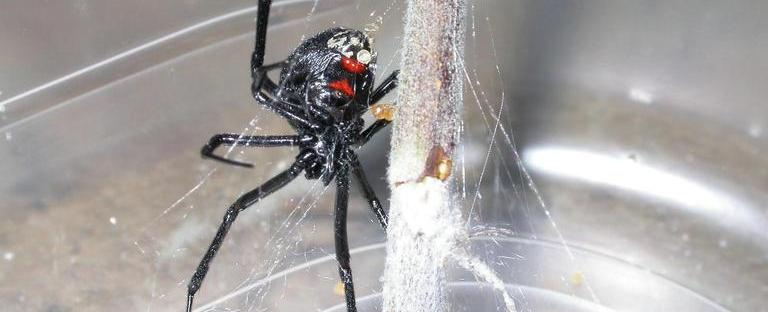
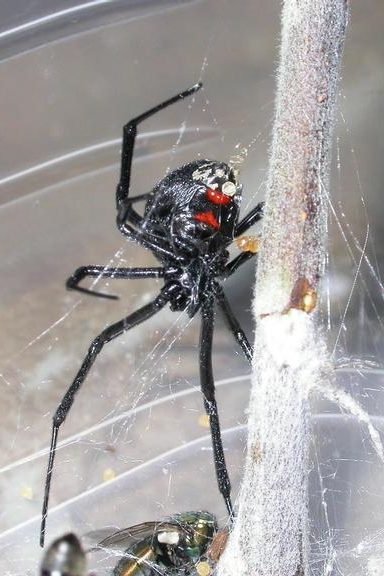
A female northern black widow (Latrodectus variolus). Photo by Jim Jasinski, Ohio State University Extension, Bugwood.org.
I take issue with the title’s phrasing, but, in a way, it’s true—the northern black widow (Latrodectus variolus) could be considered an “infrequent inhabitant” of southern and central Maine. And, unlike our hundreds of other spider species, it’s highly venomous.
That hasn’t stopped me from assuring Mainers who call me about spiders that unless they’ve been traveling or opened some strange packages, they don’t have to worry about species of medical concern.
Yes, L. variolus has been reported here, and given its distribution in nearby states and provinces, it could be indigenous. But folks have been saying this for decades. While each warmer winter probably brings L. variolus closer to establishing a firm population here (modeling even predicts it), there’s little evidence that it already has. We still don’t have the collected specimens or scientific studies to suggest a continuous presence. Individual L. variolus spiders show up occasionally—that’s it. Other highly venomous spiders, like the southern black widow, western black widow, and the brown recluse, appear too. The difference is that these spiders are almost certainly one-offs transported here by human activity. With L. variolus, it’s less clear.
But if you want to go looking for trouble…
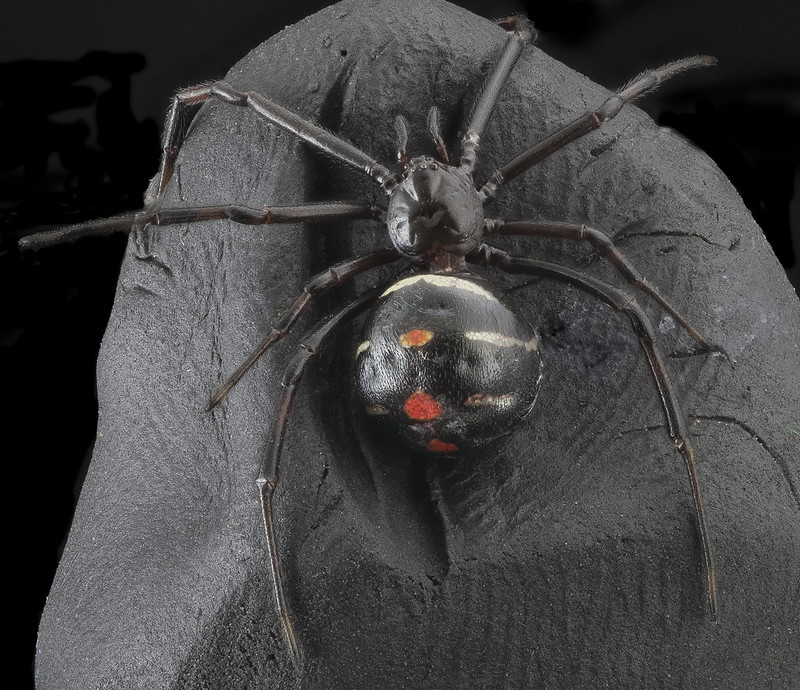
The northern black widow has a line of red markings down the top of its abdomen along with the broken hourglass marking on the underside. Photo by Sam Droege.
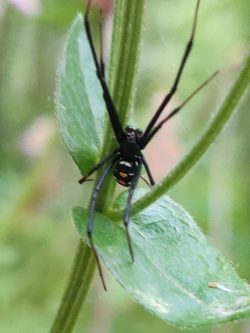
Adult female L. variolus are easy to recognize at around one-half inch long with a glossy black, bulbous abdomen and conspicuous red markings. The pattern on the northern black widow’s underside usually appears as two separate triangles rather than a complete hourglass. In addition, L. variolus typically bears a line of red spots down the back of the abdomenand may have pale, yellowish stripes when young.
Male black widows are much smaller and lack the mature female’s enlarged, rounded abdomen. Their tiny fangs can’t puncture human skin well enough to deliver venom. Males have yellowish/whitish bands and halos around their red spots. Young juveniles are brownish or tan with white or yellowish markings similar to males.
Don’t get wrapped up
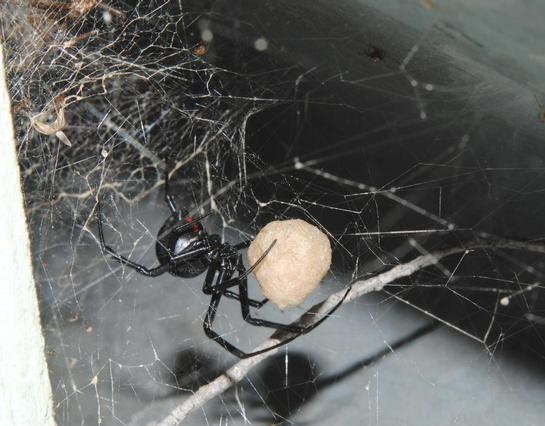
A black widow with her egg sac. Widow spiders weave tangled, disorganized webs. Photo by Josh Shoemaker, Bugwood.org.
Black widows belong to the cobweb weaver spider family (Theridiidae). They construct tangled, ugly webs of thick silk, often in cavities like rodent burrows or bait stations, hollow stumps, crevices in rock walls and wood piles, baskets, boxes, and—very unfortunately—shoes and outhouse holes. Mature females stick close to their webs. If you think black widows are around, don’t stick a body part in a dark nook without inspecting it first.
Male northern black widows don’t live as long as females—especially if they can’t escape their lady’s web. Photo by Jana Miller.
The life of the widow
Black widows get their name from the female’s habit of devouring her mate, but many spider species eat slow or clumsy males. That’s the risk the little guys run when they stride into the territory of a larger predator and start annoying her. If the male can’t escape after accomplishing his mission, at least his corpse will nourish his progeny.
We don’t know very much about L. variolus and its life cycle. If the species is like its southern relative, females could produce several egg sacs per season, each giving rise to a couple hundred spiderlings. Once they leave the sac, the bitsy brood deploy silk strands into the wind to carry them to new homes. It takes a few months and several molts for them to reach maturity. Female black widows can live up to a year and a half. Males don’t live as long.
Our bark is worse than their bite
Spiders don’t want to bite us. Most will try to run for their lives when we lumber too close, including L. variolus. Bites usually occur because we inadvertently squish the spider against our skin.
Not only are black widows rather skittish, but their deadly reputation is also exaggerated. Few fatalities have resulted from their bites—the last one reported in the United States occurred in 1983. Those most at risk of death or long-term complications include young children, the elderly, and individuals with heart conditions.
Still, bites are serious. Anyone bitten by a black widow should call poison control and seek medical attention right away. The bite site rarely hurts or swells much, but the black widow’s neurotoxic venom acts throughout the body. It can cause excruciating pain (especially in the abdomen), nausea, tremors, high blood pressure, rapid heart rate, difficulty breathing, and other unpleasant symptoms.
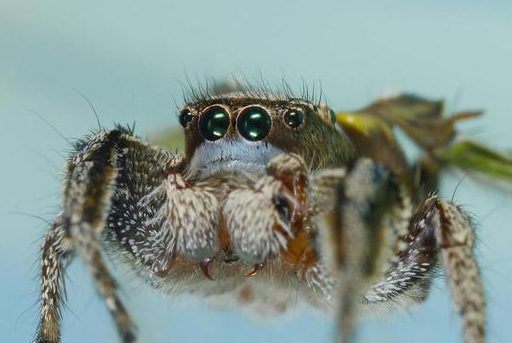
For the record, all spiders are venomous. Even the adorable ones. But only a few can deliver highly toxic venom in dangerous doses. Photo by Joseph Berger, Bugwood.org.
Avoid Shelob’s lair
Although the odds of encountering L. variolus in Maine are exceedingly low, we can do a few things to reduce the number of spiders in our homes and avoid spider bites in general. Cluttered, undisturbed areas provide excellent habitat for many species. So, sweeping, dusting, and tidying up can convince spiders to leave. Closing any gaps and cracks around doors and windows will help keep them out in the first place. Wear gloves when working outside around woodpiles, rock walls, and other debris to prevent bites. Check boots, shoes, and gloves stored in basements, attics, garages, and sheds before putting them on. And if you’re upta camp, check the hole in the outhouse before sitting down!
RESOURCES
Barry, D., and G. Fish. 2010. Structural and General Pest Management – Maine Pesticide Applicator Training Manual: Category 7A. University of Maine Cooperative Extension.
Jennings, D.T., and C.P. Donahue. 2020. A Checklist of Maine Spiders (Arachnida: Araneae). Forest Health and Monitoring Maine Forest Service Technical Report No. 47. Maine Department of Agriculture, Conservation and Forestry.
Wang, Y., N. Casajus, C. Buddle, D. Berteaux, and M. Larrivée. 2018. Predicting the distribution of poorly-documented species, northern black widow (Latrodectus variolus) and black purse-web spider (Sphodros niger), using museum specimens and citizen science data. PLoS One. 13: e0201094. https://journals.plos.org/plosone/article?id=10.1371/journal.pone.0201094
Few sounds pierce the human heart like a wolf’s howl. Whether the call elicits terror, wonder, or both hinges on perspective and circumstance, but the evocative melody will surely stir the listener. Because for many, the wolf represents more than a wild canid. It represents the wild itself, both out there, deep in the forest most of us would die in if not well-provisioned, and in ourselves. For others, the wolf is a threat to our livelihoods. It’s a competitor if not an adversary. And, for some, the wolf is still a beast in the night–that other lurking just beyond the glow of the campfire, the village, or the porch light…waiting for us to stray too far and rip us apart.
The State of Maine put a bounty on wolves that lasted for seventy years. Photo courtesy of the National Park Service.
As a non-rancher living in modern-day North America, I have the luxury of viewing wolves through that first lens. I don’t need to worry about them. They’re probably not even here. Hunted mercilessly, they were extirpated from Maine in the 1890s. But if some have crept back down from Canada as many claim, I wouldn’t be any more concerned for my or my daughter’s safety with wolves in the abutting forest than I am with our abundant black bears or our decidedly wolfy coyotes (which is close to not at all). Unprovoked attacks on humans by healthy wild wolves in North America are almost unheard of.
The same can’t be said of the Old World. My not-so-distant European ancestors had good reason to worry. Where people lived in high density alongside wolves for centuries and wars put piles of human meat out for scavenging, Canis lupus was a different beast.
While many historical accounts of man-eating wolves are likely exaggerated, plenty have been recorded. It would be naïve to deny that wild wolves have sometimes become anthropophagous (man-eating).
The most infamous of these wolves is believed to be the Beast of Gévaudan.
The Carnage
In 1764, in the former region of Gévaudan in southern France, a series of bizarre animal attacks began that historians, biologists, cryptozoologists, and even some paranormalists still discuss today.
La Bête, the beast, attacked at least ninety-nine people in less than two years, fifty-three of which it killed. Some writings claim a much higher death toll, but the first official victim was 14-year-old shepherdess Jeanne Boulet. She led her charges up to a highland pasture near the border of the Gévaudan region and never returned. Her body was found the next day. Most of those attacked were women and older children, especially teenagers. Victims were often taken while tending livestock. The bloodshed was so great that the local bishop claimed the attacks were a divine scourge meant to punish the sinful populace, calling for prayers and more virtuous behavior.
King Louis XV was a bit more pragmatic, sending expert huntsmen after the beast once tales of the monster reached his ear. Francois Antoine shot a sizable wolf that reportedly bore a bayonet wound from twenty-year-old Marie-Jeanne Vallet, who had speared it with a makeshift weapon when attacked. But the killings only stopped for a month, and the death toll crept up once again. For almost three years, the beast terrorized Gévaudan and the surrounding areas. Only after Jean Chastel, a local farmer, shot a large wolf did the attacks stop. The last documented victim was nineteen-year-old Jeanne Bastide.
La Bête
Marie-Jeanne Valet speared the beast when it attacked her and her sister, earning her the title of the Maid of Gévaudan and a statue.
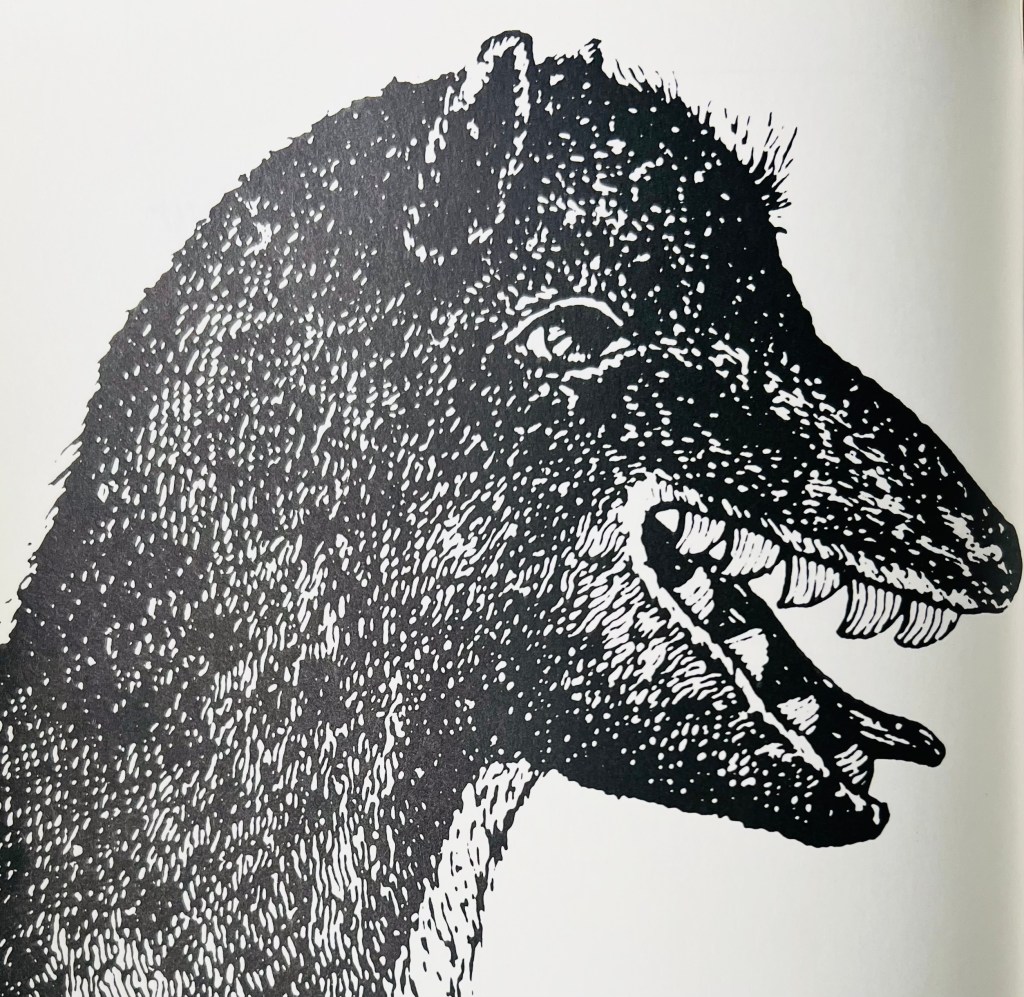
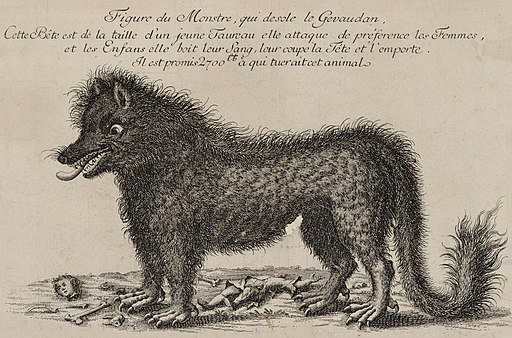
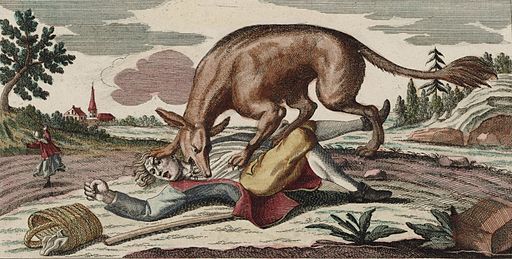
Besides the massive body count for a single canid, if the culprit was indeed one wolf, the beast had several unique characteristics. Survivors and witnesses described a tawny or reddish-colored animal, sometimes with stripes, particularly a thick strip of long, dark fur down the back. Some reported a long, tufted tail and finger-length claws. La Bête was said to be incredibly strong and able to leap great distances. It was powerful enough to carry older children and adults away. Observed attacks were primarily by ambush. The beast was sometimes reported to hold down victims with its forelimbs and smother or strangle them, presumedly by clamping its jaws over the face or throat. Several victims were decapitated. La Bête appeared to target humans, ignoring most livestock (though it allegedly leaped upon horses), and a few human victims were even saved by the animals they were tending.
One might notice that la Bête’s observed appearance and behaviors are not typical of wolves. Some are absolutely inconsistent with a wolf’s morphology.
Hence the enduring mystery of la Bête. Was it a wolf? Most historians seem to say no–it was several wolves. But an anthropophagous pack or multiple rogues explain little more than the extreme body count. It doesn’t begin to address la Bête’s strange appearance or some of its feats.
Few descriptions or depictions of la Bête resemble a normal wolf.
Unless you write off all the beast’s anomalous traits as the products of hysteria, spin, and superstition. Might the tragically disadvantaged peasantry have granted the creature terrorizing them extraordinary strength and agility? Gigantic size? Supernatural abilities? Sure. But why add the strange fur and tail? If my village was being ravaged by a wolf, I’d try to describe the offending animal as accurately as possible. That way, hunters and authorities would know what they were after.
Of course, we don’t actually have first-hand accounts from terrified peasants. If any could write, their reports are long gone. The tales we have today have been filtered through the Catholic clergy and nobility.
Could priests have altered the details of eyewitness accounts to make a monster? Maybe. But unlike the region’s bishop, the priests who wrote letters to colleagues and pled to officials for help tended to downplay la Bête’s otherworldliness. Most of their writings suggest a flesh and blood animal, not anything imbued with the supernatural. They also speculated that it wasn’t a wolf. Though some writings of the time called la Bête a wolf or wolf-like animal, others referred to it as a hyena or big cat.
Tawdry Taxidermy
One would think a simple DNA test could tell us definitively what took so many lives in the south-central highlands of France almost 260 years ago. But the mangled corpse of the animal killed by Jean Chastel and purported to be the beast was rather artlessly stuffed with straw after dissection. When it arrived in Paris to be inspected by prominent natural historian Comte de Buffon, it was a rotting abomination. It’s believed la Bête was buried somewhere in the botanical gardens after examination.
But was the slain animal even really la Bête?
La Bête was described as having long claws, but no mention of claws appeared in the report detailing Chastel’s wolf.
The most thorough assessment of the predator killed by Chastel was done locally at Besques castle by medical doctors and recorded by royal notary Roch Étienne Marin. The resultant report concluded that la Bête was a wolf, but one like no other. There are numerous inconsistencies and suspicious claims in the report, however. Taake 2023 delves into these in-depth and speculates that the report’s goal was to make an ordinary wolf seem unusual enough to have been the monster.
Why would anyone pronounce la Bête dead when it wasn’t? Perhaps to quell the understandable hysteria among the peasants. Or to mask the ineptitude of French authorities at the time and save them further embarrassment. At the very least, solving the problem of la Bête would make the local ruling class seem competent.
Yes, the deaths attributed to la Bête stopped after Chastel felled his wolf. They also paused for a month after Antoine shot his wolf. Or did they? Under pressure from the king, authorities may have been inclined to pretend the problem was no more and failed to record official victims during the lull. Witnesses may have been encouraged to positively identify a wolf carcass as la Bête. Perhaps the same was true the second time, and the killings continued quietly awhile, with any deaths being blamed on other animals.
Should we default to conspiracy? Of course not. Concluding that the wolf killed by Chastel was the last of multiple man-eating wolves in the Gévaudan region in the mid-1760s is perfectly reasonable. But some of la Bête’s more distinguishing characteristics were either missing from Chastel’s wolf or went unrecorded, which is bound to stick in some craws.
What, if Not Wolves?
Everyone familiar with la Bête has their pet theory. Here are the most prominent:
Werewolf
Whether or not one allows for the existence of werewolves and similar supernatural creatures, the evidence for this is thin. The best reason to blame a werewolf I can conjure is la Bête’s reputation for shrugging off musket balls and maybe slurping blood from its victims. Perhaps the reports of claws also have something to do with it. But most witness descriptions don’t align with what we think of as werewolves, and there seems to be little mention of them in records of la Bête. Were I to blame a shapeshifter, I’d be more inclined to believe a werehyena migrated north and perpetrated the slaughter.
Serial Killer
The theory here seems to be that a man trained a pet wolf or wolf-dog to kill people. Some folks have implicated Chastel. Although a pet wolf or hybrid is much more likely to attack humans than a wild purebred, there doesn’t seem to be much evidence that a man was directing la Bête. One might argue that dismemberment and decapitation point to human involvement, but some predators handle their prey this way. Some could also point to the number of young women killed by la Bête and interpret this as a victim profile. But it isn’t unusual for predators to target petite women and children. A smaller person usually equals a less risky kill. Besides, the young women of Gévaudon were the individuals most often sent out to tend the herd unarmed. They were put in the path of the beast. Plenty of older individuals and males became victims of la Bête anyhow.
La Bête was often described as tawny with a tufted tail and powerful front legs, which it used to hold down its victims.
Hyaenodon
I love this theory, mostly because I also love cryptids and prehistoric megafauna. What I find most intriguing is the similarity between reconstructions of the hyaenodon and some of the descriptions of the beast. Even renditions by some 18th-century artists of la Bête look strikingly similar to how paleontologists believe hyaenodons appeared. Of course, some of the features in these reconstructions come from researchers’ imaginations. We can’t know what a hyaenodon’s pelage looked like. What scientists can surmise, though, is that they were predators with large heads and doglike bodies. Based on their feet and forelimbs, they were probably not superb runners. They likely ambushed their prey and held it down with their forelegs. The problem with this theory is that paleontologists believe they went extinct around 20 million years ago. For one to have wreaked havoc into the 1760s, there would have had to have been at least a small population living in the highlands of France for as long as humans have. If that were the case, one would think there would be other documented encounters with these creatures from centuries past.
Striped hyena
I like this theory because descriptions of the beast match a striped hyena pretty closely. In fact, La Bête was called a hyena in some newspapers and correspondence of the time! And though hyenas are more closely related to cats, they appear doglike. Someone familiar with wolves but not hyenas might call one wolf-like. Had the beast been recognizable as a wolf, I think victims and survivors would have called it a wolf. The horror of the incidents might have driven them to call it a gigantic, evil wolf with hellfire gleaming in its eyes and razor-sharp fangs, but still—a wolf. Hyenas are larger than the average wolf, and they are known to attack people. They’re capable of dismembering bodies and even have a history of ripping pieces off when people are still alive. No, there weren’t wild populations of hyenas in France in the 1760s. But it’s not hard to imagine one slipping away from some noble’s private menagerie (another reason for authorities to point at Chastel’s wolf rather than acknowledge culpability for the Gévaudon nightmare). The reason I don’t fully back the hyena theory is that, as far as I know, there haven’t been hyenas on record who forsake all other prey and rack up incredible body counts in a couple of years. The typical unprovoked hyena attack seems to occur when people sleep outdoors and a hungry animal ambles by.
Big Cat
An escaped big cat is an excellent candidate for la Bête’s true identity, in my opinion. The most prolific maneaters in history are the big cats. The famous lion pair of Tsavo ate as many as 135 railroad workers. Not to be outdone, the leopard of Rudraprayag by itself had a body count of 125, the Panar leopard had 400 official victims, and the tigress of Champawat reportedly killed 436 Nepalese and Indians in the Himalayan foothills. The worst offenders of all were likely the Njombe lions, a pride believed to have slain more than 2000 people in their long tenure. These killer cats were active in the 20th century or just before it. Gods know how many they killed before firearms existed. Besides the precedent set by these prolific maneaters, cats are ambush predators, often hunting and killing as described in accounts of la Bête. They can easily drag even adult men away and dismember a human body.
Many of la Bête’s reported traits and behaviors resemble those of a male, man-eating lion.
And when a lion gets the taste for people, we tend to be all it hunts. La Bête was said to ignore the livestock and go for the shepherds. Another clue that la Bête might have been a lion is that it cracked open the skull of ~60-year-old Catherine Vally and licked the insides clean. Human-eating lions are known for this behavior. Although descriptions of the beast match a hyena more closely than a lion, if you ask me, Taake 2020 makes an excellent case for why la Bête could have been a subadult male lion. Honestly, I buy it. And some witnesses did describe la Bête as lionlike or catlike. Two things make me doubt (slightly) that the beast was a lion, though. The first is that the proportion of victims who survived seems high for lion attacks. Almost half of la Bête’s recorded victims lived. I think even a scraggly subadult would have been more lethal, especially knowing how often wounds by big cat claws turn septic and the poor state of medicine at the time. I also wonder why no one could identify it as a lion definitively. No, the shepherds may not have owned illustrated books or had the opportunity to visit a menagerie. But lions appear in the Bible. Might not some of the rural populace have seen religious (or royal) imagery depicting these animals?
Wolves
While there will always remain the possibility, if not a strong probability, that la Bête was two or more wolves, I’m inclined to give Canis lupus the benefit of the doubt. Until about the last fifty years, people of European origin hated wolves with an intensity rarely leveled at other species. Through bounties and government-sponsored campaigns, we nearly annihilated an animal that rivaled our success, ranging most of the globe. We mowed them down from airplanes, strangled them with snares, and poisoned them with strychnine, all while calling them tricksters and cowards. We made them Satan’s minions, the beast within, and the avatar of a wilderness we demanded to conquer in the name of God. Yet if one believes the tale of a she-wolf raising Romulus and Remus, then we can thank the wolf for most of Western civilization. So, for now, I’m blaming the lion, who we at least had the decency to admire before skinning and who has probably taken far more children than the big, bad wolf ever did.
RESOURCES:
Lopez, Barry. 1978. Of Wolves and Men. Simon and Schuster. ISBN: 978-0684163222
Capstick, Peter Hathaway. 1981. Maneaters. Safari Pr. ISBN: 978-1571571175
It’s my birthday week! So, I’ve decided to be self-indulgent and write about my personal monster—the yellow eyes.
Allow me to set the scene…
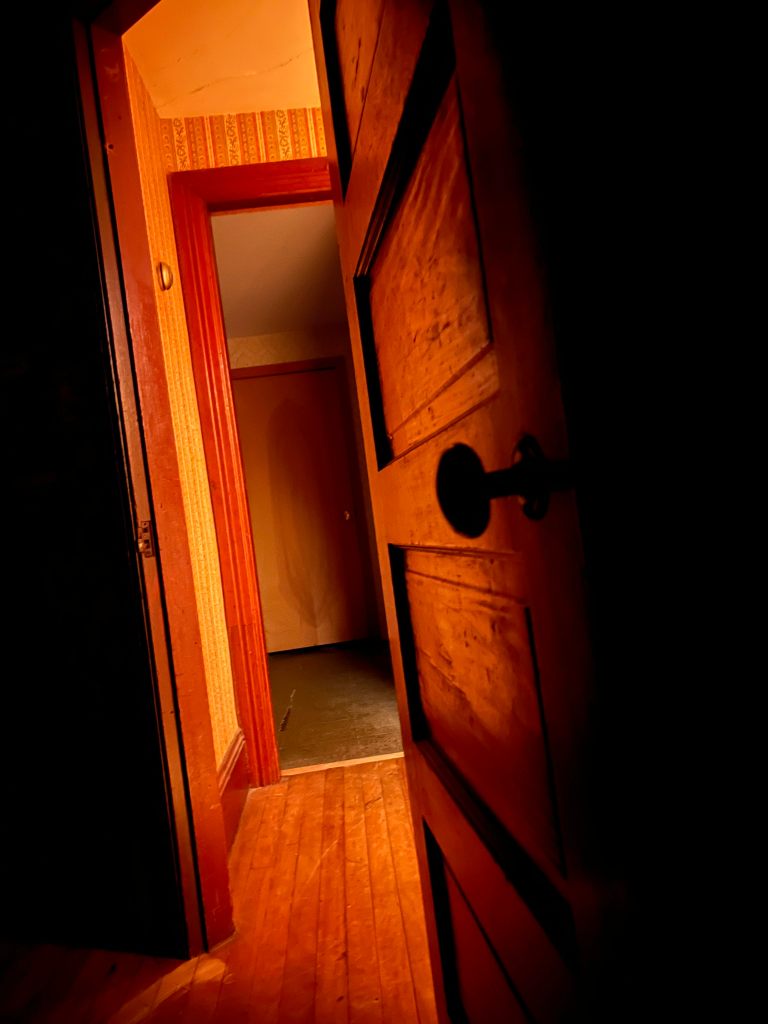
Nothing creepy about this view.
I was 8 years old, staring out my doorway as I tried to fall asleep. I could see into my younger brother’s room while lying on my right side, but only the closet area. On the night I spied the yellow eyes, it was too dark to see even the closet, though.
About the closet…
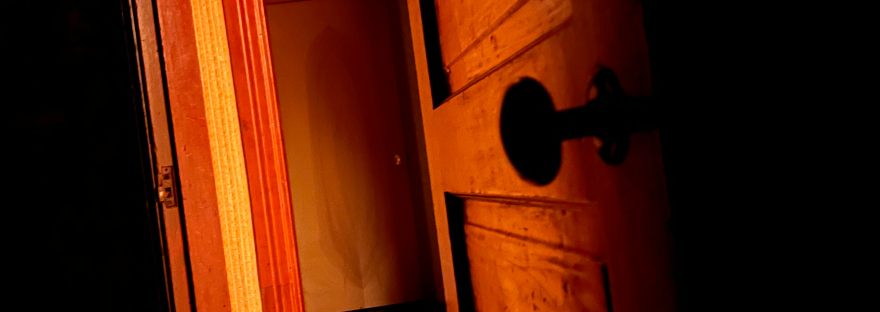
That closet door creeped me out as a kid. The wood has a monster-sized, oval knot with two little points at the bottom. I always thought the blemish looked like a shadowy devil blob. Or an ominous portal. The closest itself is weird, too. It’s massive—the size of a normal bathroom—with one counter-like shelf off to the side and no hanger rod. Bare insulation and lath and plaster form two of its walls.
Here’s what happened
I don’t think the closet opened. If it did, I didn’t hear it. The yellow eyes appeared to pop into existence before the door, though I suppose they could have phased through.
It sounds cliché, but I froze in terror. Fawn in the tall grass frozen. Like maybe if I didn’t so much as blink, they wouldn’t notice me. They saw me, though. I felt like they locked right onto me. They started toward me, bobbing slightly.
The eyes vanished after a few seconds, and I could breathe again.
Until they reappeared much closer. Right in my brother’s doorway. Just a few feet from mine. I threw my blanket over my head and tried yelling for my dad. My voice wouldn’t rise above a whisper. I shook, screaming at myself to scream, sure something terrible would rip the blanket off me at any second. It never did. Or I repressed it into oblivion. I don’t know how long I hid beneath the blankets, trying to holler for help, but enough time passed that it felt hard to breathe under there. Eventually, I fell asleep.
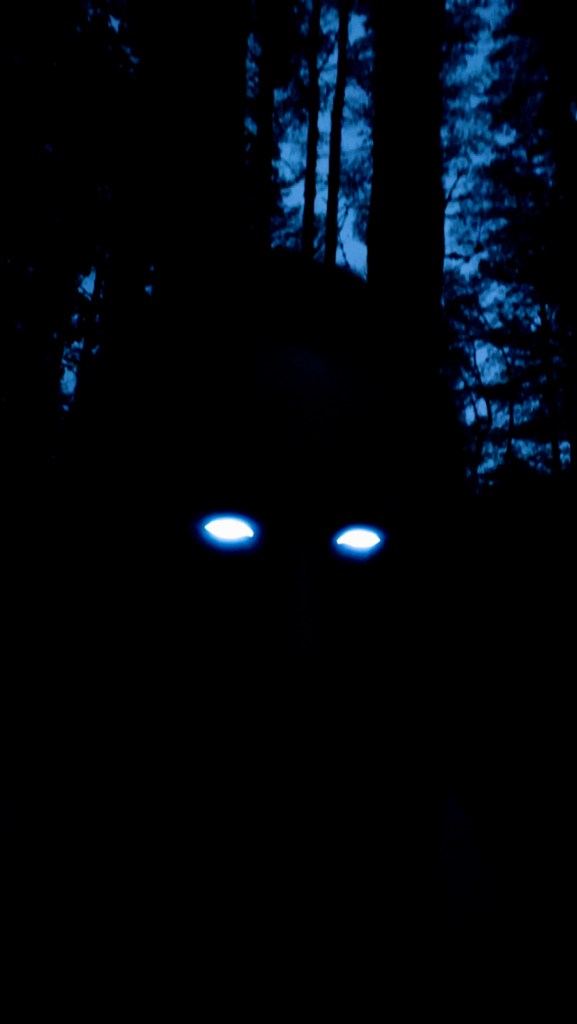
But bigger, rounder, and yellow.
Jeepers creepers
I call them eyes, but the occult orbs had no pupils, irises, or whites. They were big, perfectly round, and glowing bright yellow. Their radiance wasn’t like eyeshine. They didn’t reflect light; they emitted it. Yet they didn’t cast any into the room. I couldn’t see anything near them—no body or shape blacker than the black around it. Only diffuse darkness surrounded them. But hovering as a pair about 6 feet off the floor and moving together, they seemed decidedly eyelike.
The aftermath
I felt cold the next morning. The day brought a hollow light that refused to warm. I don’t remember what I said to my mom, but my first words to my dad were to ask if he’d been in my brother’s room with flashlights. The only non-ghost explanation was if he had snuck in with two lights, held them at the sides of his head, and played a sick prank. But he said no, of course, and I could tell he didn’t know what I was talking about. When I explained what happened, my parents brushed it off. What else could they do? My dad insisted that I’d seen car lights.
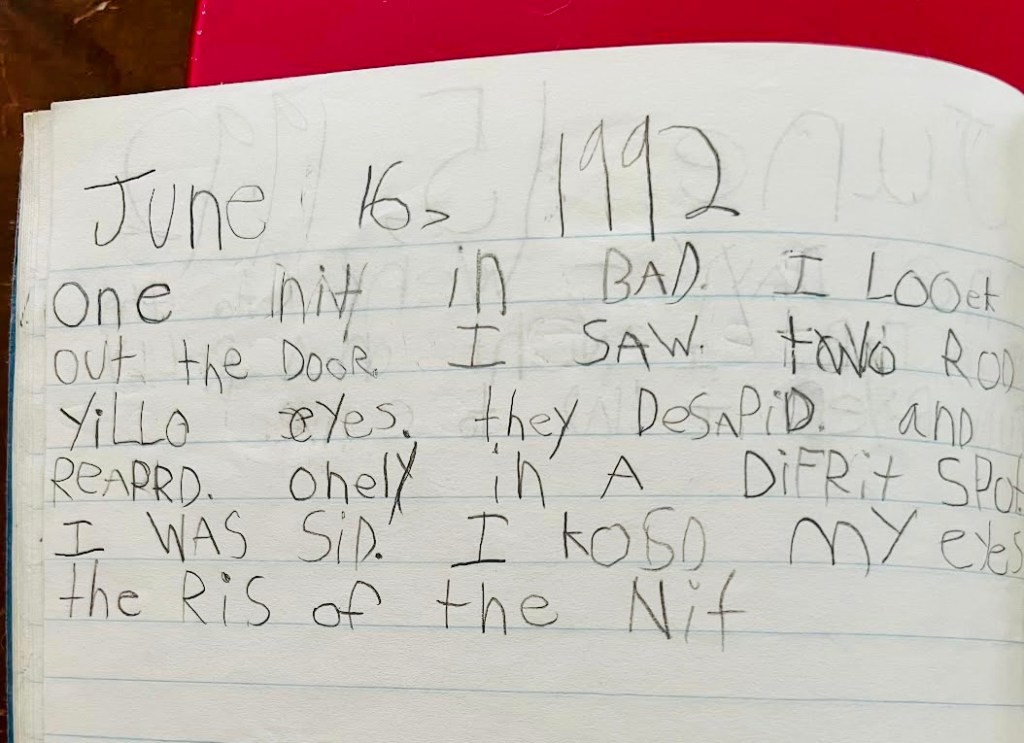
I told my friends about the yellow eyes when I got to school. Who knows if they believed me. I remember drawing a picture of the eyes in crayon. I wish I’d kept that picture. Although I don’t recall doing it, I also wrote about them in my school journal. I found the account last year when my mom gave me back some old schoolwork.
One night in bed, I looked out the door. I saw two round, yellow eyes. They disappeared and reappeared. Only in a different spot. I was sad (scared?). I closed my eyes the rest of the night.
After my encounter, I couldn’t tolerate a dark bedroom. I slept with a nightlight up through my first year of college. I’d still have one if my husband didn’t need utter blackness to sleep. For years, whenever I caught a glint, flash, or reflection at night, that heart-stopping terror would shoot through me. I always thought they’d be back for me. But they never returned.
It wasn’t f*cking headlights
The yellow eyes couldn’t have been lights from a car. There was nothing but acres of woods on that side of the house, no road. And the eyes didn’t light up the room or go along the wall. They moved out into space. Never mind that in the 40+ years my family has lived there, they never appeared again. Unless physics allows lights to bounce off clouds and trees under the perfect meteorological conditions and be projected like a hologram into 3-dimensional space in a dark bedroom, they weren’t lights from outside the house. Neither were they from an animal. We had no pets, and I can’t stress enough how little the glow looked like eyeshine. The only mundane physical explanation would be if someone was in there with dual side-clipped headlamps. That would be a whole other kind of scary story.
The eyeshine of two foxes (or shapeshifting faeries, whatever) chasing me down the beach by the light of the rising full moon. I’m familiar with eyeshine, thank you.
Not a nightmare
Of course, the simplest explanation is that I dreamed the whole thing, and I don’t blame the folks who will dismiss my account as a nightmare. But I don’t believe for a second that I dreamed it. It’s one of my most vivid childhood memories. I can still feel the blanket over my head and the raspy whispers in my throat that refused to become screams. Nightmares don’t affect you for the rest of your life. You don’t think about them every day. I’ve since had a couple other spooky experiences that I’m perfectly willing to dismiss as hypnogogic and hypnopompic hallucinations. But not the yellow eyes. I was wide awake when I saw them and stayed that way for a long while afterward. There was nothing hazy or confusing about it. I wasn’t out of it. I saw something.
What kind of something?
In childhood, the yellow eyes unequivocally belonged to a ghost. At the time, I doubt I had the context for anything else. Demons were red devils with pitchforks, aliens were on the front cover of Whitley Strieber’s COMMUNION, and cryptids were Bigfoot and Nessie. I’ve since changed my mind. If a ghost is the spirit of a dead person or a cosmic playback, I don’t think that’s what this was.
I’ll never know what I really saw, of course. Unless the yellow eyes come back. But I don’t believe they will anymore. Sometimes that pisses me off. It drives me crazy that I don’t know what they were or what they were doing. Other times, I’m terrified that they will return and reveal themselves to my daughter instead of me. She turned 8 last month.
Despite associating them with the closet, I don’t think the yellow eyes were tied to the house. Or there to bother my brother, though they manifested in his room. Maybe it was just a child’s narcissism, but I felt the yellow eyes were there for me. Whatever they were up to, they weren’t minding their own business. The whole blinking out and reappearing closer was a dick move. The maneuver seemed purposeful and threatening. And if their goal was to frighten, then I lean toward the yellow eyes being an ultra-terrestrial—some inter-dimensional entity that gets off on fear.
1800?
The old barn and ell. Both had to be taken down.
The house is old, if you’re curious. Hair in the plaster old. The local historical society has it listed as 1800(?). It was a dairy farm at one point. As far as we know, nothing awful ever happened on the property. My mom still lives there. And I still love it. Even 21 years after moving out, that old farmhouse feels like home. My family and I have had a few other creepy experiences there, and I’ve had times when I’ve gotten some bad vibes, but I don’t feel like the place is haunted.
A supernatural shepherd
Despite how much sleep I lost to yellow eyes, they weren’t all bad. As far as traumatic paranormal events go, they were pretty tame. And they made me believe there’s more to this world than science can explain (yet). If I’d never encountered them, my skepticism might win out whenever I hear a mysterious tale. The yellow eyes fueled an interest in the weird and wild that’s as strong as ever and spurred on an imagination that might have died in primary school. Forever yearning for an explanation, I dreamed up all kinds of monsters and entities to which the eyes might have belonged. In my teens, I started writing about a little girl who wakes up to the yellow eyes of a monster staring at her in her bedroom. That little girl eventually became Sarlona. And the monster morphed into Dagmar. So, if not for the yellow eyes, DRAINED might not exist. An entire (fictional) world might never have been.
So, maybe the next time I’m at Mom’s without the kiddo, I’ll leave both bedroom doors open and thank the void.








 K.W. Bernard