

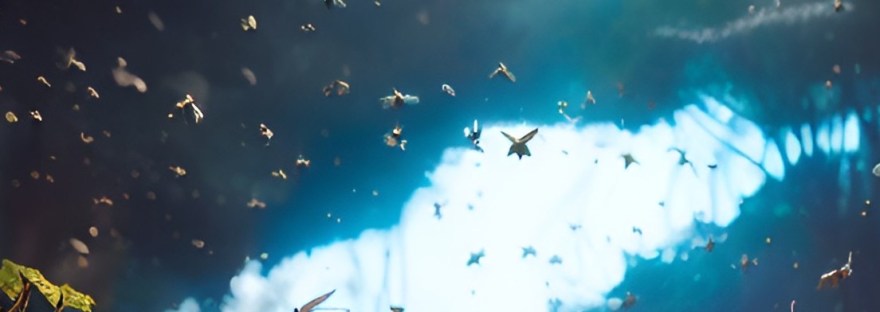
Black flies are a fixture of springtime in Maine, so much so that they’ve been nicknamed the Maine state bird. We have more than 40 species! They swarm from our woodland streams and descend en masse to buzz around our heads, crawl into our orifices, and drink our blood.
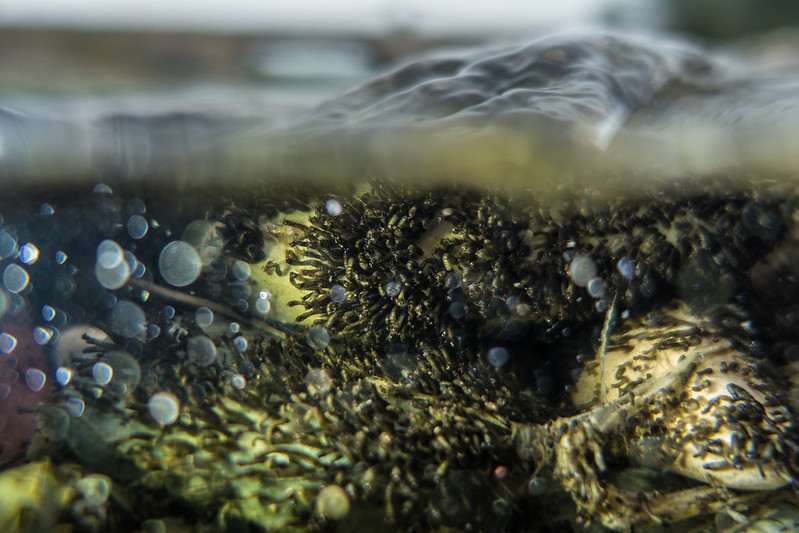
Description – Adults are small, robust, humpbacked flies. They have stubby antennae and a short, stout proboscis. Their color ranges from black to yellow. The aquatic larvae are shaped like bowling pins with one “leg” near their head on the underside. Tiny hooks on their hind ends help anchor them in flowing water. Most species bear two fanlike structures for filtering food from the current.
Distribution – Black flies inhabit every continent but Antarctica.
Habitat – Black flies need clean, moving water for their larvae. We find them in abundance near rivers, streams, and brooks. Since they can’t thrive in waters where dissolved organic matter is high or dissolved oxygen is low, their presence often signifies a healthy environment.
Life Cycle – Black flies have two different life cycles, depending on the species. Some overwinter as eggs, but most spend the winter as larvae. Females lay eggs in or near the water. After they hatch, larvae anchor themselves to rocks, logs, and other underwater objects by weaving a silk pad and hooking onto it. If the current doesn’t provide much to eat, they can let go and hope for better feeding grounds downstream. Because they breathe through their skin, they need highly oxygenated water to survive. When ready to pupate, most larvae build a silken cocoon underwater, usually in the spring after overwintering. Most adults emerge in April or May, riding an air bubble to the surface. Some species have multiple generations annually and produce biting adults throughout spring, summer, and early fall. I’m fortunate to live nearby a river that harbors one such species. Scientists have studied few black fly species in depth, but some appear entirely female, reproducing asexually.
Diet – Female black flies require blood to nourish their eggs, but like the males, they feed on nectar for their own energy. Some are opportunistic, biting whatever mammal or bird is available. Other black flies are picky, specializing in one group of animals or even one species. Simulium annulus, for example, targets loons. Some hunt humans voraciously, while others have no interest in us. A few species like us enough to circle our heads incessantly and try to burrow into our tear ducts, but rarely bite. The larvae feed on microorganisms, filtering them from the water using fanlike mouthparts.

Bites – While their antics and the welts they leave behind are maddening, blackflies aren’t the public health threat ticks and mosquitoes are–in the U.S. In some parts of the world, they cause tremendous misery through the diseases they transmit, river blindness being one of them. That’s not to say bites are harmless here. They tend to swell and bleed. A few hours with black flies leave some people looking like they just finished a bar brawl instead of a hike. How much and for how long depends on the person and previous exposure. Folks accustomed to them generally don’t react as much. Likewise, those first few bites at the beginning of the season often balloon up, but subsequent attacks leave milder welts. Sometimes individuals develop a sensitivity, however, and their reactions worsen as time goes on. And, while they’re not known to vector pathogens to humans in the U.S., they can still make us sick. When injected from numerous bites, their toxic saliva may cause fever, headaches, nausea, and swollen lymph nodes.
We don’t just have to worry about ourselves, either. Even up north, black flies can transmit disease to livestock and poultry. Occasionally, one hears a horror story in which the black flies are so thick that animals die via smothering, exsanguination, or toxic shock from their bites.
Battle Plan – Black flies are a byproduct of thriving streams and river restoration, so little opportunity exists to target them at their source without severely harming the environment. Bacillus thuringiensis var. israelensis, a bacterium that kills only mosquitoes, black flies, and similar species, is the only reasonable chemical option to control the larvae. Some states have regional control programs and apply Bti aerially. Maine doesn’t, and applications require a permit from the DEP unless the stream is contained entirely on one property.
Because females can fly miles seeking a blood meal, adult-killing sprays seldom provide control for longer than a couple of days.
Rather than trying to wipe them out, in Maine, the strategy with black flies is to discourage bites. Unfortunately, since they rely more on sight to target their victims, DEET and other insect repellents aren’t as effective against them as against mosquitoes. Avoidance and mechanical barriers will work better. Cover up, knowing black flies will crawl through any gap in clothing they can find in search of juicy flesh (they’ve figured out buttons), and dark colors attract them. A trick I learned from my dad is to coat a plastic sun helmet or hard hat in mineral oil. When the flies land on the helmet, they get stuck and suffocate. But I recommend a quality head net if the black flies are thick.
Black flies are annoying, but they’re the price of living, working, and playing alongside nature. The good news is that they don’t typically follow folks indoors and only bite during the day. They’re easy to shake if you have shelter.
Resources – For more on black flies, see:
UNH Extension Black Fly Fact Sheet
 K.W. Bernard