
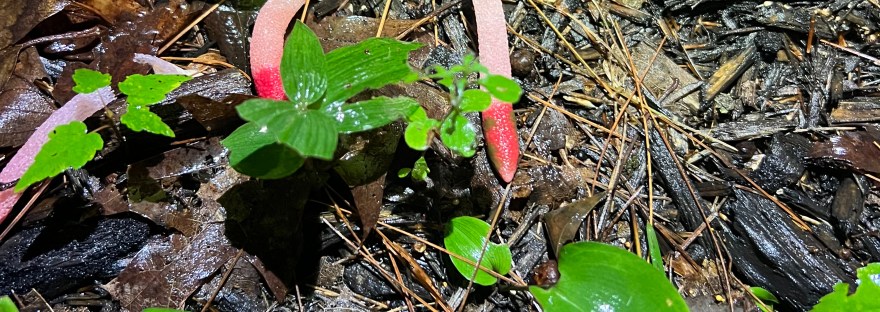
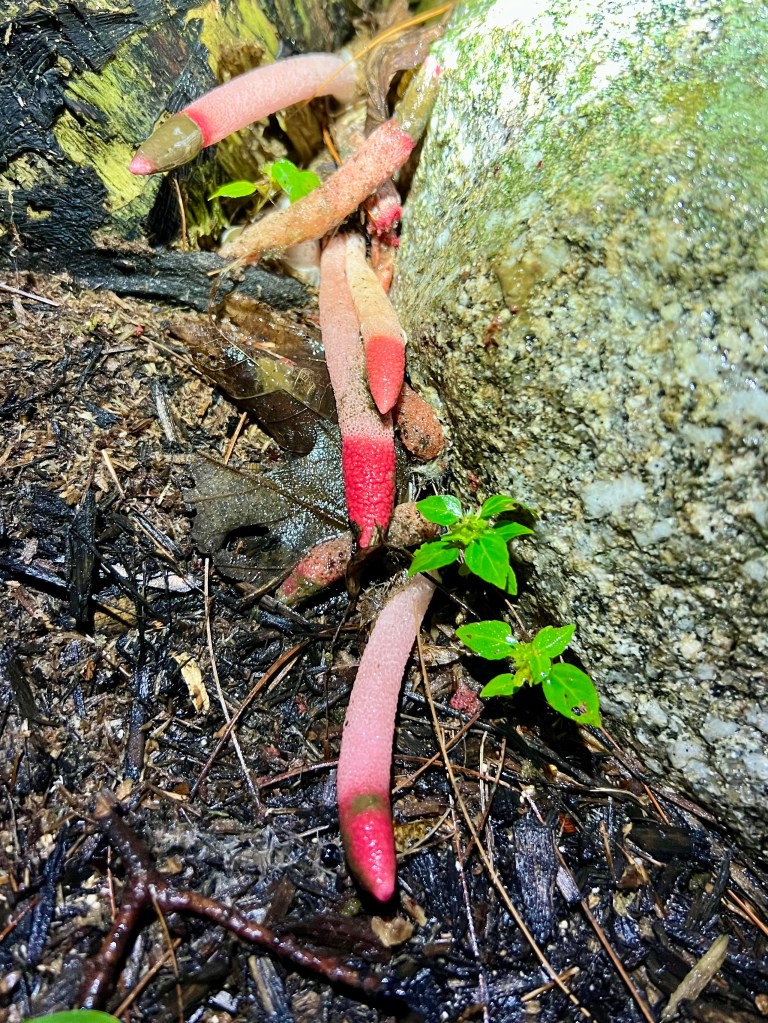
These aren’t the netherworld tentacles I wanted!
Disappointingly, they’re not abyssal tendrils at all. Or spilled gummy worms. They’re fungi–Mutinus elegans, I believe. Mutinus was a Roman phallic god, so translated from Latin, the scientific name appears to mean “elegant penis”. It belongs to the Phallaceae family, too. Mycologists are a dirty bunch, I guess. In their defense, these are the reproductive structures of the expansive fungal organism below ground.

The common name of these fungi–stinkhorn–is less sexy but perhaps more appropriate. It comes from the reeking, slimy brown patch they develop near the tip of the fruiting body. The stink attracts flies, which pick up the fungal spores and disperse them. This reproductive strategy, reminiscent of flowering plants’ tactic of attracting pollinators, is rare in fungi. Usually, they rely on wind and water to move their spores. Stinkhorns are also called witch’s eggs for the small egglike structures that precede the mushroom on the soil surface. Mutinus elegans also goes by the best epithet of all–the devil’s dipstick.

Contrary to its names, smell, and appearance, M. elegans is pretty inoffensive. It’s a saprophyte, decomposing woody material for nourishment and is considered non-toxic. Although some folks eat stinkhorn fungi, I wouldn’t recommend taking the devil’s dipstick internally.
These things caught me by surprise when I brought the dogs out in the rain last night. It was my first encounter with the devil’s dipstick, so I hope I identified it correctly. Though they apparently pop up in mulch beds often, the fruiting bodies don’t last long, so they’re easy to miss. Sometimes, they sprout overnight and are gone by morning.
I’m glad I encountered them this time. What a creepily cool life form.
Resources:
University of Florida Extension
 K.W. Bernard