Monster of the Month – Full Moon Faerie Foxes

There’s nothing like a quiet beach on a clear night. Black waves breaking under a canopy of stars hold a special kind of magic. Never more so than when draped in the glittering light of the full moon.

My grandmother taught me that. When I was little, she’d take me for walks on the beach long after sunset, and I’d sit with her and watch the moonrise. To this day, I search for glimmers of divinity in the night sky over the Atlantic. It sustains me through gray, dead days.

The beach at night is pure magic.

So, for me, walking the beach at night is a ritual. Flashlights aren’t allowed, and footwear is discouraged. The magic happens when I’m wrapped in the dark with sand between my toes. But in October 2020, I may have gotten more than I bargained for.

Pink lingered in the west, and the evening’s first stars had just sparked to life when I ventured out onto Wells Beach. It was the perfect time for a walk—the weather was mild, the tide was low, and hardly anyone was around. I’d planned to trek the 2/3 mile to the jetty and watch the full moon rise from atop it.

Things first got a little weird when I passed a group of college-aged men standing around drinking. I thought I’d given them a wide berth, but one of them had a young dog on a super long rope. The dog charged, and before his owner could reel in the slack, he leapt and gave me a big puppy kiss on the mouth. Normally, I wouldn’t have cared—I love dogs. But this was still early in the pandemic, before the vaccine, and these guys weren’t social distancing. The man apologized, and I played it off, but it shook me a bit. Little did I know, the excitement was just getting started.

Clouds swallowed the remaining light, and dusk deepened into night. By the time I reached the jetty, it was much too dark to climb it safely. In fact, with the moon still tucked behind the sea, the night was so black that I felt a little disoriented. Though the clouds threatened to ruin my plans to watch the moonrise, I figured I’d stick around to see if they broke enough for a glimpse.

The stars are brighter over the sea.

As I waited, the darkness kept shifting around me. I couldn’t see more than a few feet ahead but sensed movement. Other people had arrived in hopes of watching the moonrise as well. That wasn’t surprising since most parking for the beach is by the jetty. Why shouldn’t other folks want to enjoy the full moon rise in such a lovely spot? It wasn’t late, after all. But the meandering shapes kept wandering uncomfortably near, especially for 2020, and none spoke to each other. They drifted silently about like ghosts. Until I heard the familiar, stuttered scratching of canine paws digging through sand. It wasn’t the people who kept coming so close but their loose dogs. Two pups had started excavating beside me.

I’d already had my fill of uncontrolled dogs for one evening, and I didn’t want to twist an ankle in one of their holes, so I backed away. The clouds were thinning anyway, and I’d been too near the jetty to view the rising moon over it.

Generously, the sky’s downy curtains soon parted to reveal the gorgeous harvest moon as it ascended over the jetty. Big and orange, it almost resembled the sun, spilling its magic across the sea and sand. I tried to let some of it seep into me and forgot about the other people and their dogs.

If you follow me on social media, you know how much I love to take photos that capture even a sliver of nature’s splendor. I couldn’t let such a glorious moon go undocumented! So I pulled out my phone and snapped a picture. Unfortunately, I made a critical error in iPhone night-sky photography—I accidentally left the flash on.

The photo taken with that fateful flash. The two smaller bright spots are eyeshine from the foxes.

Everything changed in that offensive burst of artificial light. There were no other people. There were no dogs. I shared the moonrise only with a pair of foxes. They instantly fixed their glowing gazes on me, bared their fangs in devilish grins, and, to my utter shock, trotted right toward me as though I’d called them.

For a few seconds, I did what you’re supposed to do when a wild canid comes your way—I stood my ground. Using my angriest dog-mom voice, I shouted, “No.”

They didn’t so much as break stride.

I instinctively backpedaled a few steps and yelled something ridiculous like, “No, you stay there.” They kept coming.

Shoving my phone in my pocket, I turned and sprinted as fast as I could. After twenty to thirty seconds, I looked over my shoulder—they were trotting after me, keeping pace. I ran hard down the beach for about half a mile before glancing back again. This time, they were gone.

My pursuers had similar smiles.
Photo by Holly Keepers, USFWS.

They could have caught me, of course. Foxes can sprint around 30 mph. Fortunately, healthy foxes don’t attack people. They prey primarily on rodents, after all. But rabid ones have been known to bite, and that was my fear—a peak pandemic ER visit, two dead foxes, and rabies prophylaxis (which can cost upwards of $30,000).

Although this story amuses me now, I can’t convey how surreal this incident felt. It’s been almost four years, and I still think about it often. Of all the foxes I’ve encountered, these were the only ones that didn’t bolt at the sight of me or the sound of my raised voice. Why would foxes run toward a flash of light? Why were they together? How did night get so dark so fast, and then, suddenly, I could see again? Why did I think there were people around me? How did time slow enough during that flash for the foxes to whip their heads at me and grin with wicked delight?

This was the vibe. Photo by Lisa Hupp, USFWS.

The druidic fantasy writer in me knows exactly what happened—the Veil was thin that night. I was in a liminal place at a liminal time, and the moon was full. Either I slipped a little into another realm, or it leaked into this one. Those weren’t foxes. They were faeries—or something—shapeshifting from humanoid to canid as they pleased. Obviously, they couldn’t allow themselves to be photographed. So they thought they’d have some fun with the trespassing mortal.

Of course, the part of me who trained as a wildlife biologist wants an explanation less rooted in faerie magic. The foxes could have come down to the beach to forage for surf clams or crabs—easy pickings at low tide under the cover of darkness. They’d probably had their run of the beach at night all spring and summer, given the nonexistent 2020 tourist season. I’m guessing they were siblings recently run off by their parents or a mother and her straggling kit. Still, it’s hard to reconcile why a flash of light would summon a pair of crepuscular wild animals faster than a cheeseburger summons my dogs. Lights, especially those that turn on suddenly, are often used to haze and deter foxes and other midsized predators. The best explanation I can come up with is that someone had been feeding these animals at night by flashlight. When they saw the light, they thought I had something for them.

Or maybe they were rabid. Infected animals often lose their fear of people, and foxes comprise a significant portion of documented rabies cases in Maine. But if illness had driven this pair mad with aggression, they missed the perfect chance to go berserk and bite when they were digging next to me. Besides, it seems unlikely that two rabid animals would hang together and react identically to a stimulus.

So, I think these were habituated, food-conditioned animals. That’s not as scary as rabid ones, but it’s still bad for the foxes. It increases their chances of conflict with humans. Wildlife managers inevitably get involved when foxes start approaching people in public spaces. Had one nipped or scratched me, innocently trying to get chicken nuggets to pop out, that would have been it for them. They’d have been hunted down and decapitated for rabies testing. So, don’t feed wild animals. And be careful if you’re alone at night when the Veil is thin. You never know what might slip in from another realm and stare at you with a hungry smile.

Foxes – Maine IFW

Rabies Data – Maine CDC

Food-Conditioned Red Fox Killed – NPS

March

March arrived with lengthening days, fluffy snow, and warmer temperatures. Morning light means I’m jogging again (and limping around the rest of the day). The freezing nights and warm days midmonth had the sap flowing faster than I could keep up with. Every year I plan to upgrade my equipment. Yet again, milk jugs hung from my trees. Want to tap trees yourself next year? Check out UMaine Extension’s backyard sugaring resources to learn how to do it right.

Drained debuts next month! NEXT. MONTH. 

I’m seriously losing my mind knowing that these characters I’ve lived with for so long are going out into the world🎉And…I have a cover! Here’s a sneak peek!

Happy Vernal Equinox

The first day of spring was March 20th. Modern druids celebrate it as Alban Eilir. It’s a time to welcome burgeoning life, contemplate the balance of light and dark, and honor the maiden and stirring sun deities.

In the News

I made the newspaper! Not for my writing, though. It had to do with using hydrogen peroxide on houseplants. Unfortunately, some of the information I tried to convey was lost, and there’s a bit of a misquote at the end. Here’s the critical part of the message—don’t make your own pesticides. If you want to control a pest with a chemical, choose a registered product labeled for that use and follow the directions perfectly. 

Maine Magic

A sunny day after overnight snow is called a bluebird day. There’s something magical about the crisp white against the deep blue sky.

The Menagerie

We had Ray neutered this month. It hasn’t slowed him down at all. Reld’s transformation into an ogre is almost complete.

Happy Birthday

My amazing grandmother turned 90 this week. Happy birthday, Gram! 

See you in April!

March Monsters of the Month – the Kraken

A devotee to the god of the sea and desperate to shake her pursuers, Sarlona calls upon the denizens of the deep to help her escape when cornered on the beach. Chief among them is the kraken—a sea monster believed to rend ships and devour sailors. Although depicted as a massive octopus in Scandinavian lore, the kraken in Drained is described more like giant or colossal squids (Architeuthis dux and Mesonychoteuthis hamiltoni), the sightings of which probably inspired the original tales.

Like the kraken, the massive squids inhabit another world—those ocean depths we humans have only gotten glimpses into. So far, scientists have had to base their conclusions about the species on dead or dying specimens and a few video recordings. What we do know is that they are, in fact, giants. They’re also voracious predators.

Description. Earlier this month, I made the regrettable mistake of wearing an octopus t-shirt to the doctor’s office, where no less than three people assumed that my garb wasn’t an aesthetic choice but a mark of my expertise. They all wanted to know the difference between an octopus and a squid. While no tuethologist (cephalopod biologist), I did have an answer. Generally, octopi have eight appendages and spend most of their time on the sea floor. Squids have ten appendages and swim open waters.

Try as I might, I could not convince an AI art app to make a squid-like kraken.

Those ten appendages come equipped with toothed suction cups meant for wrapping around wriggling flesh and not letting go. Two of them, the tentacles, are longer than the others and designed to snatch prey at a distance. The colossal squid’s tentacles bear horrific, swiveling hooks at the ends. Including the tentacles, giant squid specimens have measured as long as 43 ft. The colossal squid has shorter appendages but is heftier, with known weights exceeding 1000 lbs. Ranking as the largest invertebrates on earth, I think it’s safe to say both species live up to their names. Of course, no one knows how big they might grow in the abyss. With eyes the diameter of a basketball, their eye size is perhaps more impressive than their overall dimensions. These monsters have bigger eyes than any other animal—critical for detecting the tiniest trace of light in the depths.

Distribution and Habitat. Giant squid have been documented in temperate ocean waters worldwide. Colossal squid dwell in the Southern Ocean. The giant squid inhabits only the deep sea, usually at depths greater than 1000ft. Those found near the surface are often injured or dying, their delicate, red skin observed torn and ragged.

Diet. Giant and colossal squids eat fish and smaller squid. They may lure their prey nearer with bioluminescence, emitting light from either their skin or eyes at will. The lorkai, though unrelated to cephalopods, can also make their eyes fluoresce. While once believed to feed rather passively, video footage in their natural habitat shows that giant squid are probably active hunters like colossal squid. Squids are fast. They swim using jet propulsion—sucking in water and squirting it through a siphon to shoot forward while steering with their mantle fins.

Giant squid themselves are prey for other animals, especially when young. Sperm whales and deep-sea sharks feed on even adult giant and colossal squids. In addition to the toothed suckers that scar the skin, giant squid shoot ink to dissuade their predators. However, their eyes are probably their best defense, able to detect hungry whales at a distance in extreme darkness.

Life cycle. We know little about giant squid reproduction, but scientists believe males inject sperm packets into the arms of females. Those females disperse millions of fertilized eggs. The lucky few squid to survive to maturity grow tremendously fast—giant squid only live four or five years.

Monster? There’s no solid evidence that giant (or colossal) squid rise from the deep to attack boats and snack on sailors like the kraken was said to. They seem only to come to the surface when dead or nearly so. But there is a strange tale or two of mysterious marine life latching onto boats and dragging them to a standstill in modern times. And smaller, better-studied cephalopods can put up a hells of a fight on the deck of a boat and have even attacked divers. So, while it probably can’t be blamed for sunken ships, the giant squid’s size, toothed suckers, and mystery qualify it as a monster in my book.

If you want to know how successful the kraken is in defending Sarlona against monsters of a different sort, check out Drained next month.

Resources: Giant and Colossal Squid Fact Sheet, Smithsonian Ocean, Marine Bio Conservation Society, and the Ocean Conservancy

February

February is almost over, and what a month! It arrived with a burst of subzero temperatures in Maine. In the first week, it plummeted to -22 F, -44 with windchill. Two weeks later, it was raining. My dad, who just turned 73, said it’s the first time in his entire life it has rained on his birthday. Find a middle ground, February.

Big announcement! My debut novel, Drained, will be released on April 10th by Champagne Book Group! Becoming a published author is a dream come true for me. I can’t believe it’s happening!

A powerful druidess overlooks a calm, moonlit sea, oblivious to the encroaching nightmare.

Maine Magic

One of my favorite February photos, taken in my backyard at sunrise.

The Menagerie

Our pug mix, Reld, had surgery to remove a rapidly growing lump from her throat. The tumor came back benign, and she’s healing up well. The new puppy, Ray, started doggy daycare this month. We hope it will make him less neurotic than Reld. Pan, the forest cat, continues to accompany me on my winter walks in the woods. Summer cat’s new hobby is taking my gloves off the shelf by the door and depositing them around the house. I have no idea what she’s trying to accomplish. My human kiddo scored her first basket at her first game of the year.

See you next month!

February Monsters of the Month – Lorkai

This first one’s mine. My novels center around the lorkai (singular and plural, like moose). These monsters feed on magical energy. They’re a caster’s worst nightmare.

Like any good immortal species, lorkai are preternaturally strong, fast, and have powers over the mortal mind. What makes them unique is their ability to control humanoid physiology through physical contact–one touch, and it’s over. They steal your energy, your free will, and maybe your life.

If they feed on someone without magic to spare, they take life force. And when they drink from someone bursting with spells, they leave them helpless and enfeebled. The more powerful your magic, the better you taste. That’s what makes poor Sarlona the perfect prey.

These are the monsters that little mages check under their beds for at night, afraid they’ll be left as a drained husk or carried off and kept as livestock. They’re not supposed to exist.

It turns out they do. There just aren’t many left.

Lorkai are almost impossible to recognize when they want to stay hidden. If you had a magnifying glass, and they deigned to allow an inspection, you might notice the fine seam that runs up the undersides of their arms from the wrist. That’s where they hide their carpal blades—nearly unbreakable swordlike claws that they keep tucked away like folding knives. They use them to drink the magical energy from the earth itself, driving them into the ground and draining every trace of life from the soil around them.

When they don’t mind being seen, lorkai are easy to spot–look for the person with the flaming, color-changing irises, ivory swords jutting from their wrists, and glowing fingertips. Of course, if they let you see them like that, you’re probably food.

Their weaknesses? Fire. But it has to burn them to ash. Anything less will piss them off. They also have no magical ability. They can’t cast so much as a cantrip.
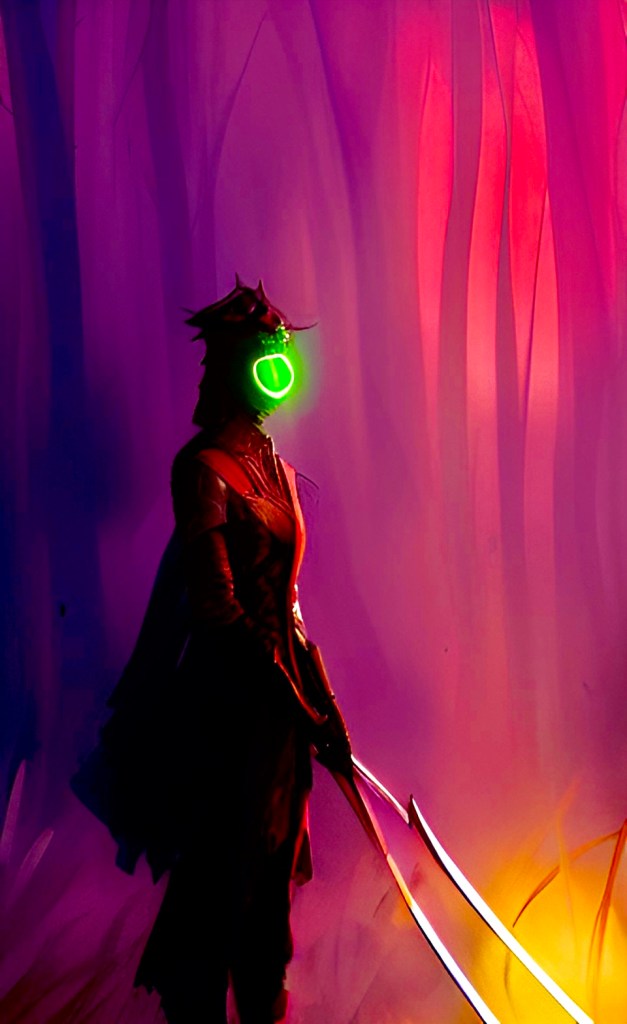
“When I make skin-to-skin contact with a living being, I have complete dominion over their anatomy. Complete. I can make his every nerve scream at once. I can kill the part of his brain that tells him how to swallow. I can rot his heart in his chest, liquefy his bladder, or rip the mineral out of his bones.” -Threats made by a lorkai after two mages wandered into her territory. 

Description. Lorkai are humanoid and indistinguishable from host species when not mimicking prey. Undisguised and at rest, their irises fluoresce multiple colors, often cycling through the visible spectrum every few minutes. Scholars believe this a vestigial trait once used as a form of communication or perhaps a lure to draw mesmerized prey into dark, isolated spaces. Lorkai bear a pair of carpal blades—hinged, swordlike claws that protrude from the inner wrists and can tuck into the undersides of their arms like folding knives. When retracted, the only sign of these appendages is the nearly imperceptible seam into which these appendages disappear. Lorkai use their carpal blades for feeding and defense. Although these claws resemble ivory, they’re stronger than diamond and tougher than mithril.

Distribution. While many believe the lorkai to be a myth concocted to frighten young casters, and others suppose they’ve gone extinct, one remnant population survives in Aven.

Habitat. Lorkai live wherever other humanoid species exist. However, they prefer rural areas.

Diet. Lorkai feed on Marrow—the magical energy that sustains all life. While they can siphon this energy from any living thing, they require the concentrated Marrow of humanoids to stay well. They feed through their fingertips, which glow manna blue as they draw Marrow from their victim. Their abilities allow them to paralyze prey, force them to comply, compel them to volunteer, or augment their memory with the touch.

Lorkai also need the pure, unadulterated Marrow of the earth itself. They feed from it by plunging their claws into the bare ground. Drawing from the land sterilizes it, creating a small dead zone around the lorkai and vaporizing any organisms within range.

Life cycle. Lorkai grow more potent with age. They reach maturity and can reproduce at around a century old. Females can make a child every hundred years or so. Males can only produce one. Young are created from human hosts, fed the lorkai quick. Quick is a highly concentrated Marrow-like substance that changes a host body from the inside out if given around the moment of death. The lorkai regurgitates the reproductive fluid and forces its potential young to swallow it.

The more Marrow-rich the mortal, the more likely they are to survive their transformation and the stronger they will be when made into a lorkai. So casters make for not only ideal prey but perfect children. Unfortunately, some casters find losing their magical abilities too devastating to live with and die by self-immolation.