Beautiful as the sea may be, it’s been full of monsters for millions of years. Perhaps none more fearsome than the megalodon.
With the Meg 2’s release earlier this month and the last few weeks of beach weather upon us, what better time to examine Otodus megalodon—a prehistoric shark of kaiju-like proportions?
The megalodon is an extinct shark species from a dead genus (Otodus) in a lost family (Otodontidae) and the largest ever known. It ruled the seas for perhaps 20 million years, from the early Miocene (23 million years ago) into the Pliocene (2.6 million years ago).
Just how big was it?
It’s hard to say from fossilized teeth and a few vertebrae. Since sharks are cartilaginous fishes, they don’t leave much behind to weather millennia. But by extrapolating from tooth size and what we know about the tooth-to-body-length ratios of living shark species, paleobiologists can make educated guesses about the megalodon’s length.
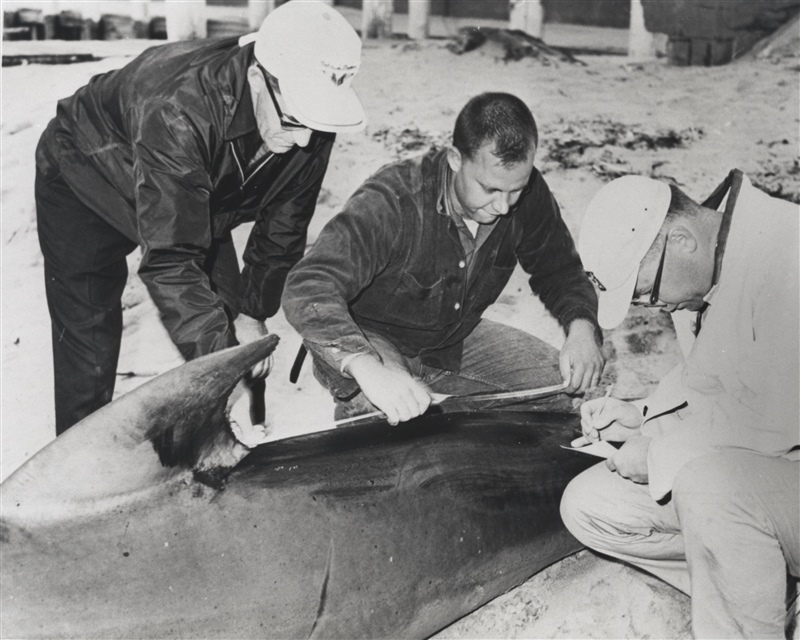
Estimates of the megalodon’s total length vary, but researchers agree it was one of the largest carnivores of all time. Non-megalodon photo courtesy of NOAA Photo Library.
Researchers have estimated the megalodon’s maximum total length to range from around 47.5 to 65.5 ft. Most seem to favor the higher end of the spectrum. Even the lower estimate is more than twice the length of the largest officially recorded great white. Scientists believe the weight of the megalodon may have exceeded 68 tons. That’s more than ten times the weight of a mid-sized African elephant, making it one of the largest carnivores to ever live. While that puts most meat-eating dinosaurs to shame, we can’t say the megalodon was the largest predator. Sperm whales rival its length, and blue whales (which prey on krill) dwarf even the megalodon.
Geochemical sorcery and ecological analogs
Although prehistoric sharks left only teeth and few vertebrae behind, scientists have learned a lot about megalodon biology through geochemical analysis of these remains.
Given that our only clues are teeth and the marks they left, plus a smattering of spine, researchers have inferred a lot about the megalodon. Through modeling using extant (living) shark species as stand-ins and isotope analysis, paleobiologists have been able to paint, or at least sketch, a picture of how the megalodon lived. Admittedly, researchers have based many of their conclusions on great white sharks, which they no longer consider closely related to megalodons. Scientists believe these two apex predators belong to the same order—Lamniformes—the mackerel sharks, but not the same family. There are still good reasons to use the great white as a model, though. It’s the largest lamniform shark that doesn’t filter feed and the only one with triangular, serrated teeth like the megalodon.
Like great whites, megalodons were probably ovoviviparous—they hatched from eggs inside the womb and then were born live. Analysis suggests baby megalodons were already over 6 feet long at birth, a size likely attained by cannibalizing the embryos of their siblings in the womb.
Juveniles would have spent their time in the relative shallows of the continental shelves, where they’d be a bit more protected and have better access to appropriately sized prey. If the “little” guys survived into adulthood, they may have lived for up to a century, roaming worldwide except for the frigid Arctic and Southern Oceans.
Baleen for breakfast
There’s no doubt the megalodon fed on marine mammals. We know this from bite marks left on the fossilized remains of pinnipeds (seal-like animals) and cetaceans (whales and dolphins). Based on the great white’s behavior, we assume it hunted them, but it’s possible the megalodon only scavenged from these animals. Geochemical analysis of the fossilized teeth supports the megalodon’s superpredator status—it was higher up the food chain than great whites. Megalodons fed on baleen and beaked whales up to the size of today’s orcas and probably ate their fair share of squids and other sharks, too. There’s even evidence they tangled with sperm whales on occasion. It makes sense that the megalodon would target giant prey items, not just because it’s so large but to avoid competition with less massive predators. A small whale could have sustained a megalodon for a couple of months.
More than a cold-blooded killer…
Some of the strongest swimming pelagic (open sea) fishes are partially warm-blooded.
Though we think of fish as cold-blooded (perhaps especially those with flesh-rending teeth that devour cute, large-brained mammals), some aren’t. A few fish, like tuna, swordfish, and yes—the great white shark—are partially endothermic (warm-blooded). They can metabolically raise and maintain their body temperature above the ambient water temperature. Although we can’t be sure, most researchers believe the megalodon, like the great white, was endothermic. This warmer body temperature could have allowed megalodons to swim faster (and farther) and exploit a wide range of habitats.
Never too big to fail.
Young megalodons probably depended on shallower nursery areas for protection and abundant prey.
The fossil record indicates the megalodon died out about 3.6 million years ago. Several factors likely contributed to its extinction. Around the time of the megalodon’s decline, the oceans grew colder, and sea levels dropped. Young megalodons may have lost their habitat as shelf areas and their productive waters disappeared. Many small baleen whales went extinct, leaving adults with fewer opportunities to feed when competition with up-and-comers like the great white shark and sperm whales was likely growing fierce. And, while advantageous when one can afford it, endothermy comes with a steep energy bill. With food resources dwindling, it may have become a liability.
Could a few megalodons still lurk in the depths?
Whale sharks can reach the size of a small megalodon, but these filter feeders have wide heads and spots. Photo courtesy of NOAA Photo Library.
While the notion of a prehistoric superpredator surviving in the Mariana Trench only to emerge and wreak havoc in modern times is a spectacular sci-fi premise, there’s no evidence the megalodon’s oceanic reign overlapped with the existence of even the earliest Homo sapiens.
Yes, reports of massive sharks appear online, sometimes accompanied by videos or photographs. As much as I love cryptids and the thought of a supersized shark, these images are far from convincing. Many purported megalodons are easily identified as whale, basking, great white, and Greenland sharks. The vague silhouettes captured in satellite images are likely whale sharks or actual whales. And when the size estimates of these incredible ichthyiods are outlandish even for the megalodon, there’s something fishy going on.
Stuck in the trenches?
“We live on a placid island of ignorance in the midst of black seas of infinity, and it was not meant that we should voyage far.” – H.P. Lovecraft
Don’t get me wrong. I don’t think we know about everything cruising around in the abyss. The USO (unidentified submersible object) folks constantly remind me that our oceans are less explored than outer space. But I’m more willing to entertain the notion that a non-human intelligence or Cthulhu-like monster is plotting its takeover from the Mariana Trench than the megalodon. We don’t know what we don’t know. But we do know some things about the megalodon—it wasn’t a deep-sea shark.
Have no fear. The megalodon is long gone. And if it isn’t, it’s scrounging for deep-sea carrion with the hagfish.
Endothermy would have allowed the megalodon to make nightmarishly deep dives through the thermocline like the sperm whale and the great white shark on occasion but also would have prevented it from living down there. While thermal vents might create some small spa pockets on the sea floor, contrary to sci-fi, the bottom of the sea is almost as cold as ice. Judging by where the megalodon left its teeth (everywhere but the polar seas), it couldn’t tolerate freezing water long-term. The energetic cost would be massive, and we know what the megalodon fed upon—marine mammals. Those have to come up to breathe. So, living in the trenches 13,000 ft below the waters where even the deepest diving among your prey dare swim doesn’t make much sense. Unless the megalodon was just a scavenger of sunken whale carcasses and not a predator. And wouldn’t that be disappointing?
RESOURCES:
A. Collareta et al. Did the giant extinct shark Carcharocles megalodon target small prey? Bitemarks on marine mammal remains from the late Miocene of Peru. Palaeogeography, Palaeoclimatology, Palaeoecology (2017) https://doi.org/10.1016/j.palaeo.2017.01.001
Boessenecker RW, Ehret DJ, Long DJ, Churchill M, Martin E, Boessenecker SJ. 2019. The Early Pliocene extinction of the mega-toothed shark Otodus megalodon: a view from the eastern North Pacific. PeerJ 7:e6088 https://doi.org/10.7717/peerj.6088
Jack A. Cooper et al. The extinct shark Otodus megalodon was a transoceanic superpredator: Inferences from 3D modeling. Sci. Adv.8, eabm9424(2022). DOI:10.1126/sciadv.abm9424
Kenshu Shimada (2019): The size of the megatooth shark, Otodus megalodon (Lamniformes: Otodontidae), revisited, Historical Biology. DOI:10.1080/08912963.2019.1666840
Kenshu Shimada, Matthew F. Bonnan, Martin A. Becker & Michael L. Griffiths (2021) Ontogenetic growth pattern of the extinct megatooth shark Otodus megalodon—implications for its reproductive biology, development, and life expectancy, Historical Biology, 33:12,3254-3259, DOI: 10.1080/08912963.2020.1861608
Skomal GB, Braun CD, Chisholm JH, Thorrold SR (2017) Movements of the white shark Carcharodon carcharias in the North Atlantic Ocean. Mar Ecol Prog Ser 580:1-16. https://doi.org/10.3354/meps
Ah, the mosquito. Who isn’t familiar with it? The buzz in your ear, then the sting as you smack yourself in the side of the head.
And, boy, are they out with a vengeance this year. If you live in the less-paved parts of New England, you’ve probably noticed their higher-than-average abundance. We’ve had one of the rainiest summers on record here in Maine, which means the mosquitoes have found themselves with all the stagnant water they could wish for.
In a typical year, most of these woodland pools would have dried up weeks ago.
I’ve gotten calls for weeks from folks under siege, asking what they can do to manage these marauding monsters, several willing to resort to chemicals for the first time. One client joked about replacing his bug zapper with an electric chair. I can relate. My shadowy, forested lair is a mosquito haven in a dry year. This summer? I’m keeping the dogs on leashes so the conniving culicids can’t fly off with them.
The deadliest animals on earth
Mosquitoes aren’t just an itchy nuisance. They sicken millions annually by vectoring the malaria, dengue, and yellow fever pathogens, among others. The cost is tremendous in some parts of the world, not only in lives and misery but the billions spent to treat those illnesses and manage mosquitoes.
In the U.S., mosquitoes don’t quite hold our health and economy hostage, but they’re still a serious pest and public health threat. Dozens of people die here every year from mosquito-borne diseases, and hundreds more become severely ill.
A dainty demon
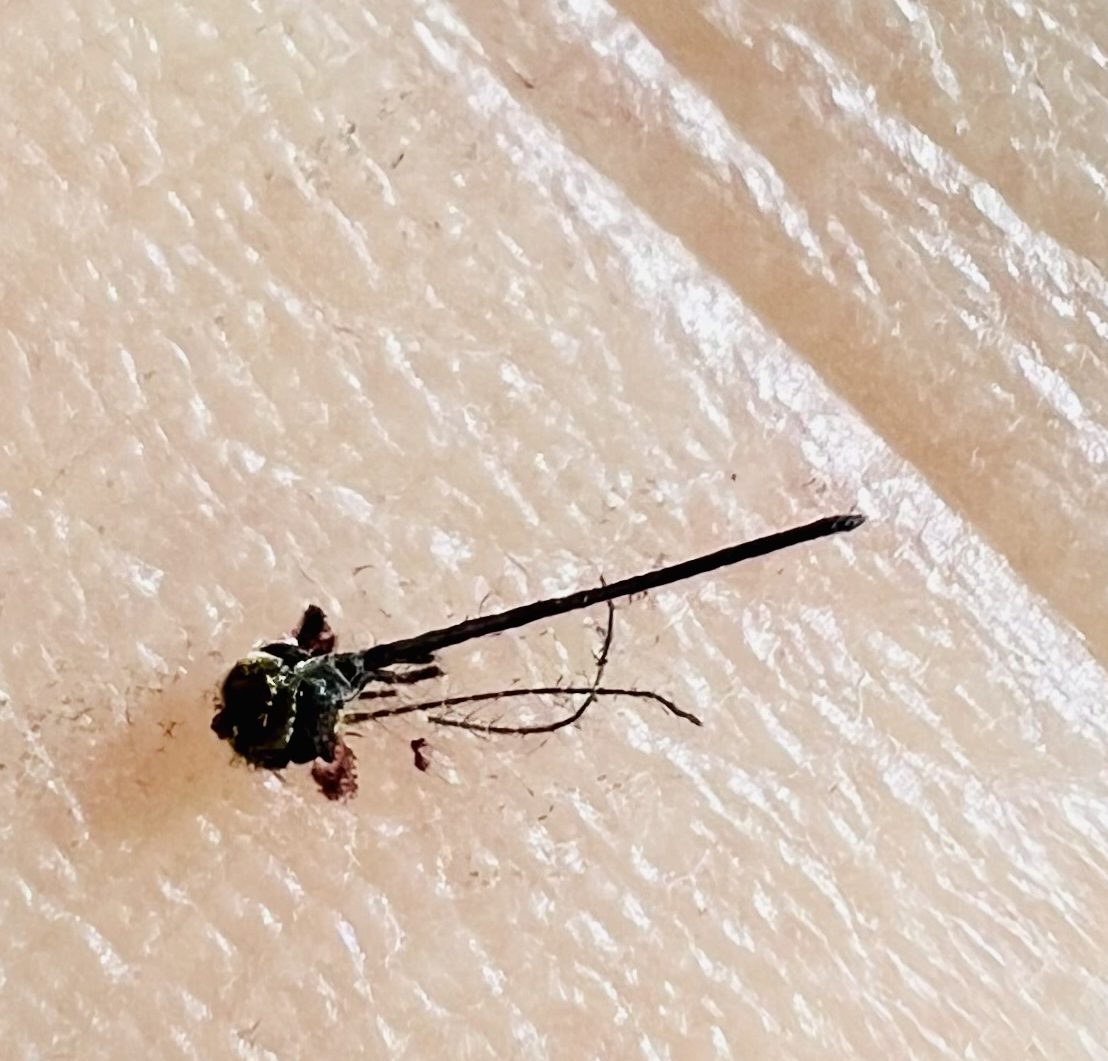
The head and mouthparts of a mosquito that I “accidentally” decapitated in self-defense.
Adult mosquitos are slender and long-limbed. Their scaly wings and the syringes on their faces set them apart from other delicate flies. Very different from the adults, the limbless larvae wield brushes, which they use to strain food particles from their aquatic environment. The heads and thoraxes fuse and enlarge when they become pupae, creating odd, comma-shaped critters, while the abdomen remains free to propel them through the water.
Tropical terror
Mosquitoes even plague the Arctic during the short time when they’re active, sometimes descending in horror-movie-esque swarms.
As with many other insects, mosquitoes are most abundant in the tropics, both in the number of species and individuals. Mosquitoes fly whenever the temperature reaches 50 ℉ and can breed continuously in places where it rarely drops below this temperature, allowing them to run rampant.
That’s not to say temperate regions don’t have plenty. In Maine, we have more than 40 species, and there’s enough flying around that they spill into my home and car every time I open the doors.
The only places mosquitoes don’t terrorize mammals and birds are the Antarctic and, for reasons that scientists have yet to elucidate, Iceland.
The productivity of puddles
Mosquitoes’ life cycles and habits vary widely by species, but they have one thing in common—their larvae need standing water. Without water, mosquito eggs won’t hatch. Depending on the species, as little as a bottlecap’s worth will do. While some mosquitoes breed in relatively fresh, clean water, others thrive in polluted, opaque stews, brackish backwaters, or briny salt marshes.
In Maine and other northern regions, transient pools formed by melting snow provide the perfect mosquito habitat for churning out late spring and early summer biters. Other prime larval habitat includes small ponds, ditches, tree holes, culverts, clogged gutters, unchlorinated pools, rain barrels, buckets, pet bowls, tarps, and tires. Mosquitoes love tires. They don’t love flowing water. So keep it moving or dump it out.
Mosquito life cycles
Females deposit their oblong offspring on the water’s surface or in depressions destined to flood. Some eggs can survive for years, waiting to be unleashed after flooding rains. Once the eggs hatch, most larvae hang out upside down just below the water’s surface. There, they can breathe through tubes or holes on their hind ends and feed by straining microorganisms or decaying matter from the water column until disturbed. Then they’ll wiggle, convulsing toward the sediment to escape predators. The larvae molt three times before they pupate. Unlike most insects during this stage, mosquito pupae know how to get around. They thrash their abdomens to propel themselves toward the depths. Adults emerge from pupae at the water’s surface and float on their cast skins while their wings dry. They can live for up to a couple of months in humid conditions. In warm weather, some species complete their life cycles in a week. Where mosquitoes must overwinter, most do it as eggs or adult females, but a few species overwinter as larvae.
Blood and nectar (I think that’s what I’ll call Book 3)
Adult mosquitoes fuel their flights with sugars from nectar and sap. Though delicious, these fluids don’t supply the proteins needed for egg development. That’s why females hunt for a blood meal before laying their eggs. Some feed every few days to nourish each new batch. A mosquito’s preference varies by species. Though many bite birds and a few feed from frogs, most mosquitoes pursue mammals. Some will drink blood from just about whatever has it.
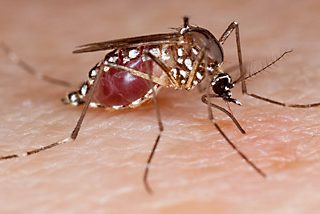
Aedes aegypti, the yellow fever mosquito. This invasive, container-breeding insect is common in the southeastern and midwestern U.S. It can vector several imported diseases. Photo courtesy of USDA-ARS by Stephen Ausmus.
Like any good vampire, the mosquito stalks its prey from the shadows. Plenty bite during the day, but they desiccate quickly out in the open on a hot, sunny day. So, many species concentrate their activity around dusk and dawn. Often some shady vegetation or cloud cover provides all the darkness they need to cause havoc.
Mosquitoes usually hunt within a few miles from home. They make short flights, then rest in protective vegetation, hopscotching their way to blood.
Mosquitoes that create buzz
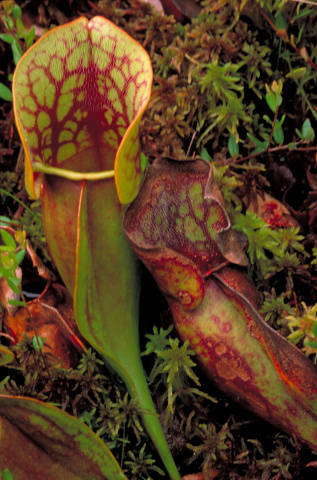
The purple pitcher plant, Sarracenia purpurea, is the center of W. smithii’s world. Photo courtesy of USFWS by Thomas G. Barnes.
My favorite culicid—the aptly-named pitcher plant mosquito (Wyeomyia smithii)—develops in water collected inside the carnivorous pitcher plant. It even overwinters there, frozen in pitcher-shaped chunks of ice. This species doesn’t require a blood meal, obtaining all the protein it needs as larvae from the remains of the pitcher plant’s prey.
One mosquito species, Uranotaeniasapphirina, sucks the blood of worms and leeches.
The larvae of the cattail mosquito, Coquillettidia perturbans, breathe by poking a tube into the oxygen-rich tissues of cattails and other aquatic plants rather than hanging out at the surface.
Females of the eastern salt marsh mosquito (Ochlerotatus sollicitans) will hunt up to 100 miles from their salty origins for blood.
Instead of filter feeding, the larvae of some Toxorhynchites species prey upon other mosquito larvae.
Purveyors of parasitic protozoa
The ability of some mosquitoes to vector Plasmodium parasites, the cause of malaria, makes them humanity’s worst animal enemy. Females of the genus Anopheles pick up these parasites from infected individuals forever after injecting them into people they bite. The parasites migrate to the liver, then multiply before infiltrating and destroying the host’s red blood cells. They’ve been at it since before humans were humans and spread across the globe with us. Today, malaria’s burden falls on poor, tropical regions where it still kills hundreds of thousands (80% of them young children) each year and sickens millions more. But malaria once plagued most of the world, including much of Europe and the United States, up into Canada. With intense mosquito management, improved living conditions, and medical advancements, this disease was eliminated from most of North America. Still, with malaria so prevalent in some areas and so much international travel, around 1,700 cases come into the U.S. annually. The mosquitoes that vector malaria remain here and sometimes bite infected travelers, then feed again, causing localized outbreaks. Fortunately, the quality of medical care and housing available to most U.S. residents makes a large-scale reintroduction unlikely. Although prophylaxes aren’t 100% effective, malaria is preventable and treatable. A vaccine now exists for children.
Arboviruses and the bird biters
In the Northeast, the most dangerous mosquitoes live near us at high densities, feed multiple times, and prefer flying feathered prey, only taking advantage of slow, bare-skinned blood bags on occasion. Since birds are reservoirs for several arboviruses (ARthropod-BOrne VIRUSES), these mosquitoes are the most likely to infect us with a disease. In Maine, the arboviral risk to humans is generally highest in August and September since mosquitoes have had the summer to infect more birds and become infected.
Birds are reservoir hosts for serious mosquito-borne viruses like WNV and EEE. Sick and dead birds can signal an outbreak, but some infected birds appear unaffected.
The arboviruses of most concern are West Nile Virus and Eastern Equine Encephalitis (EEE). Both viruses reproduce in birds and can cause severe illness when transmitted to humans and horses. Researchers believe most infected people never display symptoms, but for individuals who develop encephalitis, permanent disability or death is typical. Young children and adults over 50 are most at risk.
Don’t forget the pet
Mosquitoes transmit heartworm, which kills thousands of dogs each year. A monthly pill can prevent the disgusting nematodes from nestling in our pups’ right ventricles. Though rarer, cats and ferrets can also get heartworms.
The battle plan
Step 1 – Don your armor
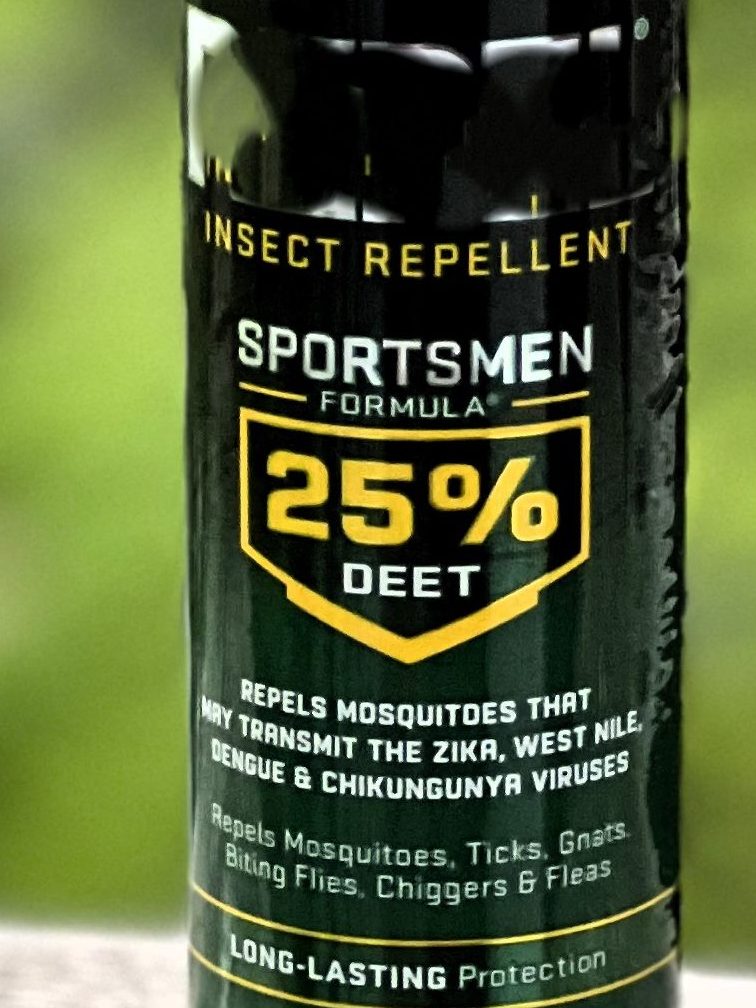
Choose a repellent that is registered with the EPA to prevent bites. DEET is an effective, low-risk repellent when used according to label directions. No product endorsement implied or intended.
Light-colored, long-sleeved clothing and a repellent containing 10-30% DEET should prevent most mosquito bites. DEET has been available to the public for over 50 years and is used by millions annually, with few reports of severe reactions. The Centers for Disease Control and Prevention and the American Academy of Pediatrics recommend using DEET to prevent arthropod-borne diseases in children older than two months. For individuals sensitive to DEET (and those who don’t like the smell or greasiness), products containing picaridin or IR3535 are effective alternatives. Oil of lemon eucalyptus can also repel mosquitoes for several hours but isn’t safe for children under three. When using repellents, always follow all label directions. Do not let children apply repellents themselves.
Step 2 – Destroy the nurseries
This bucket is full of springtails, but could easily breed mosquitoes. Dump out anything that holds standing water at least weekly.
Mosquitoes need standing water to multiply. Although we can’t do much about snowmelt pools and rain puddles, reducing the availability of stagnant water can curtail their population. Anything accessible to mosquitoes that holds water will breed them. Remember, some mosquitoes only need a bottlecap’s worth. So, remove the junk in the yard, turn it over, cover it, drill holes for drainage, or dump it out weekly. Tarps and other coverings should be tight, so they don’t sag and collect water. Change the water in kiddie pools, birdbaths, and pet bowls at least every week. Oh, and unclog the gutters.
Removing habitat used by adult mosquitoes won’t reduce their numbers much but can result in fewer bites. Adults need shaded, protected resting areas to shelter from the sun and avoid desiccation. So, keep the grass mowed and prune trees and bushes to let in as much sun and airflow as possible.
Neighborhood and community-wide management of larval habitat provides the best control. Plugged-up roadside ditches, stormwater basins, and urban wetlands create ideal mosquito breeding sites. Clearing them out makes them less favorable to larvae.
Step 3 – Employ technical superiority
Personal experience tells me mosquitoes will wait at the door until it opens, but if you’re getting bit indoors, repair any holes in window screens and seal any cracks to exclude more mosquitoes. Screens will prevent bites outdoors in small areas, like patios, porches, and gazebos, and mosquito nets for beds, hammocks, chairs, pack n’ plays, and strollers are available.
Propane-powered traps baited with carbon dioxide can catch a lot of mosquitoes but may not prevent bites. They’re not more attractive than a juicy, scantily clad human, so they must be placed between the mosquito source and the people to work.
Step 4 – Summon your allies(?)
Natural enemies are important, but efforts like adding bird boxes or dragonfly eggs probably won’t help a mosquito problem. Never release a non-native species unless you’re sure it’s legal to do so.
It doesn’t hurt to encourage the bats, birds, frogs, fish, and predatory insects that eat mosquitoes, but they’re unlikely to make a dent in the mosquito population. These animals usually target bigger and juicier insects. The western mosquitofish (Gambusia affinis) can control larvae in small ponds, but they should never be released where they aren’t native. They’re illegal in Maine because of their potential to become an invasive pest.
Step 5 – Chemical weapons
Larvicides applied to standing water can provide effective long-term control and come in lower-risk formulations like pellets, briquettes, and water-soluble pouches. Bacillus thuringiensis subspecies israelensis (Bti) is often the active ingredient of choice. It’s a bacterium that kills mosquito larvae by producing a toxin when they consume it. Bti only works on aquatic fly larvae; it doesn’t kill other insects. Unless the water body is confined to your property, individuals need approval from the DEP to apply any pesticide to aquatic sites in Maine, however.
While fogging and spraying for adult mosquitoes has become popular in recent years, except for public health emergencies, this should be the last resort. Government spray programs may reduce mosquito numbers, but the broad-spectrum chemicals often used to kill adults present safety and environmental concerns. And unless the problem mosquitoes are very short-ranging species, spraying for adults on individual properties won’t reduce mosquito abundance for long. These sprays may be helpful before an outdoor wedding or other important event but aren’t a sound long-term management strategy.
Beware of the snake oil peddlers!
Folklore and gimmicks abound around solving pest problems and circulate constantly on social media. Here are some enduring ones about mosquitoes.
Bug zappers – Though the crack of electricity as an insect meets its end might satisfy many of us, that’s about all bug zappers are good for. Yes, they attract insects, but they kill more predators of mosquitoes than mosquitoes themselves.
Ultrasonic devices – These appear to, if anything, attract mosquitoes.
Citronella candles and torches – Citronella oil repels some mosquitoes, but rarely more than a few inches from the candle or torch itself. The number needed to drive hungry mosquitoes from an area would be legion.
Mosquito plants – Similar issue. These plants contain repellent extracts, but that doesn’t mean they exude those chemicals in concentrations high enough to push mosquitoes from a patio.
This fresh-from-the-pack bug band is smelly but useless.
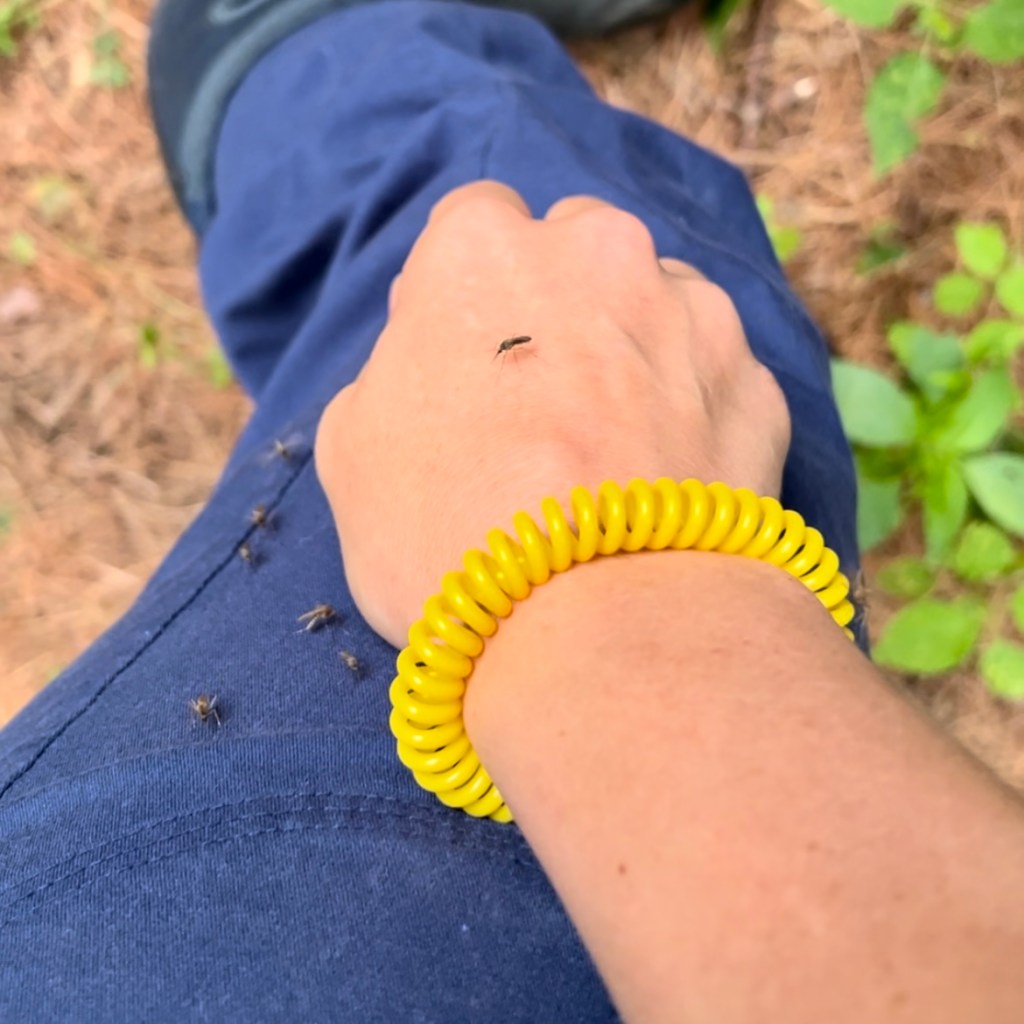
Bands, stickers, and patches – I’ve yet to find a valid study demonstrating that these repel mosquitoes from an appendage, never mind an entire person.
Eating a lot of garlic – Okay, this will make some of us repellent.
So, can we weather this weather?
In most years, Maine mosquito activity peaks in late June. So far, in 2023, they’ve shown no sign of slowing down. The torrents of rain, hideous humidity, and hellish heat have them in rare form. Unless the weather turns dry, we’ll have to wait until mid-September for a reprieve. And we aren’t the only part of the U.S. having a miserable mosquito year. This summer, we’ve seen a handful of folks with locally acquired malaria infections in Florida and Texas—for the first time in twenty years.
I’ve always loved the summer heat, but if it comes with a sopping side of mosquitoes, I’ll take a snowstorm any day.
Resources
Bernard, K.W. 2023. Category 7E Manual: Biting Fly and Other Arthropod Vectors Management. University of Maine Cooperative Extension.
Alone in the woods, you breathe deeply, inviting the earthy aroma to perfuse your being. That cool, energizing air vaporizes the inner fog. Precocious saplings, crowding the narrow path, fawn at your boots and caress your khaki hips. Fresh, bright leaves bob in the breeze. Their supple edges kiss, and their rustling drones like a distant sea, lulling your every anxious thought. The mottled sunlight, filtering from the canopy, dances on the forest floor.
Then you notice the stillness. To your left, the woods don’t waver with the wind. The splashes of green and variegated browns, a match to the surrounding brush, stand frozen. Perfect, yet incongruous. A confounding mural of itself.
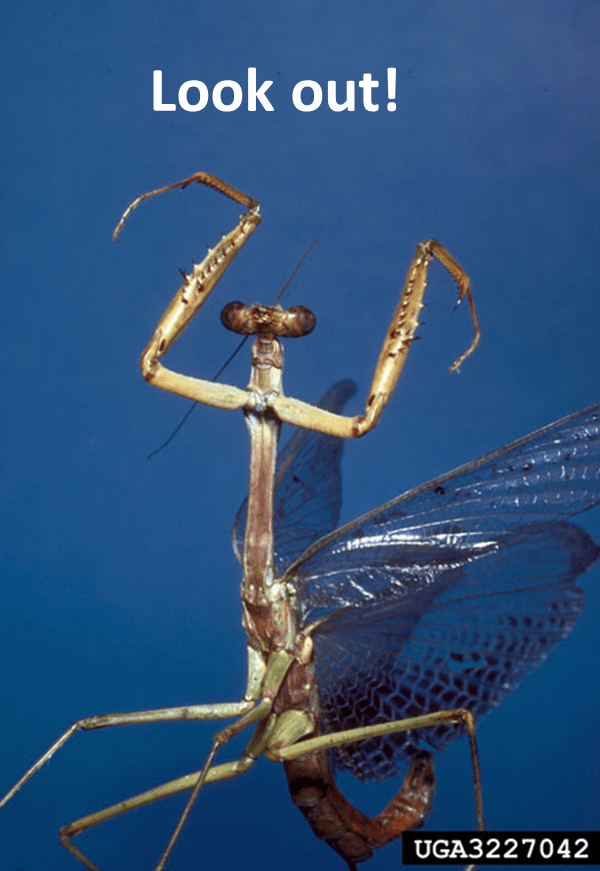
Photo by Ronald F. Billings, Texas A&M Forest Service, Bugwood.org
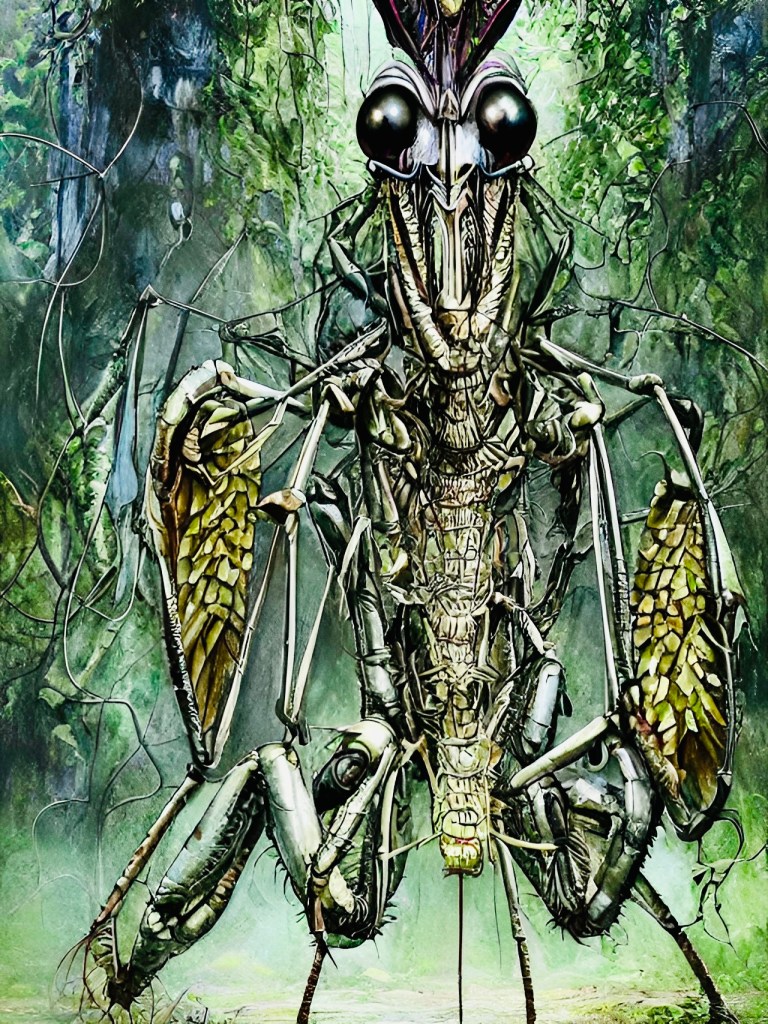
Confusion erodes peace–until you see the eyes. Seven feet up, at the apex of that strange slice of petrified forest, two multifaceted orbs perch atop a triangular, alien head, just as camouflaged as the rest, except for the dark spots resembling pupils. Terror swallows confusion. Below the insectoid head, a pair of massive forelimbs hover, each barbed with razor-sharp spines and tipped with a chitinous scythe. Those terrible weapons hang in a devout fold as if mocking the divine. The monster is unmistakable. A familiar form at an abominable height–a giant praying mantis.
You force your leaden legs backward along the path, and the head turns to follow you. Long, fingerlike projections on either side of its mouth flutter. It splays its jagged, iron mandibles. In a flash, the prayerful front legs explode toward you.
It holds you impaled in its embrace as it eats you alive.
A horrifying hexapod
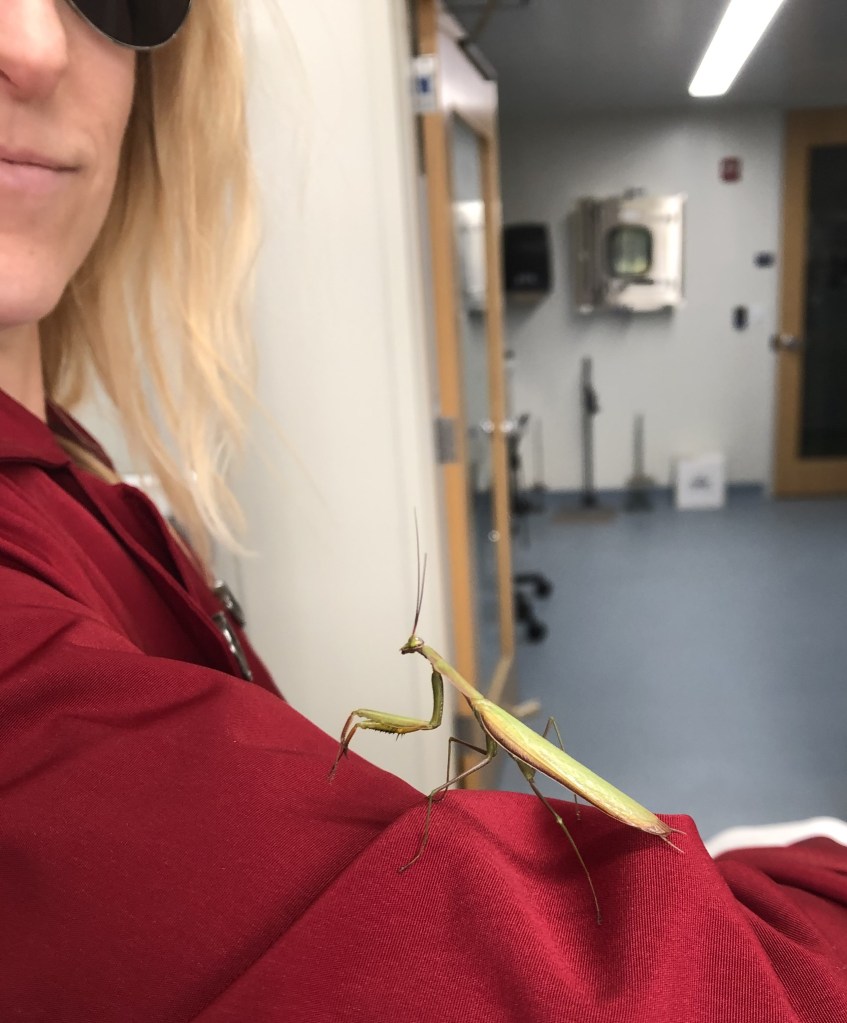
Pondering how she’ll wipe the smirk off my face.
I’m not scared of bugs. My background and job preclude it. But once, I put a waterscorpion (another elongate predatory insect with grasping forelegs) under a dissecting scope. When I peered through the eyepiece, the sight of it made me jump. An alien-looking, 100-millionth-generation predator becomes somewhat disturbing when it takes up one’s entire field of vision.
So, even though I’m close to immune to the insect ick factor, it’s a safe bet I’d piss myself staring into the compound eyes of a giant mantid. And that’s discounting the number of insects I’ve sent to the ethyl acetate gas chamber or how I impaled their corpses for display. Forget the thousands of fire ants that died for my thesis or how my career centers on helping folks vanquish their insect foes. Poetic or ironic as meeting my end between mandibles might be, the sheer hopelessness of the fight is what gets me.
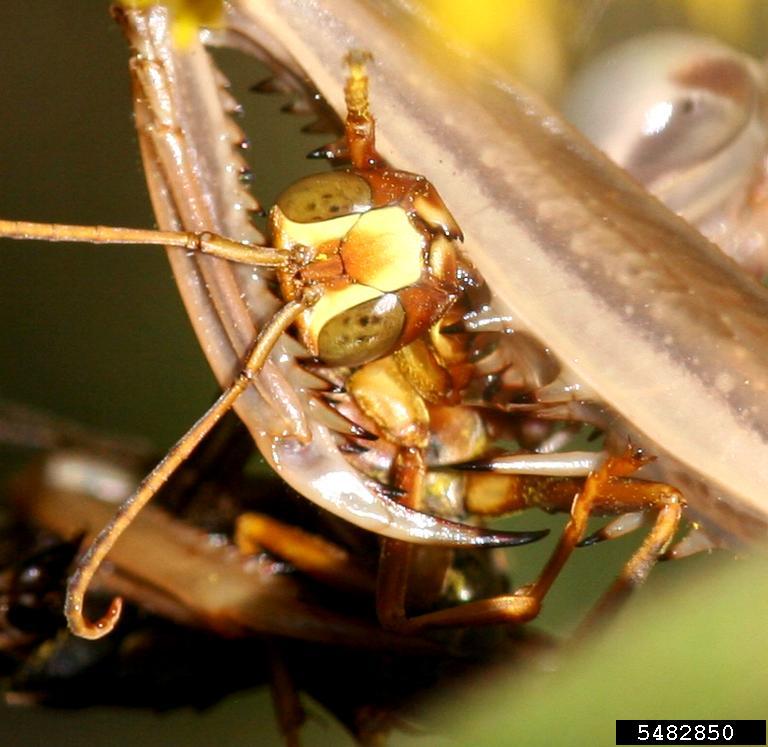
Dude’s f*cked. Photo by Johnny N. Dell, Bugwood.org
You’d have more luck escaping a bear, big cat, or shark. We’ve all seen ants carry ten times their weight. Imagine the strength of a bigfoot-sized bug. And insects have no sensitive snout to punch. A mantid isn’t about to let go if you hit it in one crunchy compound eye. They don’t feel pain like we do. Even if you could get a blade or bullet between the plates of a massive mantis’s exoskeletal armor, the odds of hitting something critical enough to stop it aren’t good. It doesn’t have lungs to puncture. There’s only one blood (hemolymph) vessel to sever. The brain isn’t even a brain. It’s a concentration of ganglia, and insects have independent extras stashed along their length, allowing the function of body parts without input from the head.
Once it’s got you, you’re not getting away.
Worst of all, mantids don’t kill their prey before chowing down. They grab on and start eating without regard for what part they devour first.
Have I put too much thought into this?
Yes. No doubt it’s a dark daydream shared by many an entomologist, but the scenario in which one finds themself standing toe to tarsus with a moose-sized mantid can’t exist.
At least, that’s what I thought until my favorite podcast, Astonishing Legends, put out their 258th episode entitled “Mantis Men”. I’d heard of mantid-like aliens encountered aboard spacecraft, but reports of seven-foot mantis monsters stalking the streams of the Northeast were new to me. Thanks for the nightmare fuel, AL.
Dreadful…or dashing?
Terrifying as a giant, bipedal insect might be, it’s all I can do not to rub my palms together in delight at the mention of bug people, though. I love the concept of humanoid insects so much that I made the magic system in my novels depend on them. So, these encounters, both in the woods and the sky, fascinate me. One aspect I find intriguing is how witnesses don’t characterize the creatures as generic insect folk. Witnesses describe the mysterious entities as resembling praying mantises, specifically.
Mantid mania
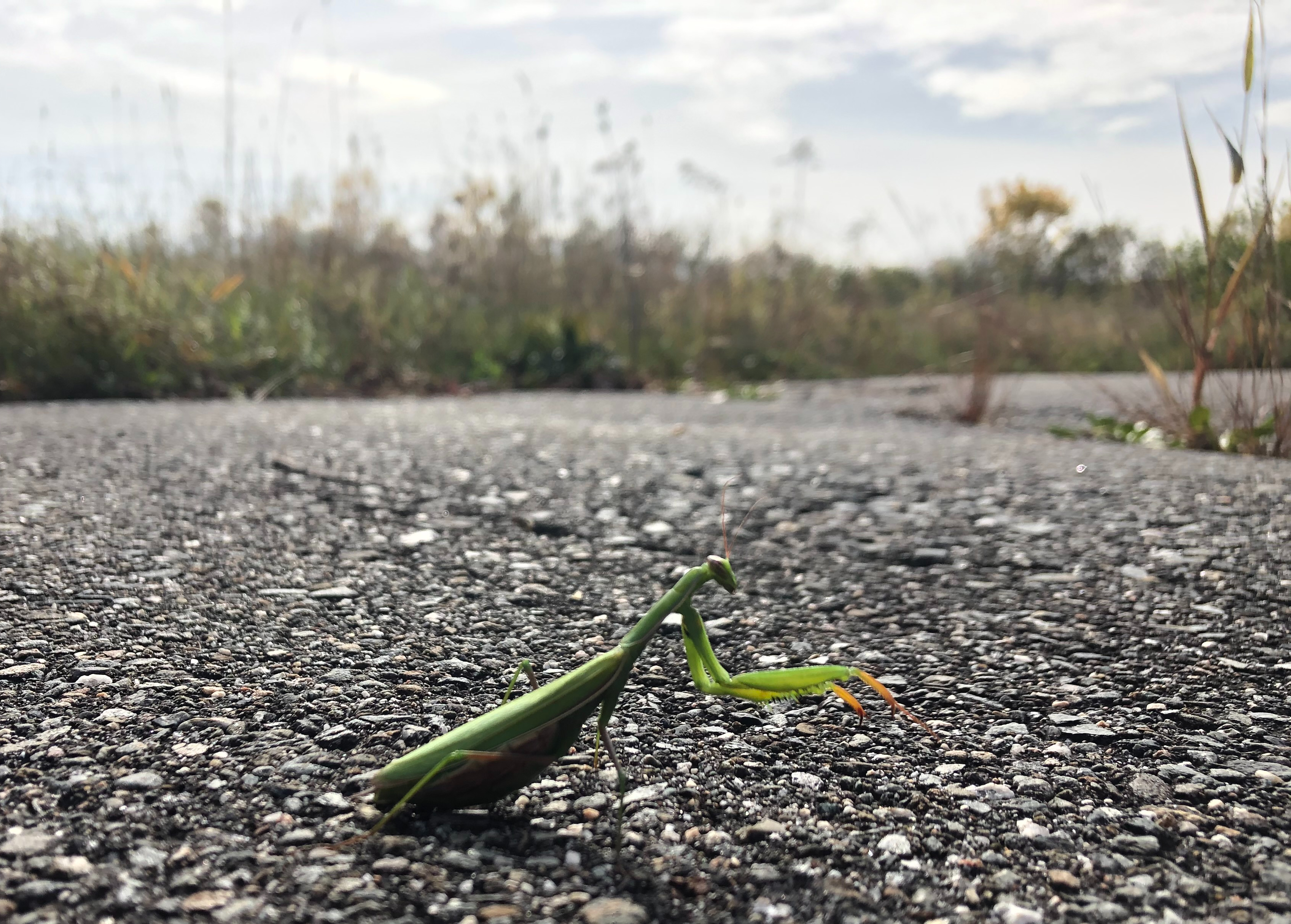
There’s no one I’d rather encounter in an abandoned parking lot.
There’s a reason I fantasize about being ripped apart by a mantid instead of a giant ground beetle. Mantids have captivated us for millennia. Various cultures have granted them a mythical status. They’ve been called soothsayers and necromancers and regarded as good omens and bad ones. Petroglyphs of mantids or mantid men date back at least 4000 years. The creation story of the Bushmen in southern Africa includes a mantid from whom their people were born. In the Egyptian Book of the Dead, a mantid appears as a guide through the underworld. The ancient Greeks put mantids on silver coins, and the Asmat of New Guinea used them as symbols for headhunting. In parts of Asia, they represented fearlessness and inspired martial arts styles, war tactics, and weapons. For centuries, westerners believed they pointed the way home for lost travelers. They were even a fixation in surrealist art for a spell. In pop culture, mantid-like beings appear as giant monsters, comical sidekicks, supernatural femme fatales, alien antagonists, and more. Mantids aren’t the only arthropods to capture our imaginations, but they do it more often than most.
Why?
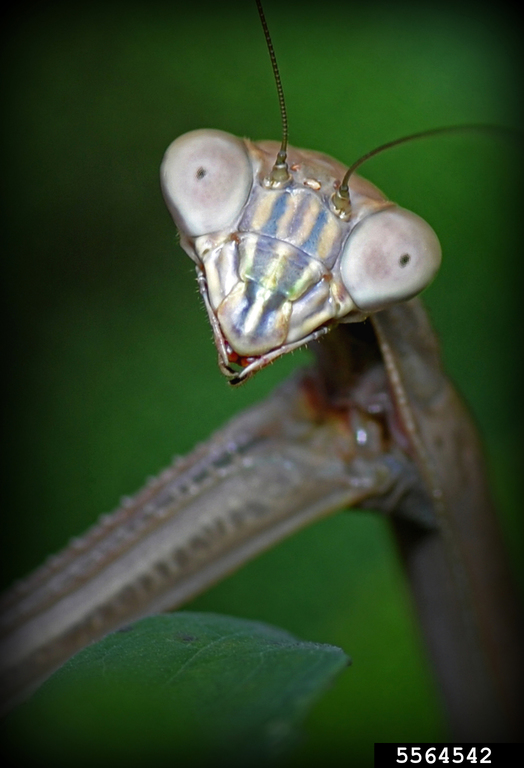
Just look at that loveable face! Photo by Jon Yuschock, Bugwood.org
Mantids win the insect charisma contest. It isn’t just their devout demeanor or large size. Their upright posture, mobile head, and grasping forelimbs make them easy to anthropomorphize. With a black spot in each prominent eye, even their gaze seems a bit human. And it appears to follow us when we move as if they have some unique interest in us. They seem a bit human! That familiarity in an insectoid makes them both endearing and freakishly alien.
Then there’s the whole sexual cannibalism thing. It’s hard to craft a more attention-catching phrase. Female mantids sometimes eat their mate. People love that shit. Or love to be horrified by it.
And, of course, mantids are badass. We adore ferocious predators. Never more so than when they don’t compete with or eat us.
The truth is out there (about mantids)
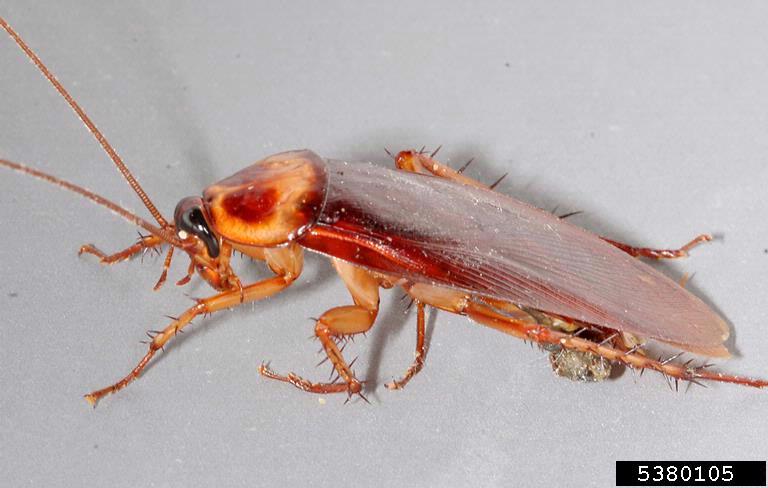
You can almost see the family resemblance. Photo by Gary Alpert, Harvard University, Bugwood.org
Despite their humanoid carriage, nothing about mantid anatomy or behavior is mystical. They’re essentially predatory cockroaches adapted to ambush prey.
Sorry.
That’s not to belittle them! Cockroaches are incredible, too. I’m hard-pressed to think of an insect taxon without some impressive anatomical, physiological, or behavioral trait. But Mantodea (praying mantises) and Blattodea (the cockroaches and termites) are sister orders, united under the superorder Dictyoptera. They share anatomical features and genes that differentiate them from other groups.
What about the eyes that stare intelligently into ours? Mantid eyes are remarkable. As described in the Astonishing Legends episode, mantids are the only insects in which researchers have confirmed stereoscopic (3D) vision–a type of sight once believed unique to primates. However, many animals have it, including other invertebrates, and scientists suspect it exists in other insects too. Regardless, mantid eyes don’t follow us. Our gaze makes the black spots in them move. The arrangement of the ommatidia in the mantid’s compound eyes causes a small dot where the light is absorbed instead of reflected for us to see. Our angle to the mantid determines the position of the pseudo pupils. They can’t “look” away.
That brown thing she’s eating is what’s left of a mantis man who botched his dismount. Photo by Whitney Cranshaw, Colorado State University, Bugwood.org
To the disappointment of many, there’s really nothing lurid about the female’s dining habits either. Many mantids will eat each other, whether they are mates, siblings, or strangers. Since the more diminutive males approach the larger females (boy bugs are usually smaller than girl bugs) while the latter are hunting, it’s no wonder the guys occasionally become food. Cannibalism isn’t so rare in the arthropod world, and the frequency with which it occurs in mantid mating has been grossly exaggerated.
None of that means mantids can’t be mystical (or evil, for that matter). We still don’t know that much about them. However, their position in folklore and popular culture probably says much more about us than them. Mantids aren’t that special.
But are they aliens?
Are mantids aliens? Sure. And they flew here in Unambiguous Aerial Pogoballs.
Mantids are undeniably insects. Are there gaps in the fossil record? Yep. Is the phylogeny of Mantodea, Blattodea, and their relatives settled? No. Insect taxonomy will continue to change with new molecular techniques, paleontological finds, and species discovery. Is it weird they’re the only known insects with stereoptic vision? Maybe, but it has evolved in other invertebrates, too (cephalopods), and doesn’t work the same way in humans and the other mammals that possess it. Genetics, comparative anatomy, and fossils bearing the combined traits of mantids, cockroaches, and termites prove they didn’t come from outer space. Unless, of course, the precursor to all insects did.
Are some aliens mantids?
Search alien mantises, and Google Scholar will return thousands of results. Of course, these mantids are just Earth species that have found their way, via human travel and commerce, to countries where they were once unknown. Search in plain old Google, and Ancient Aliens is front and center. While much less common than encounters with little gray aliens, several reports of encounters with giant mantid-like extraterrestrials exist.
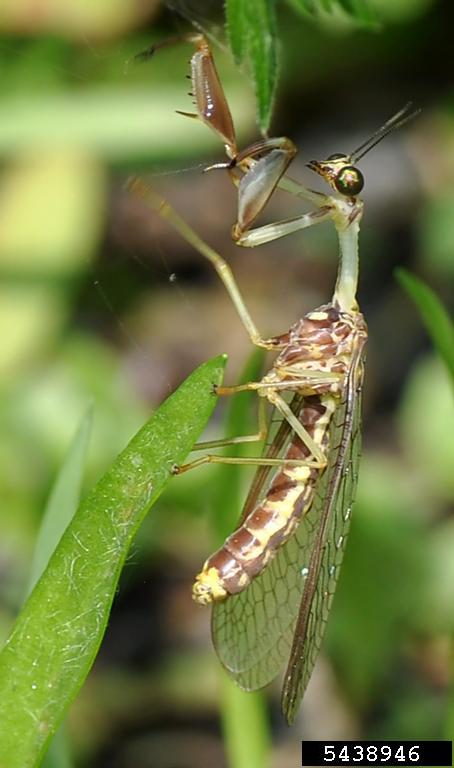
Mantidflies are neither mantids nor flies. Their resemblance to mantids is due to convergent evolution. Photo by Jon Yuschock, Bugwood.org
But resembling a mantid doesn’t make you one (take the mantidfly, a lacewing, for example). What does make a mantid a mantid? The proper answer is probably fraught with insect anatomical terms that I won’t inflict upon you here. Generally, mantids have raptorial forelegs, elongate bodies, and highly mobile heads. So, I feel confident that unless these aliens have long, spiked, grabby arms, they’re not mantids. They’re probably not insects at all. Insects have two antennae, six legs, and three body regions. None of the encounters I’ve stumbled upon report all these features, but I would love to hear more detailed descriptions of the mantis aliens folks have seen. I suspect that if mantis-y ETs exist, their similarity to insects is a case of convergent evolution (when two species develop the same trait independently due to similar selective pressures).
God has an inordinate fondness for beetles.
Insects own this world. For every human on the planet, there are at least a billion insects. One million species have been described, far more than any other group of organisms. An estimated 9 million remain undiscovered. It would be hard to argue they aren’t the most successful macroscopic living things on Earth. So if there are other worlds with environmental conditions and selective pressures anything like ours, it makes sense that similar organisms could evolve. Or maybe, if there is a creator, biologist J.B.S. Haldane was correct when he said something along the lines of, “God has an inordinate fondness for beetles” (of which there are more than 400,000 known species). Maybe the maker loves insectoids so much that they sprinkled bugs all over the universe.
If insects are so great, couldn’t they have evolved into mantid people?
Probably just gearing up to do something awful from a sci-fi novel.
I’ll be the first to say insects can do almost anything, no matter how bizarre. If you can imagine it, an insect that comes damn close to doing it probably exists. I’d wager that every terrifying parasitic scenario depicted in a sci-fi or horror flick plays out somewhere in the insect world.
Hive mind? Retractable mouth? Paralyzed and eaten alive? Inseminated by stabbing? Offspring replaced with parasitic mimics? Losing your limbs to become a feeding and breeding machine? Mind-controlled by a fungus? Shooting blistering acid? Entirely female species? Enslaved with a chemical haze? Infiltrated by vampiric imposters? Born pregnant with your great-granddaughter? Insects do it all.
But there are some limits.
Behemoth bugs
There’s a reason we’re not riding dragonflies to work and hiding from the giant ants that want to drag us underground to tend their larvae. Bugs that big couldn’t survive. The insect respiratory system doesn’t even allow for the crow-sized insects of the Carboniferous to survive today’s oxygen-poor atmosphere, never mind a monster mantid.
Except for some aquatic species/stages, which respire through gills, their skin, and various snorkel-like appendages, bugs breathe through little holes called spiracles in their sides. The spiracles attach to trachea, tiny tubes that divide into smaller and smaller passages to deliver air directly to cells. This system works great for them. It’s more efficient than ours in minute bodies. But it’s inadequate for large organisms. Monster bugs couldn’t get enough oxygen to their tissues through tracheal tubes alone. Diffusion is too slow.
This limitation is such a hang-up that I couldn’t let the humanoid insect species run free in my fantasy writing. I had to confine the faeries and their manna-producing livestock to magical valleys where the forests produce much more oxygen. They can’t survive away from their valleys for more than a few days.
Even if we assumed mantids could overcome their respiratory constraints and become mammoth monsters, why don’t we see them more often? Are they strolling around unnoticed in their active camouflage?
Masters of mimicry
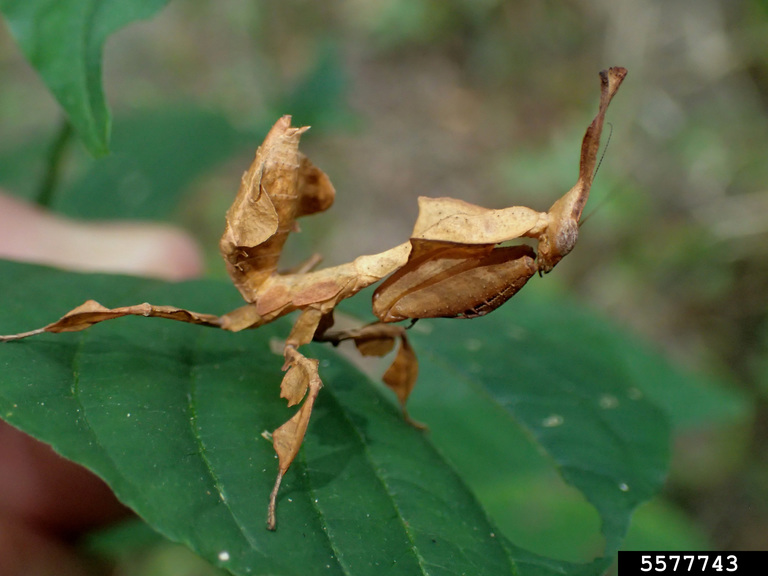
Yep, that’s no dead leaf, it’s a living ghost mantis. Photo by Whitney Cranshaw, Colorado State University, Bugwood.org
Admittedly, mantids are excellent at hiding. As ambush predators, they must go unnoticed until it’s too late for their prey. Some mantids have taken this to an extreme, perfectly mimicking flowers or leaves, even swaying slightly in the breeze like the vegetation. But becoming invisible or a shimmering distortion like the Predator as the mantid monster by the Musconetcong River purportedly did? That would be a tough trick for an insect. Unlike the skin of quick-changing cephalopods and other color-morphing creatures, the outermost part of the bug, the cuticle, isn’t alive. Made of chitin, waxy secretions, and various proteins, it doesn’t contain chromatophores or any other living cells. While insects can change colors (and often shape) by molting to the next life stage, shedding their exoskeleton is a process. Insects also darken (and harden) after molting in a process called sclerotization, but, again, not at will. That said, a scant few adult insects, including some mantids, can change color. A smattering of those can do so quickly. The mechanisms for this vary from pigment migration to the manipulation of the moisture content of the cuticle. They can only change to one color and back again, however. Melting into the forest via rapid camouflage or becoming a glimmering mirage seems well beyond a bug’s ability.
A hundred million years is a long time…
Mantid-like insects have existed for at least a hundred million years. Given such an expanse of time, could a mantid ancestor evolve a new respiratory system that would allow it to become huge? Perhaps. Could this divergent insect develop a full-fledged brain and superintelligence? I guess. We went from rodents to people in less time. Is it possible they acquired a cuttlefish-like ability to camouflage? I don’t see how, but I can’t rule it out.
The problem is there isn’t a shred of evidence that they did any of these things. We’ve found no remains, tracks, frass (insect feces), kills, or fossils of anything anywhere near between an insect and a monster humanoid mantis. All we have to go on are a handful of bizarre eyewitness accounts.
So maybe the mantid people beat us in the space race by a hundred thousand years and took off to other worlds, occasionally stopping back for a visit. Truthfully, I like that idea better than those of genetic experiments or insectoid aliens seeding the planet.
Why am I still having this conversation with myself?
There’s no telling what could step out of the faery realm.
Because insects are incredible, and I want there to be bug people. But I don’t believe that’s what these are. If mantis-like monsters exist, I think their resemblance to mantids is a case of convergent evolution with a species from another world–aliens entirely unrelated to Earth’s insects.
That’s assuming we share the same reality. Perhaps another exists in which insects rose up on two legs instead of mammals. And, every so often, in extraordinary places, the veil thins, and Manto sapiens slips through.
Whatever they are, I pray I never encounter one. But if I do, I hope I have the presence of mind to note their foreleg spination (preferably not while impaled upon it).
Bianca Greyvenstein, Hannalene du Plessis & Johnnie van den Berg (2020): The charismatic praying mantid: A gateway for insect conservation, African Zoology, DOI: 10.1080/15627020.2020.1732834
Cherry, Ron. Praying Mantids as Symbols for Headhunting, American Entomologist, Volume 50, Issue 1, Spring 2004, Pages 12–17. https://doi.org/10.1093/ae/50.1.12
Kolnegari M, Naserifard M, Hazrati M, Shelomi M (2020) Squatting (squatter) mantis man: A prehistoric praying mantis petroglyph in Iran. Journal of Orthoptera Research 29(1): 41–44. https://doi.org/10.3897/jor.29.39400
Legendre, F., Nel, A., Svenson, G. J., Robillard, T., Pellens, R., & Grandcolas, P. (2014). Phylogeny of Dictyoptera: Dating the Origin of Cockroaches, Praying Mantises and Termites with Molecular Data and Controlled Fossil Evidence. PLoS ONE, 10(7). https://doi.org/10.1371/journal.pone.0130127
Moriyama, M. (2021). Physiological and Biochemical Mechanisms of Insect Color Change Towards Understanding Molecular Links. In: Hashimoto, H., Goda, M., Futahashi, R., Kelsh, R., Akiyama, T. (eds) Pigments, Pigment Cells and Pigment Patterns. Springer, Singapore. https://doi.org/10.1007/978-981-16-1490-3_15
Prete, F.R., Wolfe, M.M. Religious supplicant, seductive cannibal, or reflex machine? In search of the praying mantis. J Hist Biol25, 91–136 (1992). https://doi.org/10.1007/BF01947506
Vigneron, J. P., Pasteels, J. M., Windsor, D. M., Vértesy, Z., Rassart, M., Seldrum, T., Dumont, J., Deparis, O., Lousse, V., Biró, L. P., Ertz, D., & Welch, V. (2007). Switchable reflector in the Panamanian tortoise beetle Charidotella egregia (Chrysomelidae: Cassidinae). Physical review. E, Statistical, nonlinear, and soft matter physics, 76(3 Pt 1), 031907. https://doi.org/10.1103/PhysRevE.76.031907
Wow, did May go fast! It seemed like I blinked, and it was gone. As ephemeral as its flowers. I’m not complaining, though. We had a late frost, and I lost a few plants, but we also had plenty of sun and summer weather. I’m ready for more.
Drained has a tentative new release date—June 12th! That’s right around the corner! I’m reviewing the galley proof now.
Monster of the Month
That’s right, monster. I’m dropping it down to one per month for now. I’ll admit it—it’s a struggle to keep up with the blog. It didn’t help that I fell deep down the rabbit hole of what was supposed to be this month’s second monster—massive mantids. I’m excited to keep working on it and share it with you in June.
Black Flies (Family Simuliidae)
Black flies are a fixture of springtime in Maine, so much so that they’ve been nicknamed the Maine state bird. We have more than 40 species! They swarm from our woodland streams and descend en masse to buzz around our heads, crawl into our orifices, and drink our blood. Learn about black flies and how to handle them here.
Maine Magic
The kiddo and I spent some time at the beach for Mother’s Day. There’s nothing I enjoy more.
The Menagerie
These pups love the warm weather. We’re trying to introduce Ray to water, but he takes after his big sister so far and gives the kiddie pool a wide berth.















 K.W. Bernard