This first one’s mine. My novels center around the lorkai (singular and plural, like moose). These monsters feed on magical energy. They’re a caster’s worst nightmare.
Like any good immortal species, lorkai are preternaturally strong, fast, and have powers over the mortal mind. What makes them unique is their ability to control humanoid physiology through physical contact–one touch, and it’s over. They steal your energy, your free will, and maybe your life.
If they feed on someone without magic to spare, they take life force. And when they drink from someone bursting with spells, they leave them helpless and enfeebled. The more powerful your magic, the better you taste. That’s what makes poor Sarlona the perfect prey.
These are the monsters that little mages check under their beds for at night, afraid they’ll be left as a drained husk or carried off and kept as livestock. They’re not supposed to exist.
It turns out they do. There just aren’t many left.
Lorkai are almost impossible to recognize when they want to stay hidden. If you had a magnifying glass, and they deigned to allow an inspection, you might notice the fine seam that runs up the undersides of their arms from the wrist. That’s where they hide their carpal blades—nearly unbreakable swordlike claws that they keep tucked away like folding knives. They use them to drink the magical energy from the earth itself, driving them into the ground and draining every trace of life from the soil around them.
When they don’t mind being seen, lorkai are easy to spot–look for the person with the flaming, color-changing irises, ivory swords jutting from their wrists, and glowing fingertips. Of course, if they let you see them like that, you’re probably food.
Their weaknesses? Fire. But it has to burn them to ash. Anything less will piss them off. They also have no magical ability. They can’t cast so much as a cantrip.
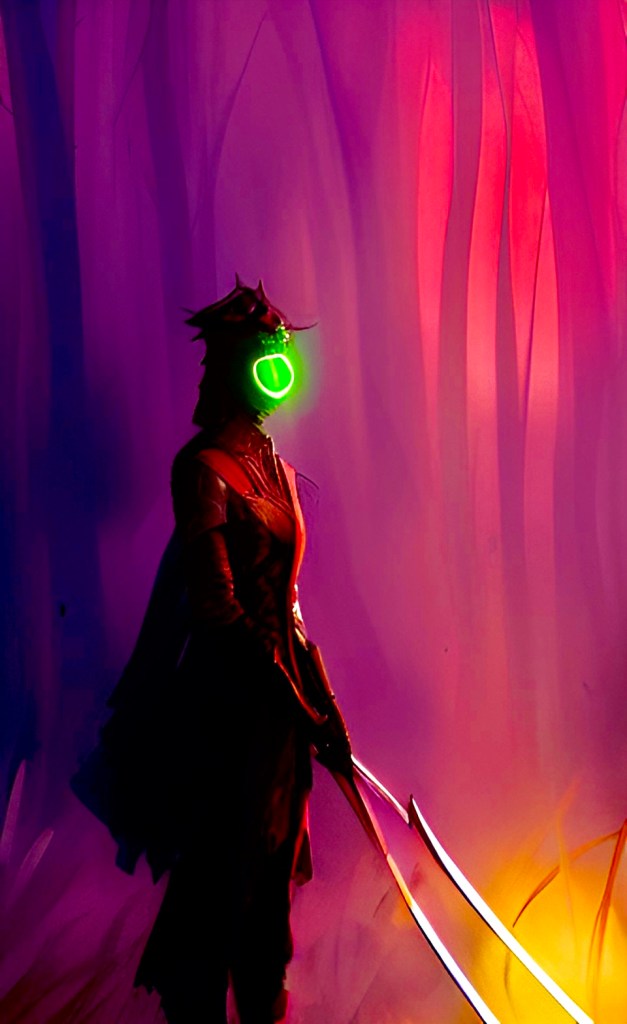
Description. Lorkai are humanoid and indistinguishable from host species when not mimicking prey. Undisguised and at rest, their irises fluoresce multiple colors, often cycling through the visible spectrum every few minutes. Scholars believe this a vestigial trait once used as a form of communication or perhaps a lure to draw mesmerized prey into dark, isolated spaces. Lorkai bear a pair of carpal blades—hinged, swordlike claws that protrude from the inner wrists and can tuck into the undersides of their arms like folding knives. When retracted, the only sign of these appendages is the nearly imperceptible seam into which these appendages disappear. Lorkai use their carpal blades for feeding and defense. Although these claws resemble ivory, they’re stronger than diamond and tougher than mithril.
Distribution. While many believe the lorkai to be a myth concocted to frighten young casters, and others suppose they’ve gone extinct, one remnant population survives in Aven.
Habitat. Lorkai live wherever other humanoid species exist. However, they prefer rural areas.
Diet. Lorkai feed on Marrow—the magical energy that sustains all life. While they can siphon this energy from any living thing, they require the concentrated Marrow of humanoids to stay well. They feed through their fingertips, which glow manna blue as they draw Marrow from their victim. Their abilities allow them to paralyze prey, force them to comply, compel them to volunteer, or augment their memory with the touch.
Lorkai also need the pure, unadulterated Marrow of the earth itself. They feed from it by plunging their claws into the bare ground. Drawing from the land sterilizes it, creating a small dead zone around the lorkai and vaporizing any organisms within range.
Life cycle. Lorkai grow more potent with age. They reach maturity and can reproduce at around a century old. Females can make a child every hundred years or so. Males can only produce one. Young are created from human hosts, fed the lorkai quick. Quick is a highly concentrated Marrow-like substance that changes a host body from the inside out if given around the moment of death. The lorkai regurgitates the reproductive fluid and forces its potential young to swallow it.
The more Marrow-rich the mortal, the more likely they are to survive their transformation and the stronger they will be when made into a lorkai. So casters make for not only ideal prey but perfect children. Unfortunately, some casters find losing their magical abilities too devastating to live with and die by self-immolation.
 K.W. Bernard