
Monster of the Month – Full Moon Faerie Foxes

There’s nothing like a quiet beach on a clear night. Black waves breaking under a canopy of stars hold a special kind of magic. Never more so than when draped in the glittering light of the full moon.

My grandmother taught me that. When I was little, she’d take me for walks on the beach long after sunset, and I’d sit with her and watch the moonrise. To this day, I search for glimmers of divinity in the night sky over the Atlantic. It sustains me through gray, dead days.

The beach at night is pure magic.

So, for me, walking the beach at night is a ritual. Flashlights aren’t allowed, and footwear is discouraged. The magic happens when I’m wrapped in the dark with sand between my toes. But in October 2020, I may have gotten more than I bargained for.

Pink lingered in the west, and the evening’s first stars had just sparked to life when I ventured out onto Wells Beach. It was the perfect time for a walk—the weather was mild, the tide was low, and hardly anyone was around. I’d planned to trek the 2/3 mile to the jetty and watch the full moon rise from atop it.

Things first got a little weird when I passed a group of college-aged men standing around drinking. I thought I’d given them a wide berth, but one of them had a young dog on a super long rope. The dog charged, and before his owner could reel in the slack, he leapt and gave me a big puppy kiss on the mouth. Normally, I wouldn’t have cared—I love dogs. But this was still early in the pandemic, before the vaccine, and these guys weren’t social distancing. The man apologized, and I played it off, but it shook me a bit. Little did I know, the excitement was just getting started.

Clouds swallowed the remaining light, and dusk deepened into night. By the time I reached the jetty, it was much too dark to climb it safely. In fact, with the moon still tucked behind the sea, the night was so black that I felt a little disoriented. Though the clouds threatened to ruin my plans to watch the moonrise, I figured I’d stick around to see if they broke enough for a glimpse.
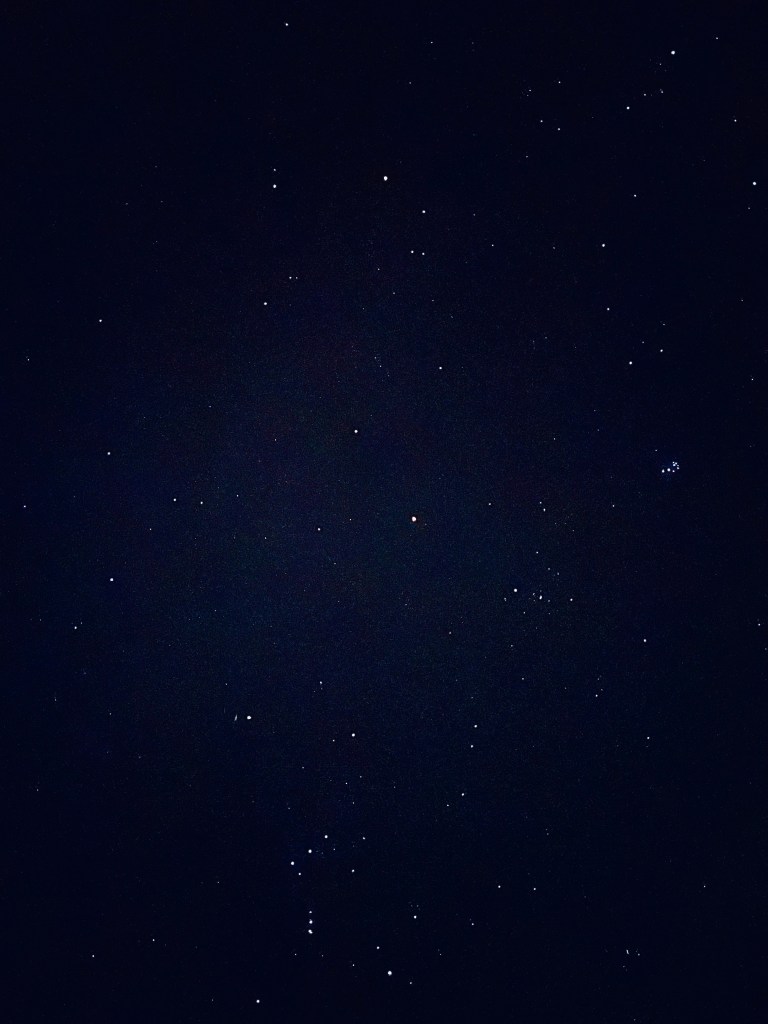
The stars are brighter over the sea.

As I waited, the darkness kept shifting around me. I couldn’t see more than a few feet ahead but sensed movement. Other people had arrived in hopes of watching the moonrise as well. That wasn’t surprising since most parking for the beach is by the jetty. Why shouldn’t other folks want to enjoy the full moon rise in such a lovely spot? It wasn’t late, after all. But the meandering shapes kept wandering uncomfortably near, especially for 2020, and none spoke to each other. They drifted silently about like ghosts. Until I heard the familiar, stuttered scratching of canine paws digging through sand. It wasn’t the people who kept coming so close but their loose dogs. Two pups had started excavating beside me.

I’d already had my fill of uncontrolled dogs for one evening, and I didn’t want to twist an ankle in one of their holes, so I backed away. The clouds were thinning anyway, and I’d been too near the jetty to view the rising moon over it.

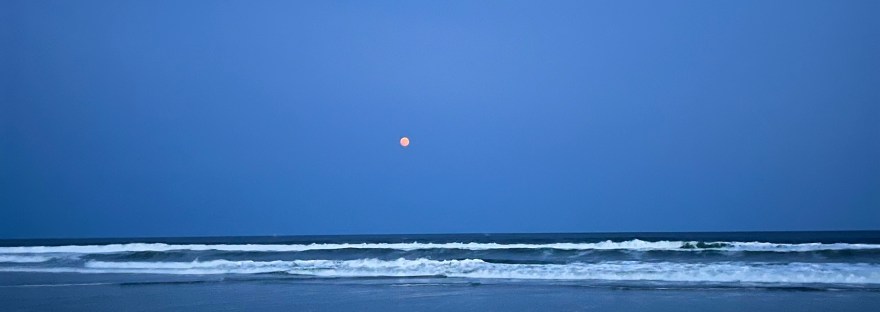
Generously, the sky’s downy curtains soon parted to reveal the gorgeous harvest moon as it ascended over the jetty. Big and orange, it almost resembled the sun, spilling its magic across the sea and sand. I tried to let some of it seep into me and forgot about the other people and their dogs.

If you follow me on social media, you know how much I love to take photos that capture even a sliver of nature’s splendor. I couldn’t let such a glorious moon go undocumented! So I pulled out my phone and snapped a picture. Unfortunately, I made a critical error in iPhone night-sky photography—I accidentally left the flash on.
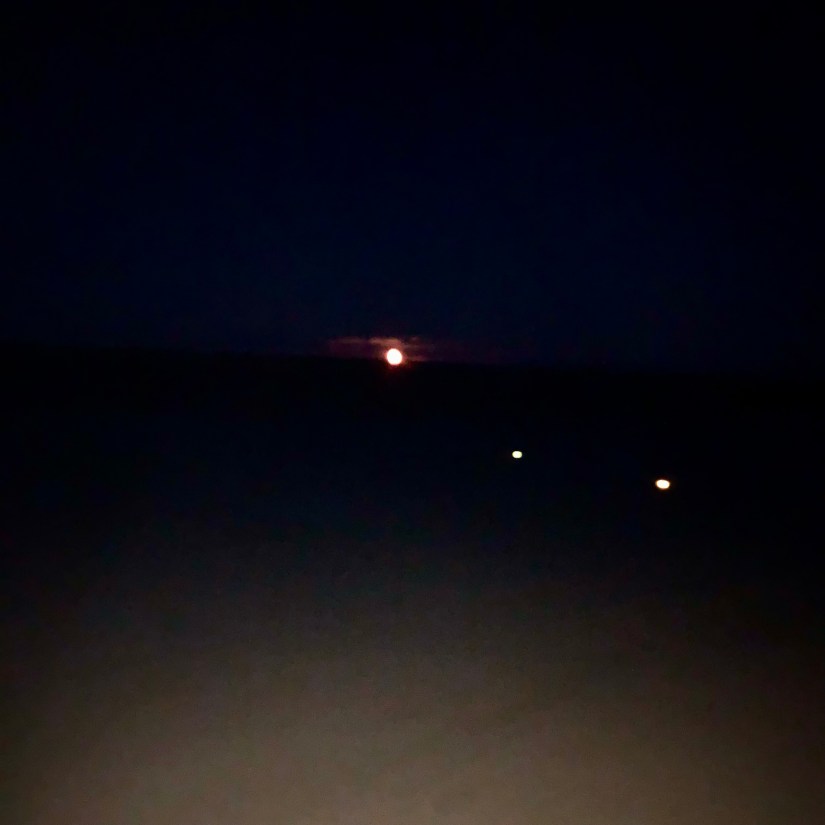
The photo taken with that fateful flash. The two smaller bright spots are eyeshine from the foxes.

Everything changed in that offensive burst of artificial light. There were no other people. There were no dogs. I shared the moonrise only with a pair of foxes. They instantly fixed their glowing gazes on me, bared their fangs in devilish grins, and, to my utter shock, trotted right toward me as though I’d called them.

For a few seconds, I did what you’re supposed to do when a wild canid comes your way—I stood my ground. Using my angriest dog-mom voice, I shouted, “No.”

They didn’t so much as break stride.

I instinctively backpedaled a few steps and yelled something ridiculous like, “No, you stay there.” They kept coming.

Shoving my phone in my pocket, I turned and sprinted as fast as I could. After twenty to thirty seconds, I looked over my shoulder—they were trotting after me, keeping pace. I ran hard down the beach for about half a mile before glancing back again. This time, they were gone.
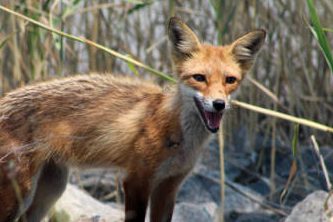
My pursuers had similar smiles.
Photo by Holly Keepers, USFWS.

They could have caught me, of course. Foxes can sprint around 30 mph. Fortunately, healthy foxes don’t attack people. They prey primarily on rodents, after all. But rabid ones have been known to bite, and that was my fear—a peak pandemic ER visit, two dead foxes, and rabies prophylaxis (which can cost upwards of $30,000).

Although this story amuses me now, I can’t convey how surreal this incident felt. It’s been almost four years, and I still think about it often. Of all the foxes I’ve encountered, these were the only ones that didn’t bolt at the sight of me or the sound of my raised voice. Why would foxes run toward a flash of light? Why were they together? How did night get so dark so fast, and then, suddenly, I could see again? Why did I think there were people around me? How did time slow enough during that flash for the foxes to whip their heads at me and grin with wicked delight?
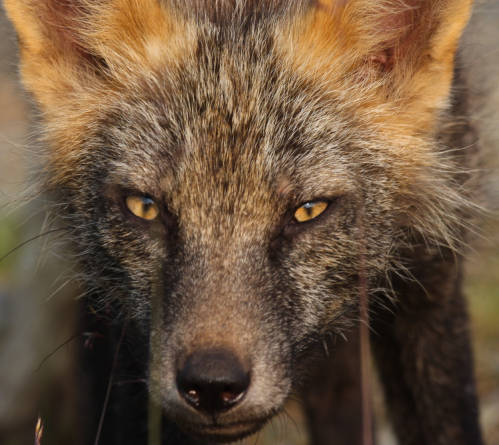
This was the vibe. Photo by Lisa Hupp, USFWS.

The druidic fantasy writer in me knows exactly what happened—the Veil was thin that night. I was in a liminal place at a liminal time, and the moon was full. Either I slipped a little into another realm, or it leaked into this one. Those weren’t foxes. They were faeries—or something—shapeshifting from humanoid to canid as they pleased. Obviously, they couldn’t allow themselves to be photographed. So they thought they’d have some fun with the trespassing mortal.

Of course, the part of me who trained as a wildlife biologist wants an explanation less rooted in faerie magic. The foxes could have come down to the beach to forage for surf clams or crabs—easy pickings at low tide under the cover of darkness. They’d probably had their run of the beach at night all spring and summer, given the nonexistent 2020 tourist season. I’m guessing they were siblings recently run off by their parents or a mother and her straggling kit. Still, it’s hard to reconcile why a flash of light would summon a pair of crepuscular wild animals faster than a cheeseburger summons my dogs. Lights, especially those that turn on suddenly, are often used to haze and deter foxes and other midsized predators. The best explanation I can come up with is that someone had been feeding these animals at night by flashlight. When they saw the light, they thought I had something for them.

Or maybe they were rabid. Infected animals often lose their fear of people, and foxes comprise a significant portion of documented rabies cases in Maine. But if illness had driven this pair mad with aggression, they missed the perfect chance to go berserk and bite when they were digging next to me. Besides, it seems unlikely that two rabid animals would hang together and react identically to a stimulus.

So, I think these were habituated, food-conditioned animals. That’s not as scary as rabid ones, but it’s still bad for the foxes. It increases their chances of conflict with humans. Wildlife managers inevitably get involved when foxes start approaching people in public spaces. Had one nipped or scratched me, innocently trying to get chicken nuggets to pop out, that would have been it for them. They’d have been hunted down and decapitated for rabies testing. So, don’t feed wild animals. And be careful if you’re alone at night when the Veil is thin. You never know what might slip in from another realm and stare at you with a hungry smile.
Foxes – Maine IFW

Rabies Data – Maine CDC

Food-Conditioned Red Fox Killed – NPS

Monster of the Month – Devil’s Dipstick (Mutinus elegans)

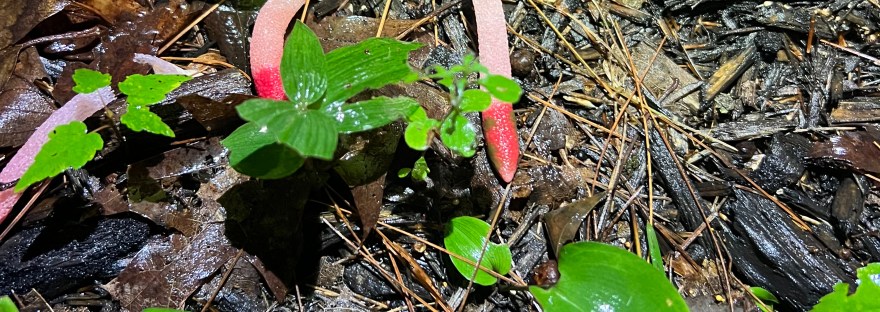
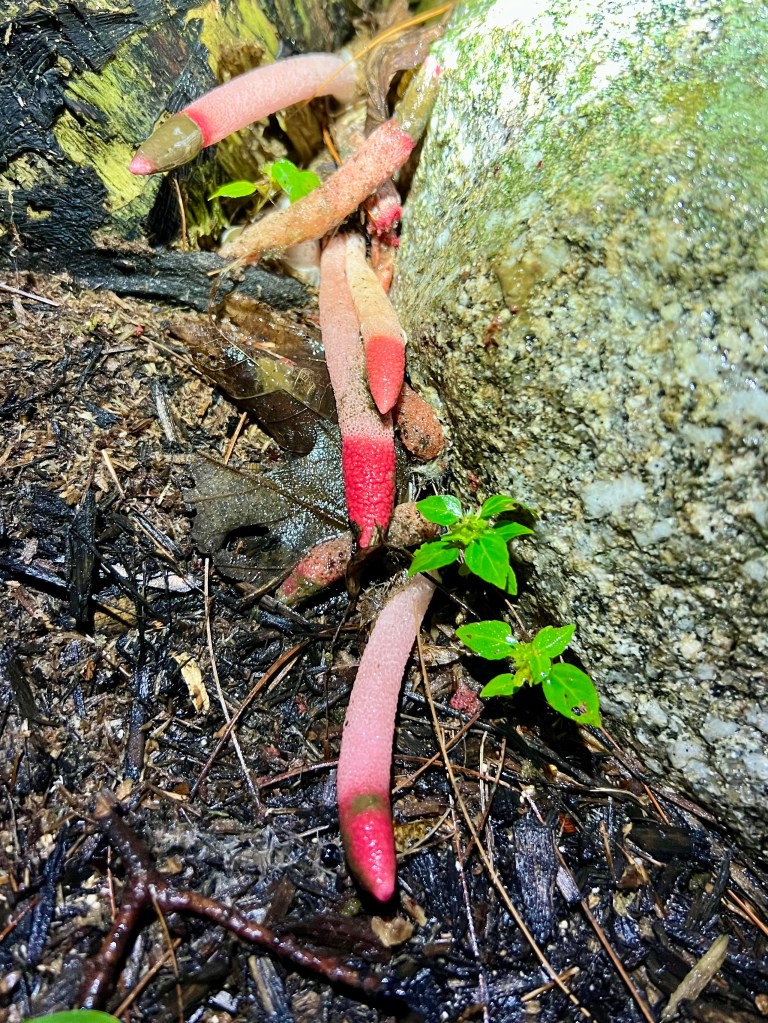
Behold their phallic elegance!

These aren’t the netherworld tentacles I wanted!

Disappointingly, they’re not abyssal tendrils at all. Or spilled gummy worms. They’re fungi–Mutinus elegans, I believe. Mutinus was a Roman phallic god, so translated from Latin, the scientific name appears to mean “elegant penis”. It belongs to the Phallaceae family, too. Mycologists are a dirty bunch, I guess. In their defense, these are the reproductive structures of the expansive fungal organism below ground. 

Nothing like getting brown slime that smells like an outhouse involved in your reproduction.

The common name of these fungi–stinkhorn–is less sexy but perhaps more appropriate. It comes from the reeking, slimy brown patch they develop near the tip of the fruiting body. The stink attracts flies, which pick up the fungal spores and disperse them. This reproductive strategy, reminiscent of flowering plants’ tactic of attracting pollinators, is rare in fungi. Usually, they rely on wind and water to move their spores. Stinkhorns are also called witch’s eggs for the small egglike structures that precede the mushroom on the soil surface. Mutinus elegans also goes by the best epithet of all–the devil’s dipstick.

Witch’s eggs.

Contrary to its names, smell, and appearance, M. elegans is pretty inoffensive. It’s a saprophyte, decomposing woody material for nourishment and is considered non-toxic. Although some folks eat stinkhorn fungi, I wouldn’t recommend taking the devil’s dipstick internally. 

These things caught me by surprise when I brought the dogs out in the rain last night. It was my first encounter with the devil’s dipstick, so I hope I identified it correctly. Though they apparently pop up in mulch beds often, the fruiting bodies don’t last long, so they’re easy to miss. Sometimes, they sprout overnight and are gone by morning. 

I’m glad I encountered them this time. What a creepily cool life form.    

Resources:

University of Florida Extension

North Carolina State Cooperative Extension

Messiah University

Monster of the Month – Megalodon (Otodus megalodon)

Beautiful as the sea may be, it’s been full of monsters for millions of years. Perhaps none more fearsome than the megalodon.

With the Meg 2’s release earlier this month and the last few weeks of beach weather upon us, what better time to examine Otodus megalodon—a prehistoric shark of kaiju-like proportions?

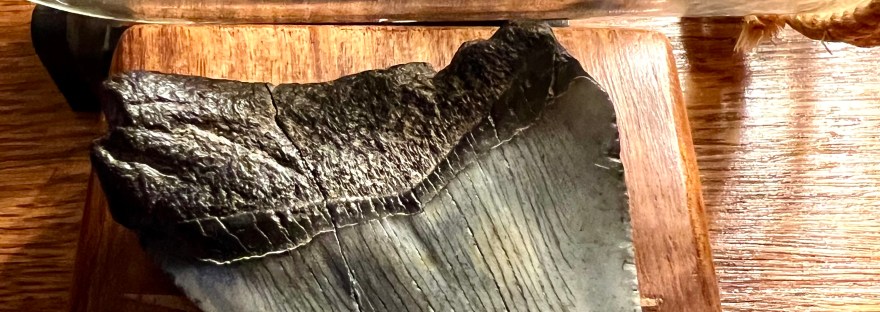
The megalodon is an extinct shark species from a dead genus (Otodus) in a lost family (Otodontidae) and the largest ever known. It ruled the seas for perhaps 20 million years, from the early Miocene (23 million years ago) into the Pliocene (2.6 million years ago).

Just how big was it? 

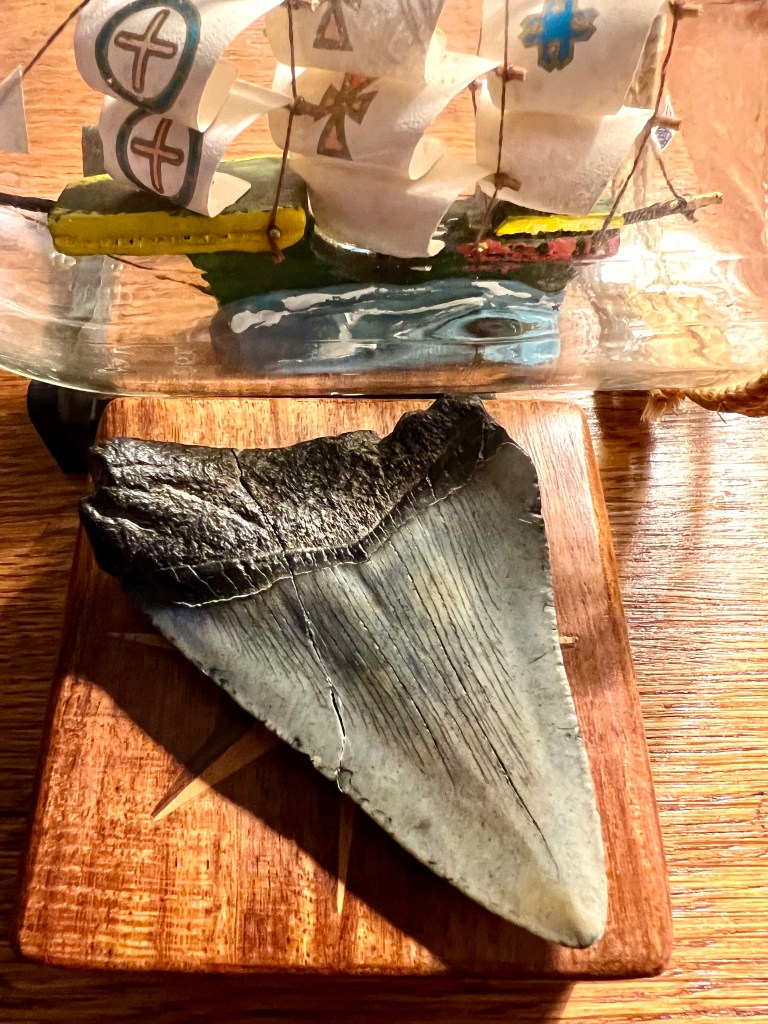
It’s hard to say from fossilized teeth and a few vertebrae. Since sharks are cartilaginous fishes, they don’t leave much behind to weather millennia. But by extrapolating from tooth size and what we know about the tooth-to-body-length ratios of living shark species, paleobiologists can make educated guesses about the megalodon’s length.

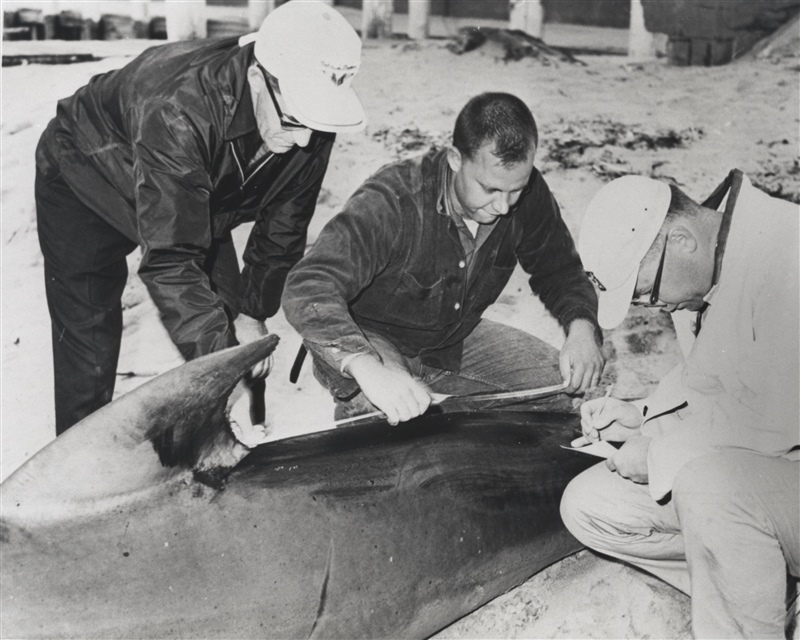
Estimates of the megalodon’s total length vary, but researchers agree it was one of the largest carnivores of all time. Non-megalodon photo courtesy of NOAA Photo Library.

Researchers have estimated the megalodon’s maximum total length to range from around 47.5 to 65.5 ft. Most seem to favor the higher end of the spectrum. Even the lower estimate is more than twice the length of the largest officially recorded great white. Scientists believe the weight of the megalodon may have exceeded 68 tons. That’s more than ten times the weight of a mid-sized African elephant, making it one of the largest carnivores to ever live. While that puts most meat-eating dinosaurs to shame, we can’t say the megalodon was the largest predator. Sperm whales rival its length, and blue whales (which prey on krill) dwarf even the megalodon.

Geochemical sorcery and ecological analogs

Although prehistoric sharks left only teeth and few vertebrae behind, scientists have learned a lot about megalodon biology through geochemical analysis of these remains.

Given that our only clues are teeth and the marks they left, plus a smattering of spine, researchers have inferred a lot about the megalodon. Through modeling using extant (living) shark species as stand-ins and isotope analysis, paleobiologists have been able to paint, or at least sketch, a picture of how the megalodon lived. Admittedly, researchers have based many of their conclusions on great white sharks, which they no longer consider closely related to megalodons. Scientists believe these two apex predators belong to the same order—Lamniformes—the mackerel sharks, but not the same family. There are still good reasons to use the great white as a model, though. It’s the largest lamniform shark that doesn’t filter feed and the only one with triangular, serrated teeth like the megalodon.

Like great whites, megalodons were probably ovoviviparous—they hatched from eggs inside the womb and then were born live. Analysis suggests baby megalodons were already over 6 feet long at birth, a size likely attained by cannibalizing the embryos of their siblings in the womb.

Juveniles would have spent their time in the relative shallows of the continental shelves, where they’d be a bit more protected and have better access to appropriately sized prey. If the “little” guys survived into adulthood, they may have lived for up to a century, roaming worldwide except for the frigid Arctic and Southern Oceans.

Baleen for breakfast

There’s no doubt the megalodon fed on marine mammals. We know this from bite marks left on the fossilized remains of pinnipeds (seal-like animals) and cetaceans (whales and dolphins). Based on the great white’s behavior, we assume it hunted them, but it’s possible the megalodon only scavenged from these animals. Geochemical analysis of the fossilized teeth supports the megalodon’s superpredator status—it was higher up the food chain than great whites. Megalodons fed on baleen and beaked whales up to the size of today’s orcas and probably ate their fair share of squids and other sharks, too. There’s even evidence they tangled with sperm whales on occasion. It makes sense that the megalodon would target giant prey items, not just because it’s so large but to avoid competition with less massive predators. A small whale could have sustained a megalodon for a couple of months.

More than a cold-blooded killer…

Some of the strongest swimming pelagic (open sea) fishes are partially warm-blooded.

Though we think of fish as cold-blooded (perhaps especially those with flesh-rending teeth that devour cute, large-brained mammals), some aren’t. A few fish, like tuna, swordfish, and yes—the great white shark—are partially endothermic (warm-blooded). They can metabolically raise and maintain their body temperature above the ambient water temperature. Although we can’t be sure, most researchers believe the megalodon, like the great white, was endothermic. This warmer body temperature could have allowed megalodons to swim faster (and farther) and exploit a wide range of habitats.

Never too big to fail.

Young megalodons probably depended on shallower nursery areas for protection and abundant prey.

The fossil record indicates the megalodon died out about 3.6 million years ago. Several factors likely contributed to its extinction. Around the time of the megalodon’s decline, the oceans grew colder, and sea levels dropped. Young megalodons may have lost their habitat as shelf areas and their productive waters disappeared. Many small baleen whales went extinct, leaving adults with fewer opportunities to feed when competition with up-and-comers like the great white shark and sperm whales was likely growing fierce. And, while advantageous when one can afford it, endothermy comes with a steep energy bill. With food resources dwindling, it may have become a liability.

Could a few megalodons still lurk in the depths?

Whale sharks can reach the size of a small megalodon, but these filter feeders have wide heads and spots. Photo courtesy of NOAA Photo Library.

While the notion of a prehistoric superpredator surviving in the Mariana Trench only to emerge and wreak havoc in modern times is a spectacular sci-fi premise, there’s no evidence the megalodon’s oceanic reign overlapped with the existence of even the earliest Homo sapiens.

Yes, reports of massive sharks appear online, sometimes accompanied by videos or photographs. As much as I love cryptids and the thought of a supersized shark, these images are far from convincing. Many purported megalodons are easily identified as whale, basking, great white, and Greenland sharks. The vague silhouettes captured in satellite images are likely whale sharks or actual whales. And when the size estimates of these incredible ichthyiods are outlandish even for the megalodon, there’s something fishy going on. 

Stuck in the trenches?

“We live on a placid island of ignorance in the midst of black seas of infinity, and it was not meant that we should voyage far.” – H.P. Lovecraft

Don’t get me wrong. I don’t think we know about everything cruising around in the abyss. The USO (unidentified submersible object) folks constantly remind me that our oceans are less explored than outer space. But I’m more willing to entertain the notion that a non-human intelligence or Cthulhu-like monster is plotting its takeover from the Mariana Trench than the megalodon. We don’t know what we don’t know. But we do know some things about the megalodon—it wasn’t a deep-sea shark. 

Have no fear. The megalodon is long gone. And if it isn’t, it’s scrounging for deep-sea carrion with the hagfish.

Endothermy would have allowed the megalodon to make nightmarishly deep dives through the thermocline like the sperm whale and the great white shark on occasion but also would have prevented it from living down there. While thermal vents might create some small spa pockets on the sea floor, contrary to sci-fi, the bottom of the sea is almost as cold as ice. Judging by where the megalodon left its teeth (everywhere but the polar seas), it couldn’t tolerate freezing water long-term. The energetic cost would be massive, and we know what the megalodon fed upon—marine mammals. Those have to come up to breathe. So, living in the trenches 13,000 ft below the waters where even the deepest diving among your prey dare swim doesn’t make much sense. Unless the megalodon was just a scavenger of sunken whale carcasses and not a predator. And wouldn’t that be disappointing?


RESOURCES:

A. Collareta et al. Did the giant extinct shark Carcharocles megalodon target small prey? Bitemarks on marine mammal remains from the late Miocene of Peru. Palaeogeography, Palaeoclimatology, Palaeoecology (2017) https://doi.org/10.1016/j.palaeo.2017.01.001

Boessenecker RW, Ehret DJ, Long DJ, Churchill M, Martin E, Boessenecker SJ. 2019. The Early Pliocene extinction of the mega-toothed shark Otodus megalodon: a view from the eastern North Pacific. PeerJ 7:e6088 https://doi.org/10.7717/peerj.6088

Jack A. Cooper et al. The extinct shark Otodus megalodon was a transoceanic superpredator: Inferences from 3D modeling. Sci. Adv. 8, eabm9424(2022). DOI:10.1126/sciadv.abm9424

Kenshu Shimada (2019): The size of the megatooth shark, Otodus megalodon (Lamniformes: Otodontidae), revisited, Historical BiologyDOI:10.1080/08912963.2019.1666840

Kenshu Shimada, Matthew F. Bonnan, Martin A. Becker & Michael L. Griffiths (2021) Ontogenetic growth pattern of the extinct megatooth shark Otodus megalodon—implications for its reproductive biology, development, and life expectancy, Historical Biology, 33:12,3254-3259, DOI: 10.1080/08912963.2020.1861608

Michael L. Griffiths et al. Endothermic physiology of extinct megatooth sharks. Proceedings of the National Academy of Sciences. 120 (27) e2218153120 https://www.pnas.org/doi/abs/10.1073/pnas.2218153120

Skomal GB, Braun CD, Chisholm JH, Thorrold SR (2017) Movements of the white shark Carcharodon carcharias in the North Atlantic Ocean. Mar Ecol Prog Ser 580:1-16. https://doi.org/10.3354/meps