
May Monsters of the Month – Black Flies (Family Simuliidae)

Black flies are a fixture of springtime in Maine, so much so that they’ve been nicknamed the Maine state bird. We have more than 40 species! They swarm from our woodland streams and descend en masse to buzz around our heads, crawl into our orifices, and drink our blood.
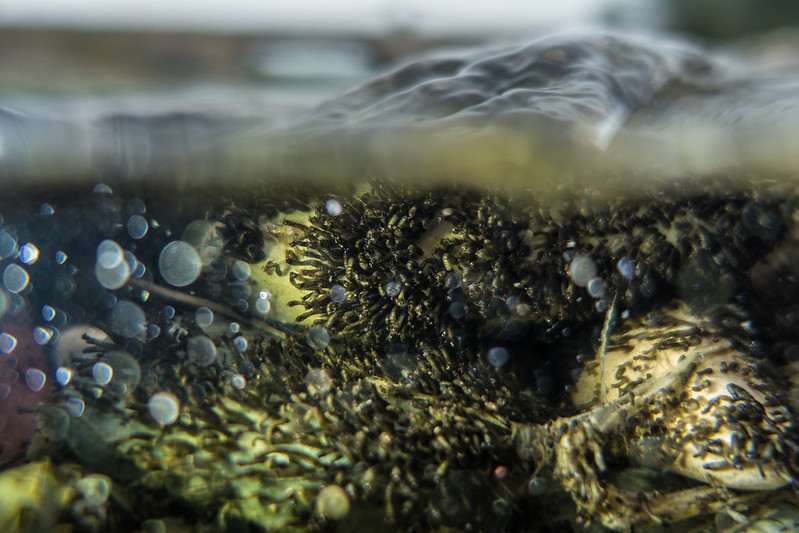
Numerous black fly larvae anchored to rocks in a clean, well-oxygenated river. Photo courtesy of the National Park Service.

Description – Adults are small, robust, humpbacked flies. They have stubby antennae and a short, stout proboscis. Their color ranges from black to yellow. The aquatic larvae are shaped like bowling pins with one “leg” near their head on the underside. Tiny hooks on their hind ends help anchor them in flowing water. Most species bear two fanlike structures for filtering food from the current.

Distribution – Black flies inhabit every continent but Antarctica. 

Habitat – Black flies need clean, moving water for their larvae. We find them in abundance near rivers, streams, and brooks. Since they can’t thrive in waters where dissolved organic matter is high or dissolved oxygen is low, their presence often signifies a healthy environment.

Life Cycle – Black flies have two different life cycles, depending on the species. Some overwinter as eggs, but most spend the winter as larvae. Females lay eggs in or near the water. After they hatch, larvae anchor themselves to rocks, logs, and other underwater objects by weaving a silk pad and hooking onto it. If the current doesn’t provide much to eat, they can let go and hope for better feeding grounds downstream. Because they breathe through their skin, they need highly oxygenated water to survive. When ready to pupate, most larvae build a silken cocoon underwater, usually in the spring after overwintering. Most adults emerge in April or May, riding an air bubble to the surface. Some species have multiple generations annually and produce biting adults throughout spring, summer, and early fall. I’m fortunate to live nearby a river that harbors one such species. Scientists have studied few black fly species in depth, but some appear entirely female, reproducing asexually. 

Diet – Female black flies require blood to nourish their eggs, but like the males, they feed on nectar for their own energy. Some are opportunistic, biting whatever mammal or bird is available. Other black flies are picky, specializing in one group of animals or even one species. Simulium annulus, for example, targets loons. Some hunt humans voraciously, while others have no interest in us. A few species like us enough to circle our heads incessantly and try to burrow into our tear ducts, but rarely bite. The larvae feed on microorganisms, filtering them from the water using fanlike mouthparts.

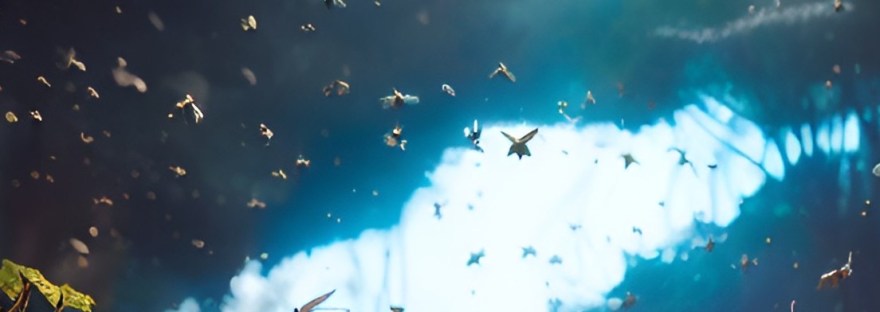
Adult black flies have a short proboscis armed with serrated, scissor-like mandibles for slicing into flesh. Some species harass humans but don’t bite often. It took me ten minutes of standing still and getting pelted in the face by a hundred flies to get this picture.

Bites – While their antics and the welts they leave behind are maddening, blackflies aren’t the public health threat ticks and mosquitoes are–in the U.S. In some parts of the world, they cause tremendous misery through the diseases they transmit, river blindness being one of them. That’s not to say bites are harmless here. They tend to swell and bleed. A few hours with black flies leave some people looking like they just finished a bar brawl instead of a hike. How much and for how long depends on the person and previous exposure. Folks accustomed to them generally don’t react as much. Likewise, those first few bites at the beginning of the season often balloon up, but subsequent attacks leave milder welts. Sometimes individuals develop a sensitivity, however, and their reactions worsen as time goes on. And, while they’re not known to vector pathogens to humans in the U.S., they can still make us sick. When injected from numerous bites, their toxic saliva may cause fever, headaches, nausea, and swollen lymph nodes.

We don’t just have to worry about ourselves, either. Even up north, black flies can transmit disease to livestock and poultry. Occasionally, one hears a horror story in which the black flies are so thick that animals die via smothering, exsanguination, or toxic shock from their bites.

Battle Plan – Black flies are a byproduct of thriving streams and river restoration, so little opportunity exists to target them at their source without severely harming the environment. Bacillus thuringiensis var. israelensis, a bacterium that kills only mosquitoes, black flies, and similar species, is the only reasonable chemical option to control the larvae. Some states have regional control programs and apply Bti aerially. Maine doesn’t, and applications require a permit from the DEP unless the stream is contained entirely on one property. 

Because females can fly miles seeking a blood meal, adult-killing sprays seldom provide control for longer than a couple of days.

Rather than trying to wipe them out, in Maine, the strategy with black flies is to discourage bites. Unfortunately, since they rely more on sight to target their victims, DEET and other insect repellents aren’t as effective against them as against mosquitoes. Avoidance and mechanical barriers will work better. Cover up, knowing black flies will crawl through any gap in clothing they can find in search of juicy flesh (they’ve figured out buttons), and dark colors attract them. A trick I learned from my dad is to coat a plastic sun helmet or hard hat in mineral oil. When the flies land on the helmet, they get stuck and suffocate. But I recommend a quality head net if the black flies are thick.

Black flies are annoying, but they’re the price of living, working, and playing alongside nature. The good news is that they don’t typically follow folks indoors and only bite during the day. They’re easy to shake if you have shelter.

Resources – For more on black flies, see:

UNH Extension Black Fly Fact Sheet  

Black Flies: Biology and Public Health Risk (Purdue)

UMN Extension Black Fly Fact Sheet

April Monsters of the Month – Cloaked Creatures

When they want to stay hidden, the monsters in Drained can turn themselves as transparent as the clearest glass. Looking right at a lorkai, you’d see little more than a distortion in the landscape. Picture the Predator from the movie of the same name (one of my favorites), and that’s pretty close. No doubt this badass alien helped inspire the lorkai’s abilities.  

Lorkai don’t accomplish this using a cloaking device, like Predator’s Predator or Star Trek’s Romulans. They instantly destroy their pigmentation and change the density of their tissues to control light scattering. If that doesn’t make complete sense, that’s why I write fantasy instead of sci-fi. It’s biological magic, so there.

Transparent and translucent animals aren’t unheard of in nature, though. Various critters, including insects, mollusks, fish, and amphibians, most with glass in their monikers, have large see-through portions of their bodies. The vast majority live underwater, where the difference in the refractive index between their bodies and the medium they inhabit is less than in terrestrial environments. As far as I know, none are sizable, and they can’t morph to clear at will like the lorkai (though many cephalopods can instantly employ active camouflage).

Now, if you don’t mind transcending the laws of nature as we know them (and I sure as hells don’t), there may be real-life examples more akin to the lorkai than a larval octopus. Two reports come to mind. 

The first is an alleged encounter at Skinwalker Ranch described in Colm Kelleher and George Knapp’s Hunt for the Skinwalker. A distorted entity was reportedly observed by Tom Gorman (a pseudonym for Terry Sherman) and his son, charging from the trees at another man in a pasture. The near-invisible creature roared in the man’s face and bolted back for the trees.

I chanced upon a second report in David Paulides’s book, Missing 411 Hunters. He reports Jan Maccabee’s strange encounter while bowhunting. While in a tree stand, the woods suddenly went silent, and she noticed a distortion in the trees higher up in front of her. She described it as something big covered in plastic wrap moving through the canopy. Reportedly, multiple witnesses saw a UFO around the same time, only a mile away.

In both accounts, the “something” was later titled the Predator. As an experiencer of the unexplained, I believe witnesses, so both recountings fascinate me. Could the stories have been exaggerated in the retelling? Of course. Might there be mundane explanations? Maybe. If not, what could these witnesses have seen? Aliens? Ghosts? Military personnel testing new stealth technology? 

I haven’t a clue. Both anomalies were spotted in association with trees, where the movie Predator also spent substantial time. Might this cloaked alien be so firmly embedded in the zeitgeist that the brain might interpret something unusual in the trees as just that? Or could the trope be much older? Perhaps it’s something that’s always been in the canopies and our collective unconscious that birthed the iconic image of the Predator in the minds of its creators. The idea that humanoids could disappear using clothing (be it tech or magical) goes back at least as far as ancient Greece and Hades’ cap of invisibility.

But I’m partial to natural, biological invisibility–intrinsic active camouflage. Could there be some kind of monster like the lorkai in the wood, turning transparent at will? Perhaps a creature from another dimension, popping in for a visit? Stealthy fairy folk? Or an undiscovered aerial entity with the refractive index of air?

I hope so.

March Monsters of the Month – the Kraken

A devotee to the god of the sea and desperate to shake her pursuers, Sarlona calls upon the denizens of the deep to help her escape when cornered on the beach. Chief among them is the kraken—a sea monster believed to rend ships and devour sailors. Although depicted as a massive octopus in Scandinavian lore, the kraken in Drained is described more like giant or colossal squids (Architeuthis dux and Mesonychoteuthis hamiltoni), the sightings of which probably inspired the original tales.

Like the kraken, the massive squids inhabit another world—those ocean depths we humans have only gotten glimpses into. So far, scientists have had to base their conclusions about the species on dead or dying specimens and a few video recordings. What we do know is that they are, in fact, giants. They’re also voracious predators.

Description. Earlier this month, I made the regrettable mistake of wearing an octopus t-shirt to the doctor’s office, where no less than three people assumed that my garb wasn’t an aesthetic choice but a mark of my expertise. They all wanted to know the difference between an octopus and a squid. While no tuethologist (cephalopod biologist), I did have an answer. Generally, octopi have eight appendages and spend most of their time on the sea floor. Squids have ten appendages and swim open waters.

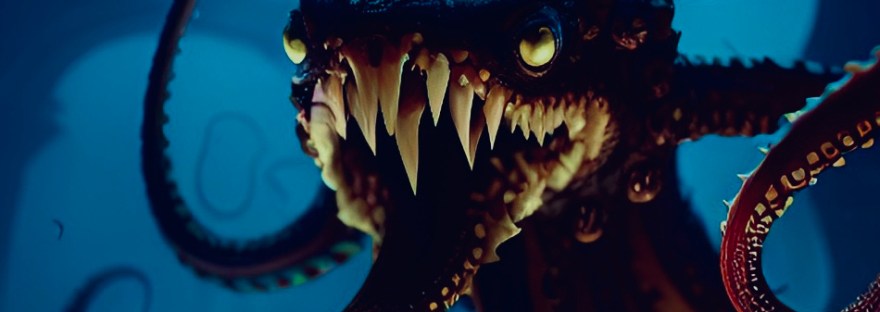
Try as I might, I could not convince an AI art app to make a squid-like kraken.

Those ten appendages come equipped with toothed suction cups meant for wrapping around wriggling flesh and not letting go. Two of them, the tentacles, are longer than the others and designed to snatch prey at a distance. The colossal squid’s tentacles bear horrific, swiveling hooks at the ends. Including the tentacles, giant squid specimens have measured as long as 43 ft. The colossal squid has shorter appendages but is heftier, with known weights exceeding 1000 lbs. Ranking as the largest invertebrates on earth, I think it’s safe to say both species live up to their names. Of course, no one knows how big they might grow in the abyss. With eyes the diameter of a basketball, their eye size is perhaps more impressive than their overall dimensions. These monsters have bigger eyes than any other animal—critical for detecting the tiniest trace of light in the depths.

Distribution and Habitat. Giant squid have been documented in temperate ocean waters worldwide. Colossal squid dwell in the Southern Ocean. The giant squid inhabits only the deep sea, usually at depths greater than 1000ft. Those found near the surface are often injured or dying, their delicate, red skin observed torn and ragged.

Diet. Giant and colossal squids eat fish and smaller squid. They may lure their prey nearer with bioluminescence, emitting light from either their skin or eyes at will. The lorkai, though unrelated to cephalopods, can also make their eyes fluoresce. While once believed to feed rather passively, video footage in their natural habitat shows that giant squid are probably active hunters like colossal squid. Squids are fast. They swim using jet propulsion—sucking in water and squirting it through a siphon to shoot forward while steering with their mantle fins.

Giant squid themselves are prey for other animals, especially when young. Sperm whales and deep-sea sharks feed on even adult giant and colossal squids. In addition to the toothed suckers that scar the skin, giant squid shoot ink to dissuade their predators. However, their eyes are probably their best defense, able to detect hungry whales at a distance in extreme darkness.

Life cycle. We know little about giant squid reproduction, but scientists believe males inject sperm packets into the arms of females. Those females disperse millions of fertilized eggs. The lucky few squid to survive to maturity grow tremendously fast—giant squid only live four or five years.

Monster? There’s no solid evidence that giant (or colossal) squid rise from the deep to attack boats and snack on sailors like the kraken was said to. They seem only to come to the surface when dead or nearly so. But there is a strange tale or two of mysterious marine life latching onto boats and dragging them to a standstill in modern times. And smaller, better-studied cephalopods can put up a hells of a fight on the deck of a boat and have even attacked divers. So, while it probably can’t be blamed for sunken ships, the giant squid’s size, toothed suckers, and mystery qualify it as a monster in my book.

If you want to know how successful the kraken is in defending Sarlona against monsters of a different sort, check out Drained next month.

Resources: Giant and Colossal Squid Fact Sheet, Smithsonian Ocean, Marine Bio Conservation Society, and the Ocean Conservancy

February Monsters of the Month – Lorkai

This first one’s mine. My novels center around the lorkai (singular and plural, like moose). These monsters feed on magical energy. They’re a caster’s worst nightmare.

Like any good immortal species, lorkai are preternaturally strong, fast, and have powers over the mortal mind. What makes them unique is their ability to control humanoid physiology through physical contact–one touch, and it’s over. They steal your energy, your free will, and maybe your life.

If they feed on someone without magic to spare, they take life force. And when they drink from someone bursting with spells, they leave them helpless and enfeebled. The more powerful your magic, the better you taste. That’s what makes poor Sarlona the perfect prey.

These are the monsters that little mages check under their beds for at night, afraid they’ll be left as a drained husk or carried off and kept as livestock. They’re not supposed to exist.

It turns out they do. There just aren’t many left.

Lorkai are almost impossible to recognize when they want to stay hidden. If you had a magnifying glass, and they deigned to allow an inspection, you might notice the fine seam that runs up the undersides of their arms from the wrist. That’s where they hide their carpal blades—nearly unbreakable swordlike claws that they keep tucked away like folding knives. They use them to drink the magical energy from the earth itself, driving them into the ground and draining every trace of life from the soil around them.

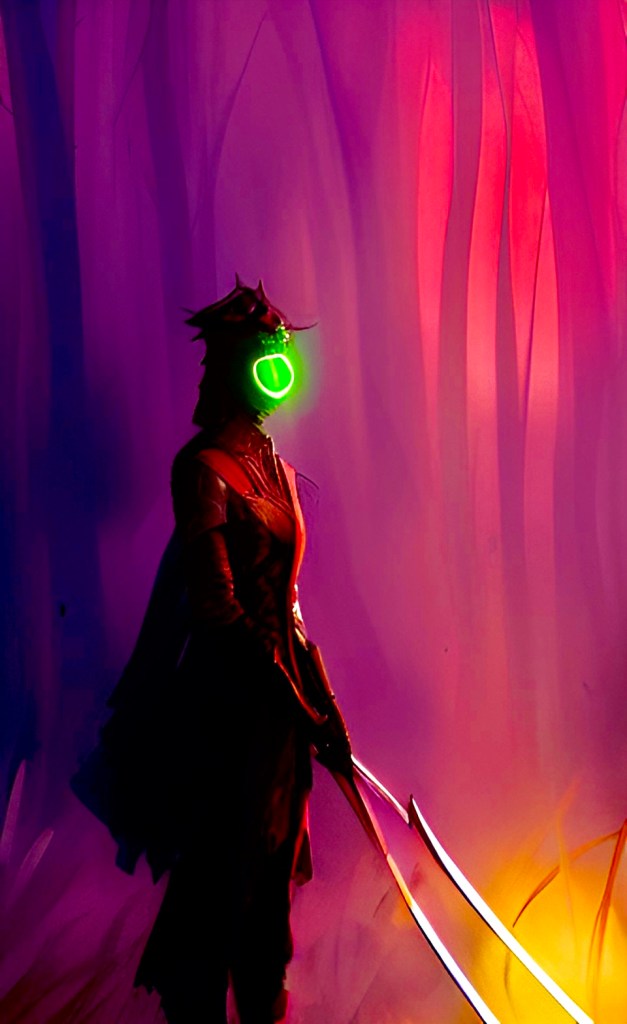
When they don’t mind being seen, lorkai are easy to spot–look for the person with the flaming, color-changing irises, ivory swords jutting from their wrists, and glowing fingertips. Of course, if they let you see them like that, you’re probably food.

Their weaknesses? Fire. But it has to burn them to ash. Anything less will piss them off. They also have no magical ability. They can’t cast so much as a cantrip.

“When I make skin-to-skin contact with a living being, I have complete dominion over their anatomy. Complete. I can make his every nerve scream at once. I can kill the part of his brain that tells him how to swallow. I can rot his heart in his chest, liquefy his bladder, or rip the mineral out of his bones.” -Threats made by a lorkai after two mages wandered into her territory. 

Description. Lorkai are humanoid and indistinguishable from host species when not mimicking prey. Undisguised and at rest, their irises fluoresce multiple colors, often cycling through the visible spectrum every few minutes. Scholars believe this a vestigial trait once used as a form of communication or perhaps a lure to draw mesmerized prey into dark, isolated spaces. Lorkai bear a pair of carpal blades—hinged, swordlike claws that protrude from the inner wrists and can tuck into the undersides of their arms like folding knives. When retracted, the only sign of these appendages is the nearly imperceptible seam into which these appendages disappear. Lorkai use their carpal blades for feeding and defense. Although these claws resemble ivory, they’re stronger than diamond and tougher than mithril.

Distribution. While many believe the lorkai to be a myth concocted to frighten young casters, and others suppose they’ve gone extinct, one remnant population survives in Aven.

Habitat. Lorkai live wherever other humanoid species exist. However, they prefer rural areas.

Diet. Lorkai feed on Marrow—the magical energy that sustains all life. While they can siphon this energy from any living thing, they require the concentrated Marrow of humanoids to stay well. They feed through their fingertips, which glow manna blue as they draw Marrow from their victim. Their abilities allow them to paralyze prey, force them to comply, compel them to volunteer, or augment their memory with the touch.

Lorkai also need the pure, unadulterated Marrow of the earth itself. They feed from it by plunging their claws into the bare ground. Drawing from the land sterilizes it, creating a small dead zone around the lorkai and vaporizing any organisms within range.

Life cycle. Lorkai grow more potent with age. They reach maturity and can reproduce at around a century old. Females can make a child every hundred years or so. Males can only produce one. Young are created from human hosts, fed the lorkai quick. Quick is a highly concentrated Marrow-like substance that changes a host body from the inside out if given around the moment of death. The lorkai regurgitates the reproductive fluid and forces its potential young to swallow it.

The more Marrow-rich the mortal, the more likely they are to survive their transformation and the stronger they will be when made into a lorkai. So casters make for not only ideal prey but perfect children. Unfortunately, some casters find losing their magical abilities too devastating to live with and die by self-immolation.