
Alone in the woods, you breathe deeply, inviting the earthy aroma to perfuse your being. That cool, energizing air vaporizes the inner fog. Precocious saplings, crowding the narrow path, fawn at your boots and caress your khaki hips. Fresh, bright leaves bob in the breeze. Their supple edges kiss, and their rustling drones like a distant sea, lulling your every anxious thought. The mottled sunlight, filtering from the canopy, dances on the forest floor.
Then you notice the stillness. To your left, the woods don’t waver with the wind. The splashes of green and variegated browns, a match to the surrounding brush, stand frozen. Perfect, yet incongruous. A confounding mural of itself.
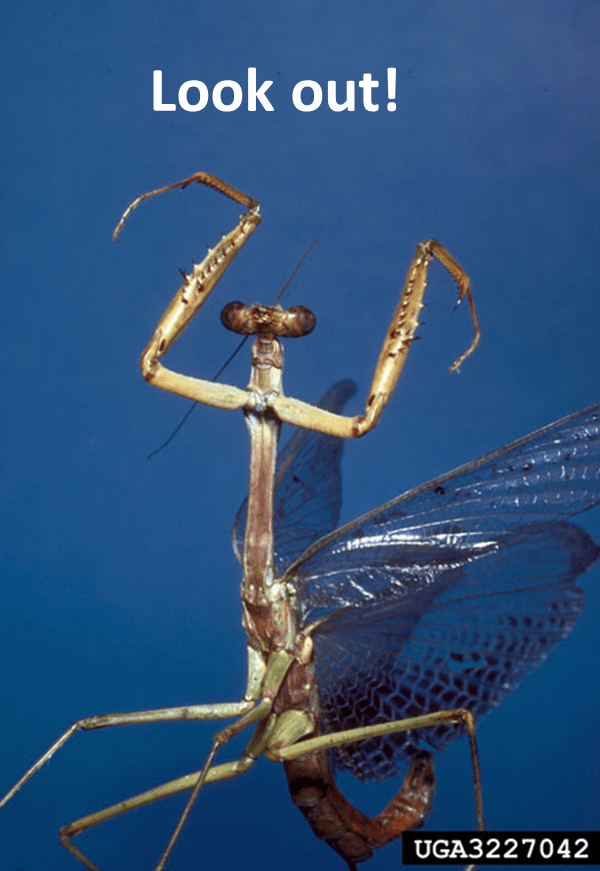
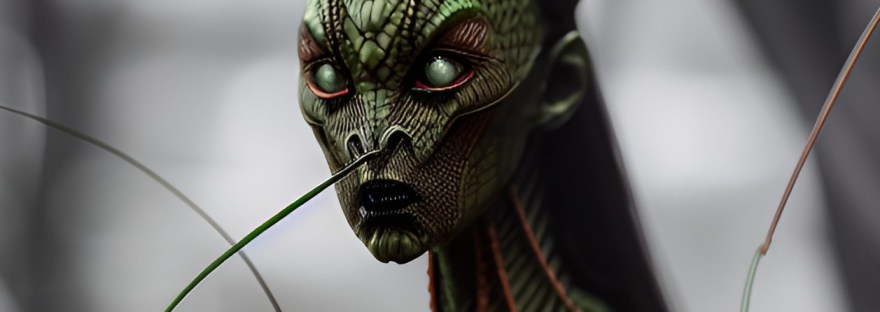
Confusion erodes peace–until you see the eyes. Seven feet up, at the apex of that strange slice of petrified forest, two multifaceted orbs perch atop a triangular, alien head, just as camouflaged as the rest, except for the dark spots resembling pupils. Terror swallows confusion. Below the insectoid head, a pair of massive forelimbs hover, each barbed with razor-sharp spines and tipped with a chitinous scythe. Those terrible weapons hang in a devout fold as if mocking the divine. The monster is unmistakable. A familiar form at an abominable height–a giant praying mantis.
You force your leaden legs backward along the path, and the head turns to follow you. Long, fingerlike projections on either side of its mouth flutter. It splays its jagged, iron mandibles. In a flash, the prayerful front legs explode toward you.
It holds you impaled in its embrace as it eats you alive.
A horrifying hexapod
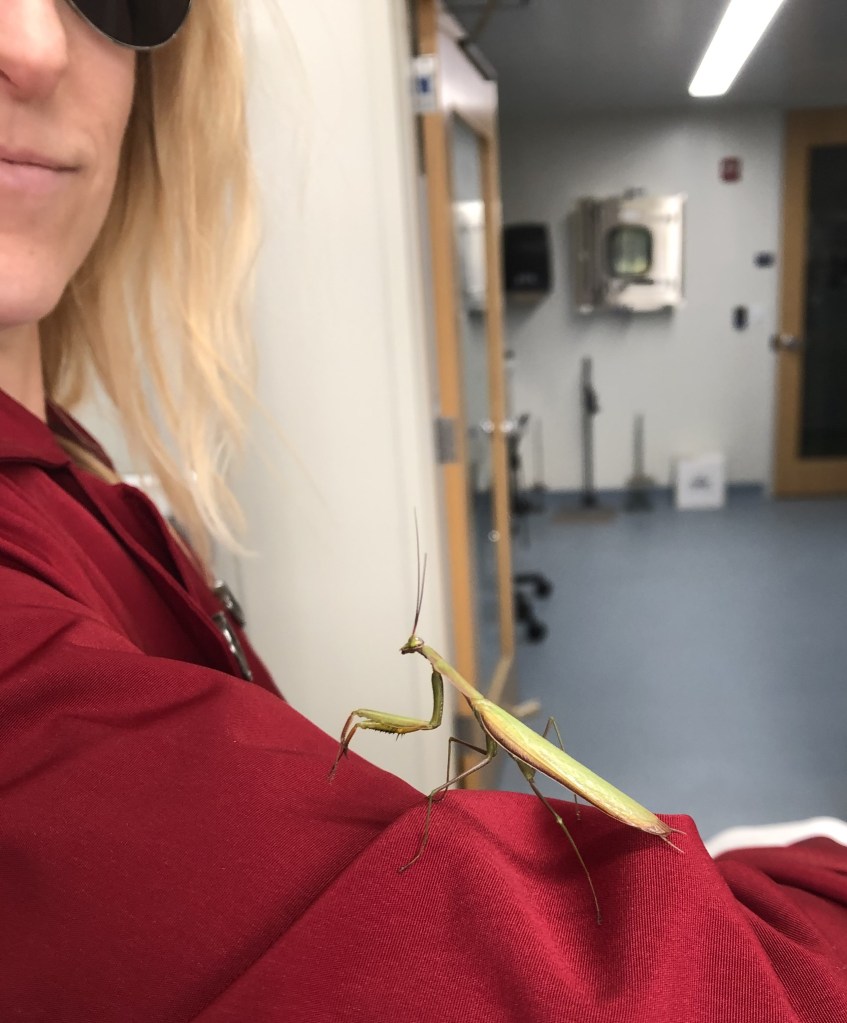
I’m not scared of bugs. My background and job preclude it. But once, I put a waterscorpion (another elongate predatory insect with grasping forelegs) under a dissecting scope. When I peered through the eyepiece, the sight of it made me jump. An alien-looking, 100-millionth-generation predator becomes somewhat disturbing when it takes up one’s entire field of vision.
So, even though I’m close to immune to the insect ick factor, it’s a safe bet I’d piss myself staring into the compound eyes of a giant mantid. And that’s discounting the number of insects I’ve sent to the ethyl acetate gas chamber or how I impaled their corpses for display. Forget the thousands of fire ants that died for my thesis or how my career centers on helping folks vanquish their insect foes. Poetic or ironic as meeting my end between mandibles might be, the sheer hopelessness of the fight is what gets me.
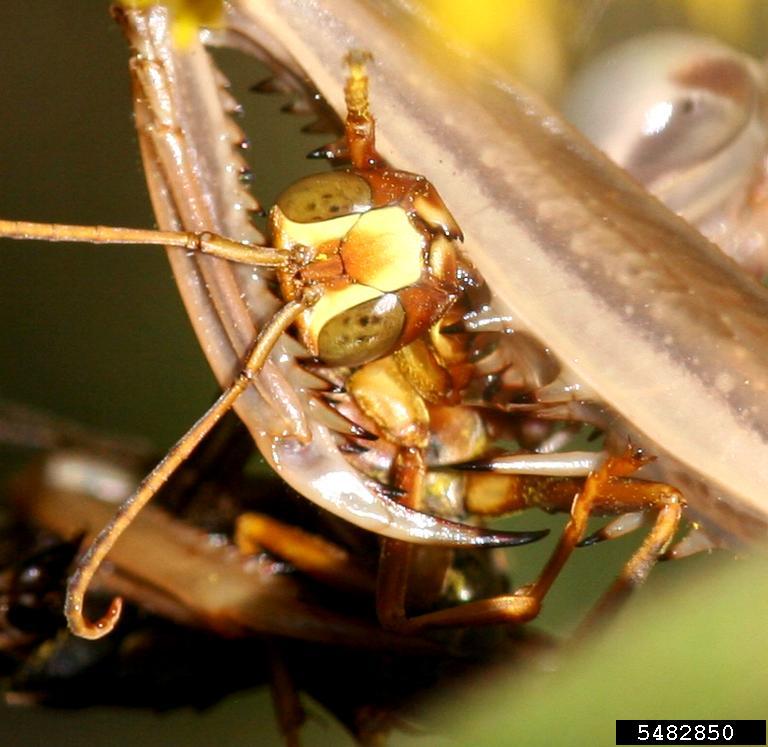
Photo by Johnny N. Dell, Bugwood.org
You’d have more luck escaping a bear, big cat, or shark. We’ve all seen ants carry ten times their weight. Imagine the strength of a bigfoot-sized bug. And insects have no sensitive snout to punch. A mantid isn’t about to let go if you hit it in one crunchy compound eye. They don’t feel pain like we do. Even if you could get a blade or bullet between the plates of a massive mantis’s exoskeletal armor, the odds of hitting something critical enough to stop it aren’t good. It doesn’t have lungs to puncture. There’s only one blood (hemolymph) vessel to sever. The brain isn’t even a brain. It’s a concentration of ganglia, and insects have independent extras stashed along their length, allowing the function of body parts without input from the head.
Once it’s got you, you’re not getting away.
Worst of all, mantids don’t kill their prey before chowing down. They grab on and start eating without regard for what part they devour first.
Have I put too much thought into this?
Yes. No doubt it’s a dark daydream shared by many an entomologist, but the scenario in which one finds themself standing toe to tarsus with a moose-sized mantid can’t exist.
At least, that’s what I thought until my favorite podcast, Astonishing Legends, put out their 258th episode entitled “Mantis Men”. I’d heard of mantid-like aliens encountered aboard spacecraft, but reports of seven-foot mantis monsters stalking the streams of the Northeast were new to me. Thanks for the nightmare fuel, AL.

Terrifying as a giant, bipedal insect might be, it’s all I can do not to rub my palms together in delight at the mention of bug people, though. I love the concept of humanoid insects so much that I made the magic system in my novels depend on them. So, these encounters, both in the woods and the sky, fascinate me. One aspect I find intriguing is how witnesses don’t characterize the creatures as generic insect folk. Witnesses describe the mysterious entities as resembling praying mantises, specifically.
Mantid mania
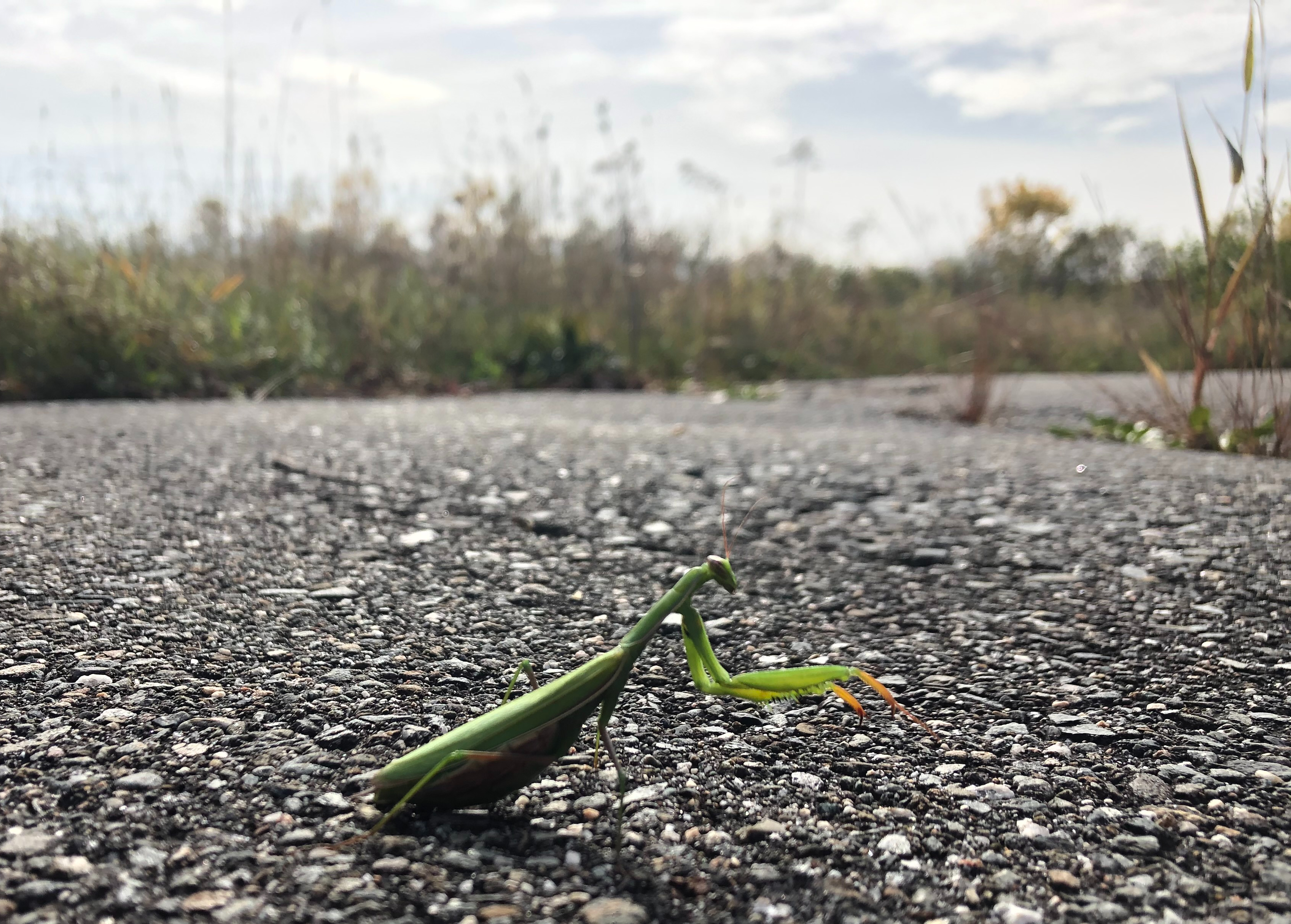
There’s a reason I fantasize about being ripped apart by a mantid instead of a giant ground beetle. Mantids have captivated us for millennia. Various cultures have granted them a mythical status. They’ve been called soothsayers and necromancers and regarded as good omens and bad ones. Petroglyphs of mantids or mantid men date back at least 4000 years. The creation story of the Bushmen in southern Africa includes a mantid from whom their people were born. In the Egyptian Book of the Dead, a mantid appears as a guide through the underworld. The ancient Greeks put mantids on silver coins, and the Asmat of New Guinea used them as symbols for headhunting. In parts of Asia, they represented fearlessness and inspired martial arts styles, war tactics, and weapons. For centuries, westerners believed they pointed the way home for lost travelers. They were even a fixation in surrealist art for a spell. In pop culture, mantid-like beings appear as giant monsters, comical sidekicks, supernatural femme fatales, alien antagonists, and more. Mantids aren’t the only arthropods to capture our imaginations, but they do it more often than most.
Why?
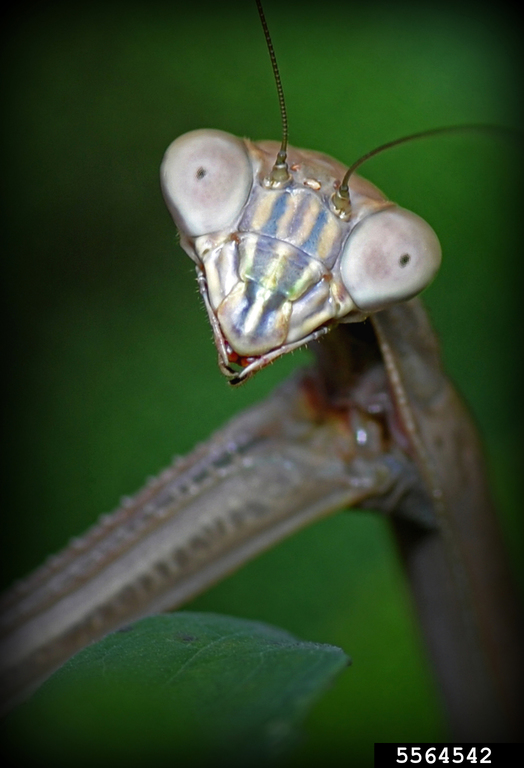
Photo by Jon Yuschock, Bugwood.org
Mantids win the insect charisma contest. It isn’t just their devout demeanor or large size. Their upright posture, mobile head, and grasping forelimbs make them easy to anthropomorphize. With a black spot in each prominent eye, even their gaze seems a bit human. And it appears to follow us when we move as if they have some unique interest in us. They seem a bit human! That familiarity in an insectoid makes them both endearing and freakishly alien.
Then there’s the whole sexual cannibalism thing. It’s hard to craft a more attention-catching phrase. Female mantids sometimes eat their mate. People love that shit. Or love to be horrified by it.
And, of course, mantids are badass. We adore ferocious predators. Never more so than when they don’t compete with or eat us.
The truth is out there (about mantids)
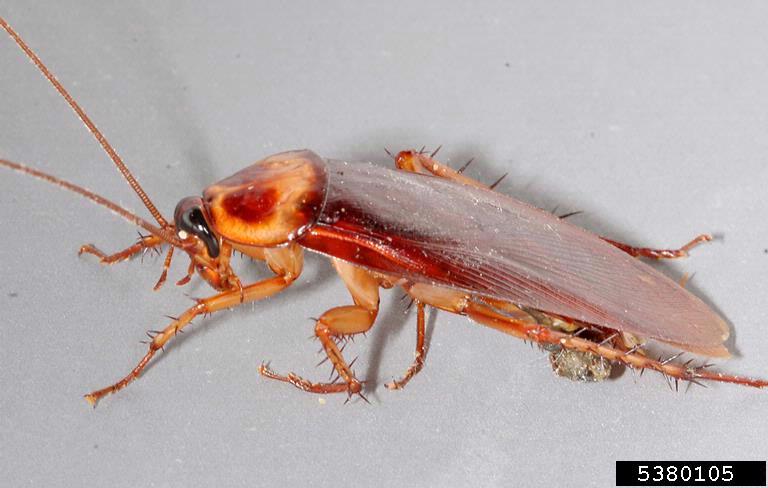
Photo by Gary Alpert, Harvard University, Bugwood.org
Despite their humanoid carriage, nothing about mantid anatomy or behavior is mystical. They’re essentially predatory cockroaches adapted to ambush prey.
Sorry.
That’s not to belittle them! Cockroaches are incredible, too. I’m hard-pressed to think of an insect taxon without some impressive anatomical, physiological, or behavioral trait. But Mantodea (praying mantises) and Blattodea (the cockroaches and termites) are sister orders, united under the superorder Dictyoptera. They share anatomical features and genes that differentiate them from other groups.
What about the eyes that stare intelligently into ours? Mantid eyes are remarkable. As described in the Astonishing Legends episode, mantids are the only insects in which researchers have confirmed stereoscopic (3D) vision–a type of sight once believed unique to primates. However, many animals have it, including other invertebrates, and scientists suspect it exists in other insects too. Regardless, mantid eyes don’t follow us. Our gaze makes the black spots in them move. The arrangement of the ommatidia in the mantid’s compound eyes causes a small dot where the light is absorbed instead of reflected for us to see. Our angle to the mantid determines the position of the pseudo pupils. They can’t “look” away.

To the disappointment of many, there’s really nothing lurid about the female’s dining habits either. Many mantids will eat each other, whether they are mates, siblings, or strangers. Since the more diminutive males approach the larger females (boy bugs are usually smaller than girl bugs) while the latter are hunting, it’s no wonder the guys occasionally become food. Cannibalism isn’t so rare in the arthropod world, and the frequency with which it occurs in mantid mating has been grossly exaggerated.
None of that means mantids can’t be mystical (or evil, for that matter). We still don’t know that much about them. However, their position in folklore and popular culture probably says much more about us than them. Mantids aren’t that special.
But are they aliens?

Mantids are undeniably insects. Are there gaps in the fossil record? Yep. Is the phylogeny of Mantodea, Blattodea, and their relatives settled? No. Insect taxonomy will continue to change with new molecular techniques, paleontological finds, and species discovery. Is it weird they’re the only known insects with stereoptic vision? Maybe, but it has evolved in other invertebrates, too (cephalopods), and doesn’t work the same way in humans and the other mammals that possess it. Genetics, comparative anatomy, and fossils bearing the combined traits of mantids, cockroaches, and termites prove they didn’t come from outer space. Unless, of course, the precursor to all insects did.
Are some aliens mantids?
Search alien mantises, and Google Scholar will return thousands of results. Of course, these mantids are just Earth species that have found their way, via human travel and commerce, to countries where they were once unknown. Search in plain old Google, and Ancient Aliens is front and center. While much less common than encounters with little gray aliens, several reports of encounters with giant mantid-like extraterrestrials exist.
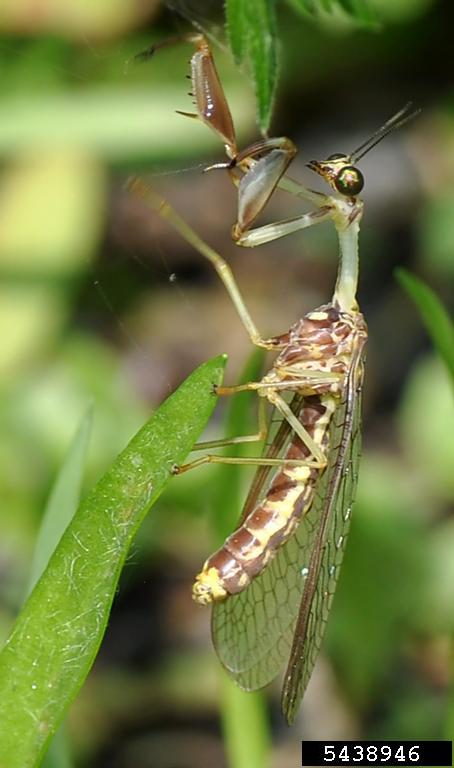
But resembling a mantid doesn’t make you one (take the mantidfly, a lacewing, for example). What does make a mantid a mantid? The proper answer is probably fraught with insect anatomical terms that I won’t inflict upon you here. Generally, mantids have raptorial forelegs, elongate bodies, and highly mobile heads. So, I feel confident that unless these aliens have long, spiked, grabby arms, they’re not mantids. They’re probably not insects at all. Insects have two antennae, six legs, and three body regions. None of the encounters I’ve stumbled upon report all these features, but I would love to hear more detailed descriptions of the mantis aliens folks have seen. I suspect that if mantis-y ETs exist, their similarity to insects is a case of convergent evolution (when two species develop the same trait independently due to similar selective pressures).
God has an inordinate fondness for beetles.
Insects own this world. For every human on the planet, there are at least a billion insects. One million species have been described, far more than any other group of organisms. An estimated 9 million remain undiscovered. It would be hard to argue they aren’t the most successful macroscopic living things on Earth. So if there are other worlds with environmental conditions and selective pressures anything like ours, it makes sense that similar organisms could evolve. Or maybe, if there is a creator, biologist J.B.S. Haldane was correct when he said something along the lines of, “God has an inordinate fondness for beetles” (of which there are more than 400,000 known species). Maybe the maker loves insectoids so much that they sprinkled bugs all over the universe.
If insects are so great, couldn’t they have evolved into mantid people?
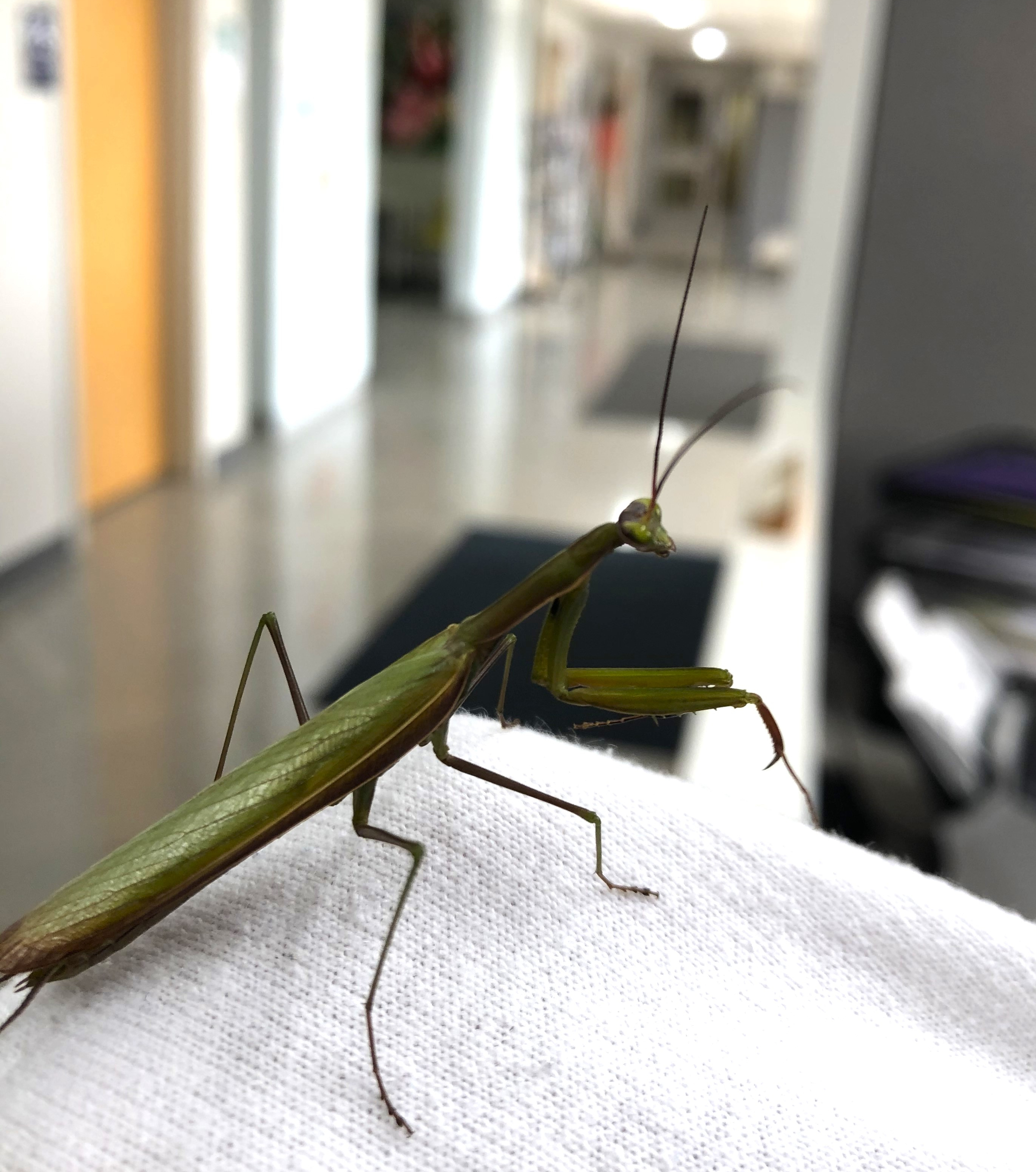
I’ll be the first to say insects can do almost anything, no matter how bizarre. If you can imagine it, an insect that comes damn close to doing it probably exists. I’d wager that every terrifying parasitic scenario depicted in a sci-fi or horror flick plays out somewhere in the insect world.
Hive mind? Retractable mouth? Paralyzed and eaten alive? Inseminated by stabbing? Offspring replaced with parasitic mimics? Losing your limbs to become a feeding and breeding machine? Mind-controlled by a fungus? Shooting blistering acid? Entirely female species? Enslaved with a chemical haze? Infiltrated by vampiric imposters? Born pregnant with your great-granddaughter? Insects do it all.
But there are some limits.
Behemoth bugs
There’s a reason we’re not riding dragonflies to work and hiding from the giant ants that want to drag us underground to tend their larvae. Bugs that big couldn’t survive. The insect respiratory system doesn’t even allow for the crow-sized insects of the Carboniferous to survive today’s oxygen-poor atmosphere, never mind a monster mantid.
Except for some aquatic species/stages, which respire through gills, their skin, and various snorkel-like appendages, bugs breathe through little holes called spiracles in their sides. The spiracles attach to trachea, tiny tubes that divide into smaller and smaller passages to deliver air directly to cells. This system works great for them. It’s more efficient than ours in minute bodies. But it’s inadequate for large organisms. Monster bugs couldn’t get enough oxygen to their tissues through tracheal tubes alone. Diffusion is too slow.
This limitation is such a hang-up that I couldn’t let the humanoid insect species run free in my fantasy writing. I had to confine the faeries and their manna-producing livestock to magical valleys where the forests produce much more oxygen. They can’t survive away from their valleys for more than a few days.
Even if we assumed mantids could overcome their respiratory constraints and become mammoth monsters, why don’t we see them more often? Are they strolling around unnoticed in their active camouflage?
Masters of mimicry
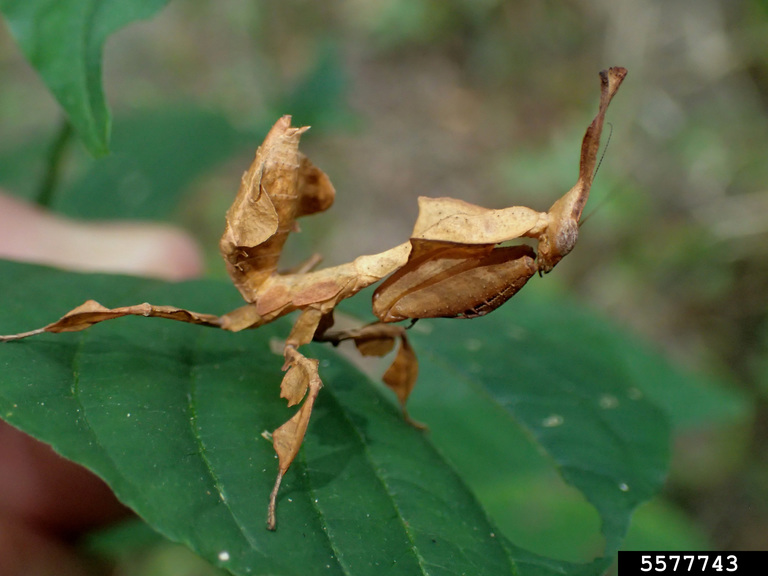
Admittedly, mantids are excellent at hiding. As ambush predators, they must go unnoticed until it’s too late for their prey. Some mantids have taken this to an extreme, perfectly mimicking flowers or leaves, even swaying slightly in the breeze like the vegetation. But becoming invisible or a shimmering distortion like the Predator as the mantid monster by the Musconetcong River purportedly did? That would be a tough trick for an insect. Unlike the skin of quick-changing cephalopods and other color-morphing creatures, the outermost part of the bug, the cuticle, isn’t alive. Made of chitin, waxy secretions, and various proteins, it doesn’t contain chromatophores or any other living cells. While insects can change colors (and often shape) by molting to the next life stage, shedding their exoskeleton is a process. Insects also darken (and harden) after molting in a process called sclerotization, but, again, not at will. That said, a scant few adult insects, including some mantids, can change color. A smattering of those can do so quickly. The mechanisms for this vary from pigment migration to the manipulation of the moisture content of the cuticle. They can only change to one color and back again, however. Melting into the forest via rapid camouflage or becoming a glimmering mirage seems well beyond a bug’s ability.
A hundred million years is a long time…
Mantid-like insects have existed for at least a hundred million years. Given such an expanse of time, could a mantid ancestor evolve a new respiratory system that would allow it to become huge? Perhaps. Could this divergent insect develop a full-fledged brain and superintelligence? I guess. We went from rodents to people in less time. Is it possible they acquired a cuttlefish-like ability to camouflage? I don’t see how, but I can’t rule it out.
The problem is there isn’t a shred of evidence that they did any of these things. We’ve found no remains, tracks, frass (insect feces), kills, or fossils of anything anywhere near between an insect and a monster humanoid mantis. All we have to go on are a handful of bizarre eyewitness accounts.
So maybe the mantid people beat us in the space race by a hundred thousand years and took off to other worlds, occasionally stopping back for a visit. Truthfully, I like that idea better than those of genetic experiments or insectoid aliens seeding the planet.
Why am I still having this conversation with myself?
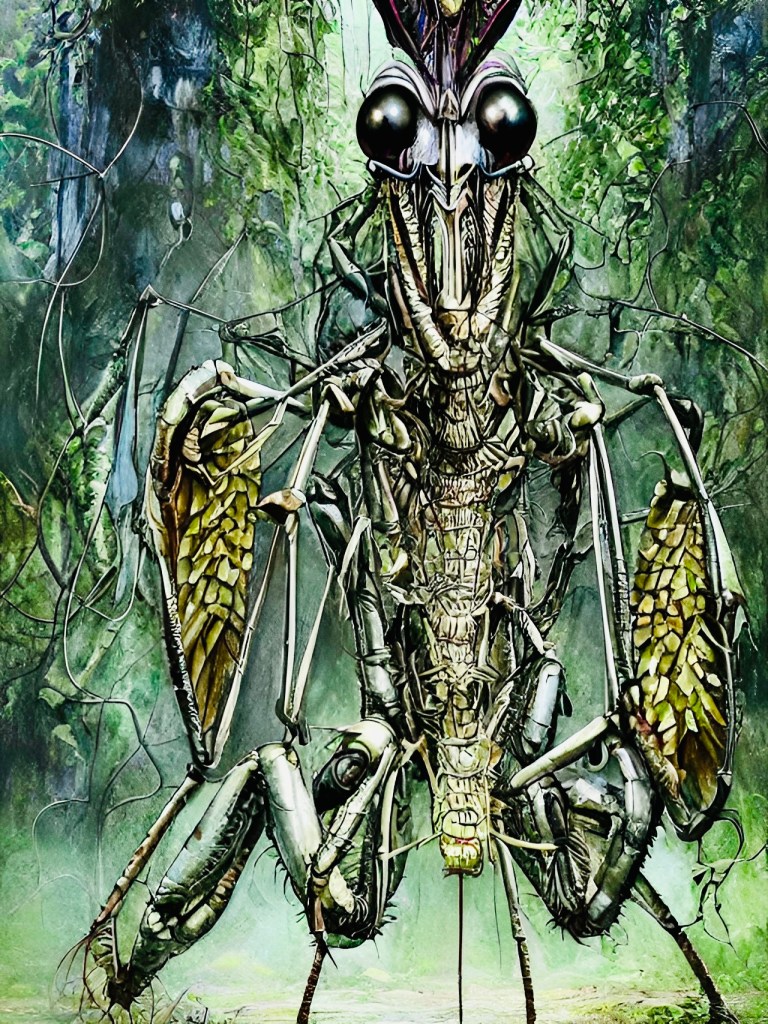
Because insects are incredible, and I want there to be bug people. But I don’t believe that’s what these are. If mantis-like monsters exist, I think their resemblance to mantids is a case of convergent evolution with a species from another world–aliens entirely unrelated to Earth’s insects.
That’s assuming we share the same reality. Perhaps another exists in which insects rose up on two legs instead of mammals. And, every so often, in extraordinary places, the veil thins, and Manto sapiens slips through.
Whatever they are, I pray I never encounter one. But if I do, I hope I have the presence of mind to note their foreleg spination (preferably not while impaled upon it).
Resources:
Astonishing Legends Episode 258: “Mantis Men”
Battiston, R., & Fontana, P. (2010). Colour change and habitat preferences in Mantis religiosa. Bulletin of Insectology, 63, 85-89.
Bianca Greyvenstein, Hannalene du Plessis & Johnnie van den Berg (2020): The charismatic praying mantid: A gateway for insect conservation, African Zoology, DOI: 10.1080/15627020.2020.1732834
Cherry, Ron. Praying Mantids as Symbols for Headhunting, American Entomologist, Volume 50, Issue 1, Spring 2004, Pages 12–17. https://doi.org/10.1093/ae/50.1.12
Glaeser, G., Paulus, H.F. (2015). A world of color. In: The Evolution of the Eye. Springer, Cham. https://doi.org/10.1007/978-3-319-17476-1_9
Kolnegari M, Naserifard M, Hazrati M, Shelomi M (2020) Squatting (squatter) mantis man: A prehistoric praying mantis petroglyph in Iran. Journal of Orthoptera Research 29(1): 41–44. https://doi.org/10.3897/jor.29.39400
Legendre, F., Nel, A., Svenson, G. J., Robillard, T., Pellens, R., & Grandcolas, P. (2014). Phylogeny of Dictyoptera: Dating the Origin of Cockroaches, Praying Mantises and Termites with Molecular Data and Controlled Fossil Evidence. PLoS ONE, 10(7). https://doi.org/10.1371/journal.pone.0130127
Moriyama, M. (2021). Physiological and Biochemical Mechanisms of Insect Color Change Towards Understanding Molecular Links. In: Hashimoto, H., Goda, M., Futahashi, R., Kelsh, R., Akiyama, T. (eds) Pigments, Pigment Cells and Pigment Patterns. Springer, Singapore. https://doi.org/10.1007/978-981-16-1490-3_15
Prete, F.R., Wolfe, M.M. Religious supplicant, seductive cannibal, or reflex machine? In search of the praying mantis. J Hist Biol 25, 91–136 (1992). https://doi.org/10.1007/BF01947506
Read, Jenny C.A. 2021. Binocular Vision and Stereopsis Across the Animal Kingdom Annual Review of Vision Science 7:1, 389-415
Vigneron, J. P., Pasteels, J. M., Windsor, D. M., Vértesy, Z., Rassart, M., Seldrum, T., Dumont, J., Deparis, O., Lousse, V., Biró, L. P., Ertz, D., & Welch, V. (2007). Switchable reflector in the Panamanian tortoise beetle Charidotella egregia (Chrysomelidae: Cassidinae). Physical review. E, Statistical, nonlinear, and soft matter physics, 76(3 Pt 1), 031907. https://doi.org/10.1103/PhysRevE.76.031907
Vršanský, Peter & Hinkelman, Jan & Koubová, Ivana & Sendi, Hemen & Kúdelová, Tatiana & Kúdela, Matúš & Barclay, Maxwell. (2021). A single common ancestor for praying mantids, termites, cave roaches and umenocoleoids. 11. 1-16.
William L. Pressly (1973) The Praying Mantis in Surrealist Art, The Art Bulletin, 55:4, 600-615, DOI: 10.1080/00043079.1973.10790751
(n.d.). Facts and Figures. Royal Entomological Society. https://www.royensoc.co.uk/understanding-insects/facts-and-figures/
 K.W. Bernard