


When I was a young kid growing up in southern Maine, we rarely encountered ticks. Then the developments moved in, the no-hunting signs went up, and the deer took over. My mom has had Lyme disease four times now.
I escaped north, avoiding the people, deer, and ticks–for a while.
Last year, for the first time in the 13 years I’ve lived here, I saw deer sign on the property. They came in during the winter a few times to chew on my apple tree. I wouldn’t mind, except I was pretty sure I knew what would follow them.
I did.
In November, I discovered several ticks on the dogs, including one engorged with sweet, delicious pug blood. Since UMaine Extension’s Tick Lab is right across the hall from me, I had it tested. Sure enough, the sanguineous little parasite carried the Lyme bacterium. A few months later, the dog tested positive, too.
This year I found ticks before the snow had melted from the yard.
So, I’m conscripted to fight against the minute monsters. Having written about tick control and organized tick management programs, at least I’m ready for battle.
DESCRIPTION
Ticks are arachnids, so they’re eight-legged (except as larvae), antennae-less, and have a combined head and thorax region. The part of the tick that looks like its head, the capitulum, is its mouthparts.
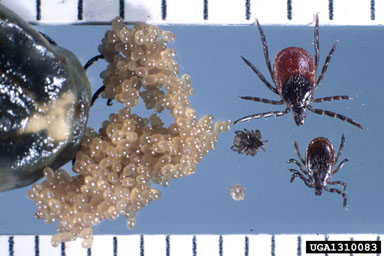
Adult deer ticks (Ixodes scapularis) measure in at the size of a sesame seed. Females are two-toned, reddish brown, with a little dark brown shield on their backs. Males are uniformly dark. Nymphs are lighter colored and about the size of a poppy seed. If you see the six-legged larvae, congratulations on your preternatural eyesight.
DISTRIBUTION AND HABITAT
While particularly numerous in the northeast, deer ticks range throughout the eastern half of the U.S. and southern Canada. They have little trouble surviving Maine’s warming winters with adequate leaf litter. Dry summer heat, on the other, makes life tough for ticks. That’s why we find them less in the sunny lawn and more along the edge of the woods, amongst overgrown vegetation, and in piles of leaves. They need these cooler, moist, protected areas to avoid desiccation. So, deer ticks tend to stick to the shadows where they belong.
DIET
Blood. That’s it. Unlike mosquitoes, which at least have the decency to feed on detritus as larvae or nectar as males, all deer ticks need blood to molt to the next life stage. Females require extra to nourish their eggs. Deer ticks will feed on many mammal and bird species at any stage, but they have their preferences. The larvae mostly attach to rodents. Nymphs may seek larger prey, including rabbits, turkeys, robins, skunks, canines, and humans. The white-tailed deer is the ideal blood donor for adult deer ticks, but they’ll try to make do with any large mammal, including us, and small ones in a pinch.
Despite the myth that deer ticks leap out at us from the trees, they’re passive hunters. They can’t fly, jump, or even skitter. The deer tick holds onto the vegetation with its back legs and reaches out with its front ones, hoping we brush by so it can grab on–a behavior called questing. It would seem ridiculous if the loot wasn’t our blood. Once the successful tick hitches a ride, it often crawls upward, seeking penetrable flesh.
Using their barbed mouthparts, ticks puncture and anchor themselves in the skin. Swelling around the bite may make the tick appear to have burrowed in, but they only embed their feeding apparatus. Deer ticks feed for about a week if not removed. As they engorge with blood, females may quadruple in length. Their disgusting swollen abdomens pale, making them difficult to distinguish from engorged American dog ticks, a larger, less dangerous species.
LIFE CYCLE
The deer tick has a two-year, three-host life cycle. Yep, they’re not just gross and disease-vectoring–they’re needlessly complicated. In spring, females lay up to 3000 eggs among the dead leaves. The larvae hatch in late summer and usually snag a small mammal as their first host (and first opportunity to pick up the Lyme bacterium). After feeding, the larvae drop off and molt into nymphs. Nymphs lay low, spending the winter under leaves and other debris. They start questing for a second host in late spring or early summer of the following year. In Maine, peak nymph activity occurs around mid-July. Once they drop off the second host, nymphs molt into adults. Females must feed a third time to produce eggs, seeking a host (ideally a white-tailed deer) in the fall. Males may also quest in hopes of finding a mate on the host. If a female fails her autumn quest, she’ll get a second chance. Adults spend a another winter under the leaf litter. Any time temperatures rise above freezing, females that missed out in the fall will be on the hunt, but peak spring activity typically occurs in April.
BATTLE PLAN
Staying inside isn’t an option. Someone has got to do the yard work and take the dog out. The kids need to play in the fresh air. But most ticks are picked up in the backyard. So, what do we do?
Destroy their barracks. First, we can make our properties less hospitable to ticks. If there’s one thing humans excel at, it’s destroying habitat. Conveniently (for us, not wildlife), deer ticks suffer in the immaculate turf we’ve decided should surround our homes. Keeping the grass short, pruning low branches, removing fallen leaves, and cutting back brush make the yard less inviting to ticks. Areas people frequent, like the mailbox, swing set, picnic table, and hose hookup, should be trimmed short or surrounded by woodchips or gravel.
Target their allies. Rodents are not only tick nurseries but serve as the primary reservoirs for the pathogens that ticks vector. The fewer, the better when it comes to tick management. Remove the brush, rock piles, debris, and groundcover vegetation that harbor them. Clean up food and feed and keep garbage in rodent-proof containers.
Build a wall or moat. Hear me out. If you can exclude deer with a fence (it’ll have to be at least 6′ high), that should keep a lot of gravid female ticks off the property. A moat, okay, a strip (> 3 ft wide) of woodchips or gravel where the lawn meets woods, can keep ticks from moving out of the forest and serves as a visual cue to remind folks when they’re passing into tick habitat.
Don your armor. Wear long pants, socks, and closed-toed shoes when entering enemy territory. Tuck your pants into your socks and shirt into your pants. Choose light colors to make ticks easier to spot. Then spray clothes from the waist down with an EPA-registered insect repellent that lists ticks on the label. Products containing 20% DEET or higher are effective against ticks. Insect repellents containing picaridin, IR3535, and lemon oil of eucalyptus can also work. A better option is to wear permethrin-impregnated clothing. You can buy pre-treated clothing or treat clothes you own already, but never apply permethrin to your body. Whatever repellent you choose, read and follow the label directions.
Be vigilant for infiltrators. Ticks removed within 24 hours of attachment seldom infect their host with a disease. So end each day with a tick check, and if you find one, extract the atrocious arachnid immediately. You may have heard of using a matchhead, Vaseline, duct tape, gasoline, or the blood of a three-toed salamander to coax a tick to let go. As much as I love a good spell, don’t use witchcraft to convince a tick to detach. It won’t (but it might vomit into your wound). Use tweezers or a tick spoon.
Chemical warfare. Sometimes the health risks of a pest outweigh the health (and environmental) risks of pesticides. With greater than 40% of deer ticks carrying human pathogens in some areas, it’s no wonder many folks choose to treat their yards. Applications made by responsible licensed professionals provide the best and safest control. Treatments must target tick habitat, don’t hire a company that wants to spray the whole lawn. While some plant extracts can kill or repel ticks, they’re less effective than pyrethroids (the go-to synthetic chemicals for ticks). Botanical pesticides often break down quickly in the environment, requiring repeat applications for adequate control.
One low-risk strategy shown to reduce tick abundance is a spray of Metarhizium brunneum combined with tick control boxes. Metarhizium brunneum is an entomopathogenic (bug-infecting) fungus that kills ticks. It occurs naturally in the soil. Tick control boxes target ticks’ rodent hosts, luring them in with bait. But instead of poisoning the rodent, the box treats it with fipronil, the same pesticide found in many topical flea and tick preventatives for pets. It kills immature ticks on the host.
What am I going to do?
I’m not ready to spray the yard, but if tick abundance on my property climbs to levels I’ve seen farther south, I will. For now, mowing the lawn short will be the top priority. We’ll keep pushing the forest back, clearing vegetation. I’m working hard to remove the invasive plants established by the previous owner. With their dense growth habit, these species make prime tick habitat. I’ve surrounded the garden beds with gravel. Next, I want to get a mini electric woodchipper to shred every twig at the forest edge and create my moat. After having a fence relentlessly crushed by falling trees and moose, I think a wall is out. I need to do a better job with the leaves this fall.
We vaccinated the uninfected dog for Lyme. Both canines now take a chewable that kills ticks when they bite. I prefer using a permethrin-containing topical because it prevents ticks from hitching a ride, but permethrin is highly toxic to cats. And, of course, one of mine is extra sensitive to it. She almost died once from chewing on the dogs the day after I treated them. I still apply it to my boots and one outfit dedicated to yard work.
Every night, on days when my daughter or I venture beyond the lawn, I do a tick check. It’s been a hard habit to get into, but critical for anyone who resides alongside tick habitat. Like many folks, I’m anxiously awaiting the human Lyme vaccine, which is in trials now.
If you’d like to learn more about tick management and tick-borne disease prevention, see the excellent resources below.
Resources:
University of Maine Cooperative Extension Tick Lab
MaineHealth Institute for Research Lyme & Vector-Borne Disease Laboratory

 K.W. Bernard
Very informative, nice job!
LikeLike